

















Suggested Searches

Comet 3I/ATLAS

Cataloguing the journey of comet 3I/ATLAS through the solar system. Because the object comes from outside our solar system, it is just passing through – so we use all the tools at our disposal to observe it before it disappears back into the cosmic dark. A host of NASA missions are coming together to observe this interstellar object, which was first discovered in summer 2025, before it leaves forever. While the comet poses no threat to Earth, NASA’s space telescopes help support the agency's ongoing mission to find, track, and better understand solar system objects.

Categories

NASA’s Hubble Space Telescope Revisits Interstellar Comet
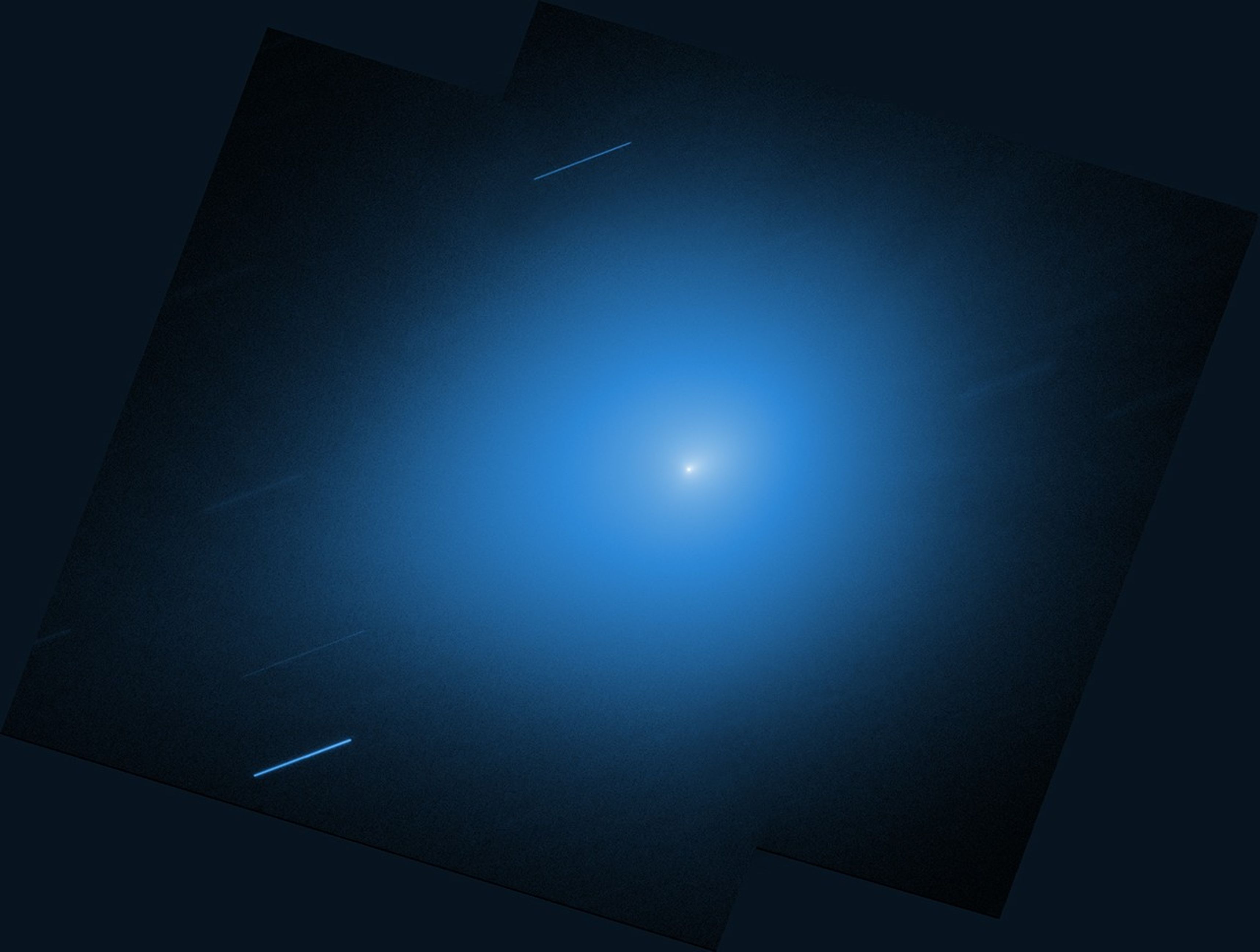
An image from NASA’s Hubble Space Telescope showing the interstellar comet 3I/ATLAS. The comet is a small white dot in the center of the image, with a light blue halo of light that takes up most of the image. Other stars are shown streaking across the image as diagonal blue-white lines.
NASA’s Hubble Space Telescope reobserved interstellar comet 3I/ATLAS Nov. 30, with its Wide Field Camera 3 instrument.
NASA, ESA, STScI, D. Jewitt (UCLA), M.-T. Hui (Shanghai Astronomical Observatory). Image Processing: J. DePasquale (STScI)

NASA’s Hubble Space Telescope reobserved interstellar comet 3I/ATLAS Nov. 30, with its Wide Field Camera 3 instrument. At the time, the comet was about 178 million miles (286 million kilometers) from Earth. Hubble tracked the comet as it moved across the sky. As a result, background stars appear as streaks of light.

Hubble previously observed 3I/ATLAS in July, shortly after its discovery, and a number of NASA missions have since studied the comet as well. Observations are expected to continue for several more months as 3I/ATLAS heads out of the solar system.
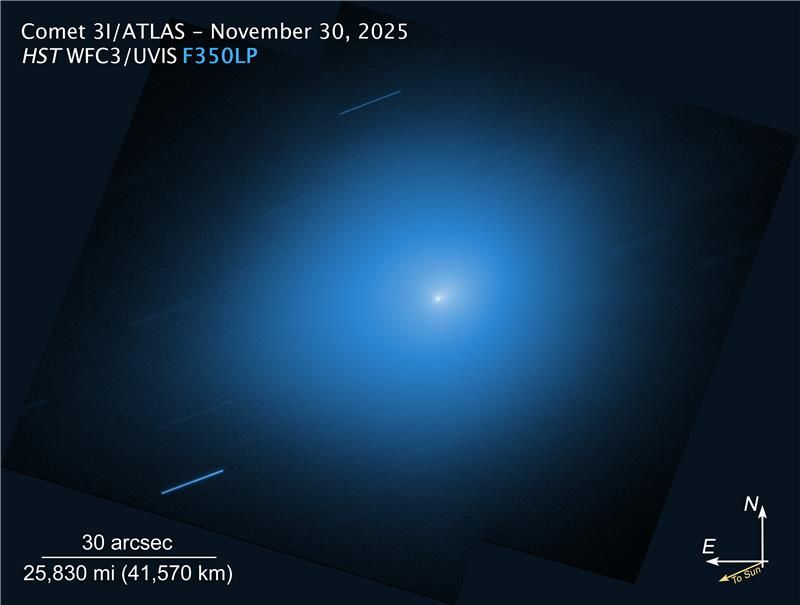
An image from NASA’s Hubble Space Telescope showing the interstellar comet 3I/ATLAS. The comet is a small white dot in the center of the image, with a light blue halo of light that takes up most of the image. Other stars are shown streaking across the image as diagonal blue-white lines.
NASA, ESA, STScI, D. Jewitt (UCLA), M.-T. Hui (Shanghai Astronomical Observatory). Image Processing: J. DePasquale (STScI)