

























Core Community Surveys
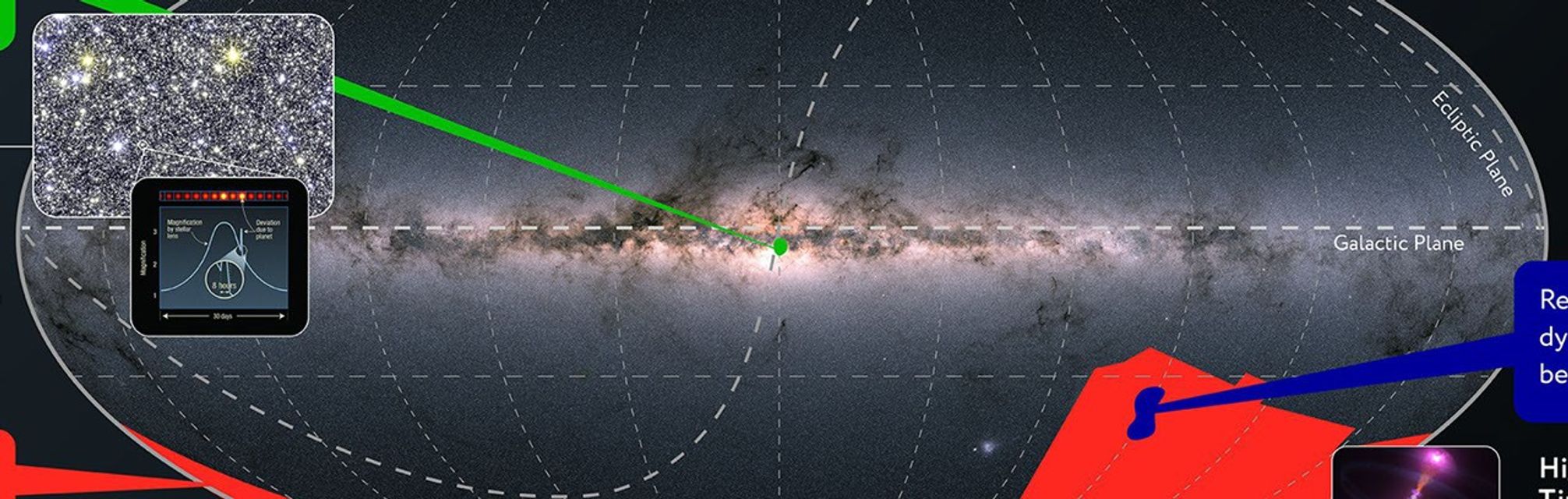
During the first five years Roman’s observing program will consist of Core Community Surveys (CCS) with the Wide Field Instrument (WFI). These are surveys that will be defined by the astronomical community and will include a High Latitude Wide Area Survey (~17 months), a High Latitude Time Domain Survey (~6 months), and a Galactic Bulge Time Domain Survey (~15 months). General Astrophysics Surveys with the WFI that will be competitively selected, including the Galactic Plane Survey.
Core Community Surveys Overview
Roman’s Core Community Surveys (CCSs), which combined are anticipated to use the majority of Roman’s observing time during the first five years, will enable a broad range of astrophysical investigations while meeting the Roman Space Telescope’s scientific mission requirements in cosmology and exoplanet demographics. These requirements leave significant parameter space available to define the observational strategies (filters, depth, cadence, etc.) in a way that will enable a broad range of other astrophysical investigations. The goal of the community-led definition of the Roman CCSs is thus to determine an observational strategy for each that will maximize their expansive scientific impact by enabling a broad range of astrophysical investigations while providing the observations needed to meet Roman’s science requirements in cosmology and exoplanet demographics. All Roman data will be publicly available immediately.
The Roman Observations Time Allocation Committee (ROTAC)
The Nancy Grace Roman Space Telescope project formed the Roman Observations Time Allocation Committee (ROTAC) to review the implementation reports of the Core Community Surveys (CCS) and to advise the Roman Project on the implementation of each survey. The ROTAC will also be charged with considering the balance between community-defined surveys and PI-led General Astrophysics Surveys (GAS).
Roman’s Wide Field Instrument (WFI) observing program will include both CCS and GAS, defined by a community-led process and traditional peer-reviewed calls for proposals. The CCS consist of the Galactic Bulge Time-Domain Survey (GBTDS), High-Latitude Time-Domain Survey (HLTDS), and High-Latitude Wide-Area Survey (HLWAS). The majority of observing time during the primary 5-year mission will be devoted to the CCS surveys, although approximately 25% of Roman's observing time will be reserved for GAS observations. Unlike HST and JWST, where the bulk of the observations are driven by proposals each cycle, each CCS spans several years and must be planned prior to launch. Each CCS has a committee tasked with providing recommendations for their respective surveys.
The CCS committees’ reports can be read here. With this milestone achieved, the ROTAC was formed to guide the next phase of planning. The original call for self-nominations for the ROTAC was released in July 2024. Over 50 self-nominations from around the world were received. The final committee is composed of thirteen scientists: ten community representatives with expertise covering a broad range of astrophysics and one co-chair from each of the three CCS Definition Committees. The ROTAC is co-chaired by Dr. Gail Zasowski (The University of Utah) and Dr. Saurabh Jha (Rutgers University).
The ROTAC evaluated input from the CCS committees and delivered their recommendations to the Roman Project April 2025.
ROTAC Recommendations
In April 2025, the ROTAC made the following recommendations for the three Core Community Surveys:
- Adoption of the nominal (in-guide) survey proposed by the High-Latitude Wide-Area Survey Definition Committee
- Adoption of the nominal (in-guide) survey proposed by the High-Latitude Time-Domain Survey Definition Committee
- Adoption of the overguide survey proposed by the Galactic Bulge Time-Domain Survey Definition Committee with the exceptions that that the first high-cadence bulge season be modestly reduced to leave time for the Galactic Plane Survey, and that the observation schedule during the low-cadence seasons be further studied to minimize disruption to the High-Latitude Time-Domain Survey and General Astrophysics Surveys
- And 389 days (25.5% of the science operations time) reserved for Roman’s General Astrophysics Surveys, including the early-definition Galactic Plane Survey
| Roman Observations Time Allocation Committee Membership |
|---|
| Gail Zasowski, University of Utah (Co-Chair) Saurabh Jha, Rutgers University (Co-Chair) Laura Chomiuk, Michigan State University Xiaohui Fan, University of Arizona Ryan Hickox, Dartmouth College Dan Huber, University of Hawaii (Manoa) Eamonn Kerins, University of Manchester Chip Kobulnicky, University of Wyoming Tod Lauer, NOIRLab Masao Sako, University of Pennsylvania Alice Shapley, UCLA Denise Stephens, Brigham Young University David Weinberg, The Ohio State University Ben Williams, University of Washington |
Roman’s Core Community Surveys

Read the “Interim Report: The Community Definition of Roman’s Core Community Surveys”
High-Latitude Wide-Area Survey
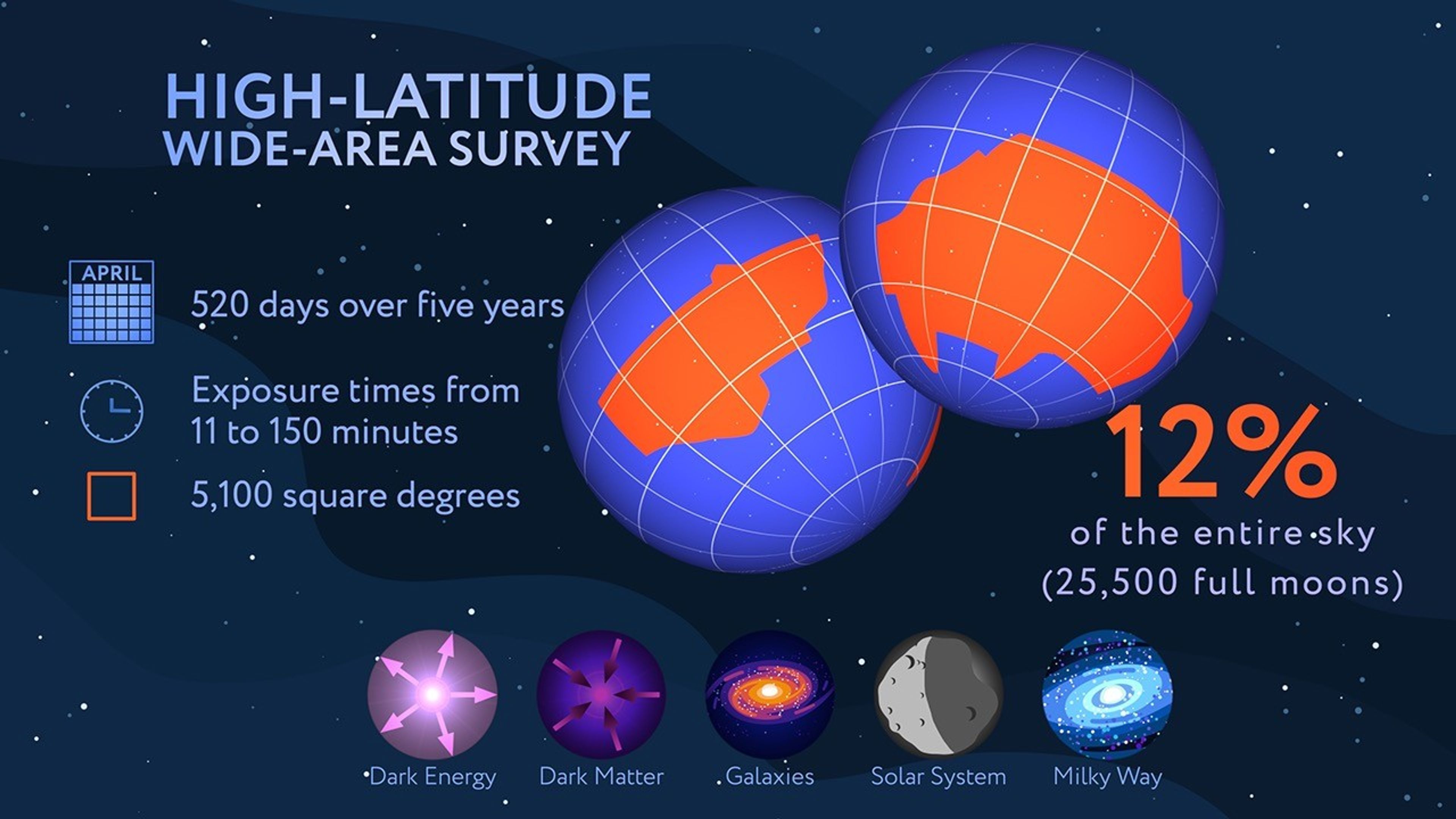
A wide area imaging and spectroscopic survey to probe the origin of cosmic acceleration that will enable a wide range of science investigations including solar system objects, Galactic structure, nearby galaxies, and galaxy and quasar evolution out to the epoch of reionization. The High-Latitude Wide-Area Survey imaging survey is designed to probe the origin of cosmic acceleration by using weak gravitational lensing and galaxy clustering to make precision measurements of cosmic expansion and the growth of cosmic structure. The High-Latitude Wide-Area Survey spectroscopic survey is designed to achieve similar goals using precision measurements of baryon acoustic oscillations and redshift-space distortions in galaxy clustering. The Deep Tier provides necessary calibration data for the Medium and Wide Tiers, and it will be a powerful resource for studying faint stellar populations and the most distant galaxies and quasars.
The High-Latitude Wide-Area Survey includes Medium, Deep, and Wide Tiers. The Medium Tier will enable the study of local galaxies, Milky Way stellar populations, and the relation between galaxies and dark matter over a vast span of redshifts via a 2400 deg2 Y-, J-, and H-band imaging and grism spectroscopic survey. The Deep Tier will enable the study of faint objects (e.g., most distant galaxies) and include a dense time-sampling for solar system science via multi-band imaging and grism spectroscopy comparatively deeper than the Medium Tier. The Wide Tier will add an additional 2700 deg2 in the H-band alone to more than double the total area of the High-Latitude Wide-Area Survey (>5000 deg2) and to overlap with Rubin optical photometry and other wide-field multi-wavelength surveys. High-Latitude Wide-Area Survey observations will be spread throughout the 5-year mission, with at least half of the Deep Tier observations carried out early in the mission and most of the Wide Tier observations carried out late in the mission. This survey is allocated ~17 months of time.
High-Latitude Time-Domain Survey
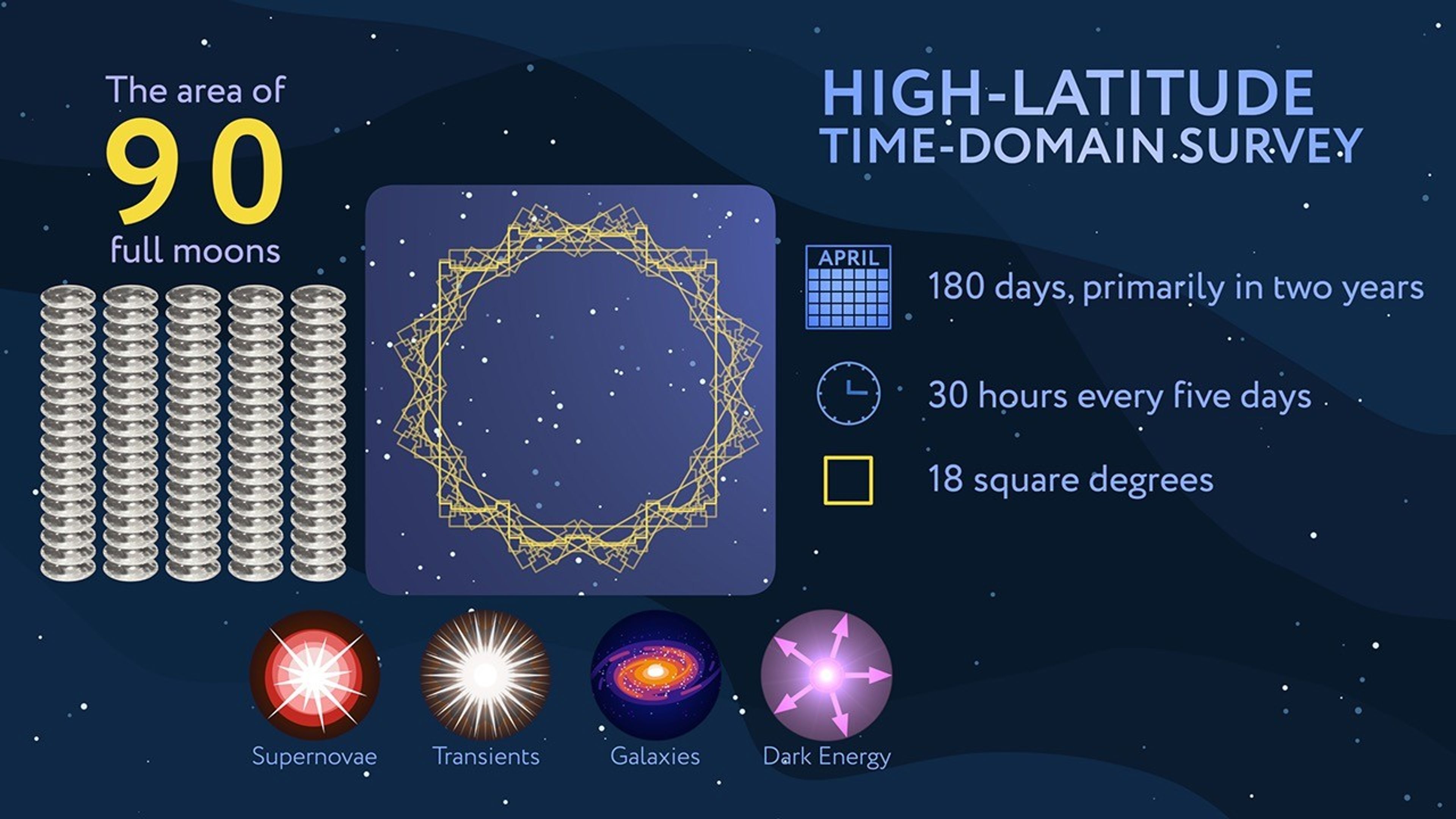
A time domain imaging and spectroscopic survey of high-latitudes of the Milky Way Galaxy to measure the expansion history of the Universe, enabling a wide range of extragalactic time-domain and transient science investigations. The High-Latitude Time-Domain Survey is designed to probe the origin of cosmic acceleration by using supernovae Ia to make precision measurements of the cosmic expansion history. The survey will also provide deep co-added imaging and spectroscopy over areas 1–2 orders of magnitude larger than any comparably deep Hubble imaging.
The High-Latitude Time-Domain Survey is composed of Core, Pilot, and Extended Components. The Core Component will serve as the primary source of discovery and characterization of Type Ia supernovae and other transients. It will feature Roman/WFI Wide and Deep imaging over filters and prism spectroscopy. The Pilot Component will be identical to the Core Component, but occur only over 8 epochs with a 20-day cadence as early possible in Roman’s mission to serve as a collection of template images for difference imaging, a collection of reference prism data for host galaxy subtraction/modeling, and measurement of supernovae Ia rates above z~1. The Extended Component will conduct Deep Imaging Tier observations over 8 epochs with a 120-day cadence to provide temporal coverage over Roman’s 5-year mission for long-duration transients and variables. This survey is allocated ~6 months of time.
Galactic Bulge Time-Domain Survey
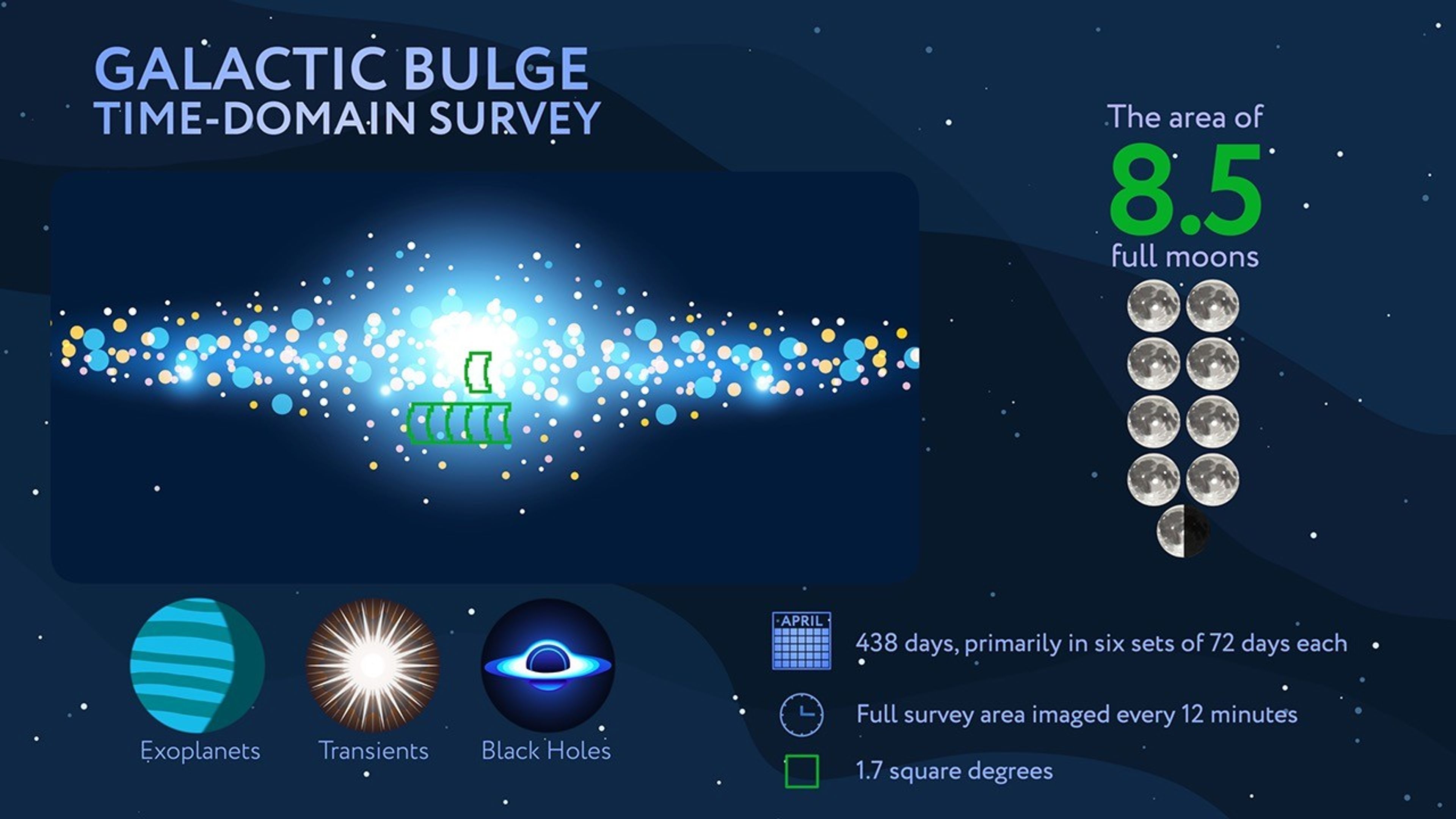
A time domain imaging survey of the Galactic bulge to detect more than a thousand wide-orbit planets in the habitable zone and beyond, as well as stars and black holes, via microlensing, detect more than 105 transiting planets, measure asteroseismic masses for over 104 evolved stars, and enable a wide range of other studies of stellar and Galactic astrophysics. The Galactic Bulge Time-Domain Survey is designed to measure the demographics of exoplanets via gravitational microlensing, sensitive to a regime of mass and orbital separation that is complementary to those of the Kepler and TESS missions, including free floating planets.
The Galactic Bulge Time-Domain Survey features high-cadence observations of 12.1-mins over 6 seasons (3 early and 3 late in Roman’s 5-year mission). The survey also includes low-cadence seasons of 5-days or faster for long-duration microlensing events and other variable types in the middle bulge seasons of Roman’s 5-year mission. Lastly, this survey will have “snapshots” of the survey fields with multiband photometry for stellar characterization and grism spectroscopy for measuring stellar temperatures, metallicities, and radial velocities. This survey is allocated ~15 months of time.
View a technical overview on each survey:
Science Pitches & White Papers
| Science Pitches | White Papers |
|---|---|
| Submission of a short, one to two paragraph 'science pitch' (including a questionnaire) was due February 17, 2023, and resulted in more than 100 submissions. The aim of the Roman CCS science pitches was to capture, from a large cross-section of the community, the full breadth of science investigations possible with the Roman CCSs, as well as high level information on what aspects of survey design are most important for these investigations. View the science pitches | Technically focused white papers describing what observing strategies were solicited by the mission, due on June 16, 2023. Over 70 submissions were received. The aim of the more detailed Roman CCS white papers was to compile quantitative discussions of CCS observation strategies, including what strategies will enable a given science investigation and the impact of survey design choices on the science, expressed via appropriate metrics or figures of merit. View the white papers. |
Core Community Survey Definition Committees
In August 2023 the Roman Mission solicited self-nominations to serve on definition committees for the three Core Community Surveys: the Galactic Bulge Time-Domain Survey, the High-Latitude Time-Domain Survey, and the High-Latitude Wide-Area Survey. Over 80 submissions were received. From those submissions and other sources, the committees were constituted.
| Galactic Bulge Time-Domain Survey Definition Committee | High-Latitude Time-Domain Survey | High-Latitude Wide-Area Survey | Solar System Expert Liaison (serving all three committees) |
|---|---|---|---|
| Jessie Christiansen, NExScI/Caltech (Co-chair) Daniel Huber, UH/USyd (Co-chair) Annalisa Calamida, STScI Jessica Lu, UC Berkeley Eduardo Martin, Instituto de Astrofisica de Canarias (ESA) Benjamin Monte, UNSW Kris Pardo, USC Matthew Penny, LSU Hans Walter Rix, MPIA Jennifer Sobeck, IPAC | Brad Cenko, GSFC (Co-chair) Masao Sako, UPenn (Co-chair) Alessandra Corsi, Texas Tech Michael Fausnaugh, Texas Tech Sebastian Gomez, STScI Rebekah Hounsell, UMBC Takashi Moriya,NAOJ Gordon Richards, Drexel Russell Ryan, STScI Schuyler Van Dyk, IPAC/Caltech Ashley Villar, CfA/Harvard | Ryan Hickox, Dartmouth (Co-chair) Risa Wechsler, Stanford/KIPAC (Co-chair) Micaela Bagley, UT Austin Keith Bechtol, University of Wisconsin-Madison Michael Blanton, NYU Chris Hirata, OSU Elizabeth Krause, U of Arizona Nikhil Padmanabhan, Yale Ismael Tereno, Instituto de Astrofisica e Ciencas do Espaço (ESA) L. Y. Aaron Yung, STScI David Weinberg, OSU Anja von der Linden, Stony Brook | Rosemary Pike, Center for Astrophysics | Harvard & Smithsonian Susan Benecchi, Planetary Science Institute |
The Core Community Survey Definition Committees will be charged with defining the CCS observational strategies in a way that maximizes the science that can be achieved with each survey and represents the interests of the full astronomical community.
The CCS definition committees will use the initial community input to
- identify the most promising synergies between general astrophysics and the drivers of the science requirements for each CCS,
- determine where additional investigative work is needed (e.g., to define appropriate metrics for a science investigation or determine if a science investigation is feasible within constraints),
- discover areas where community consensus-building is needed (e.g., where there are significant discrepancies in strategy for similar science investigations), target additional requests for community input, and
- inform the programs and agendas for later follow-up community workshops on the CCS survey definition.
The CCS definition committees, with the support of the Roman Science Centers at STScI and IPAC, will continue to engage with the astronomical community as they consider observational strategy trades and their impacts on science investigations while iteratively developing the survey concepts.