
























APOD
Astronomy Picture of the Day
Discover the cosmos! Each day a different image or photograph of our fascinating universe is featured, along with a brief explanation written by a professional astronomer.
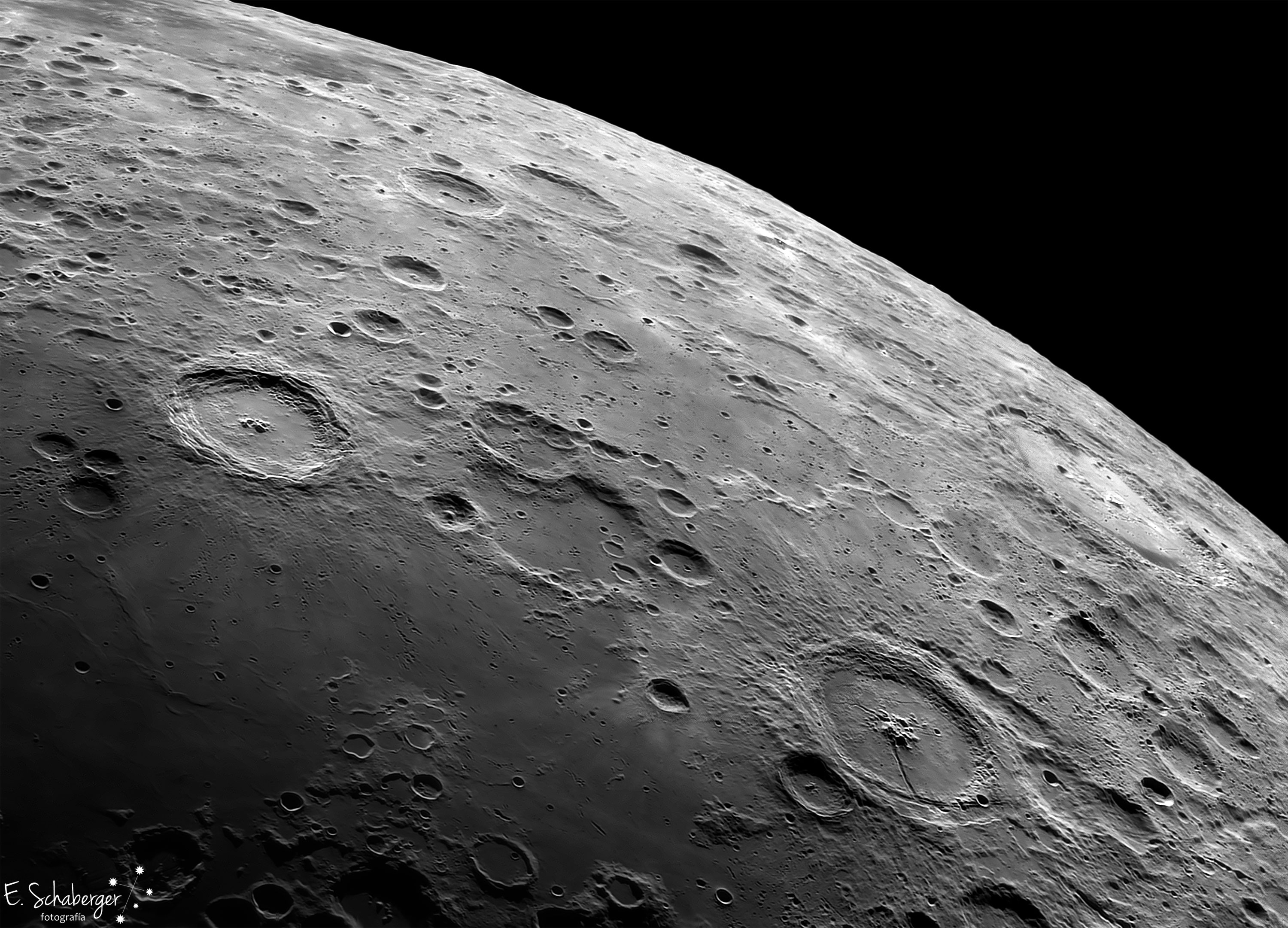
Lunar Craters Langrenus and Petavius
Explanation: The history of the Moon is partly written in its craters. Pictured here is a lunar panorama taken from Earth featuring the large craters Langrenus , toward the left, and Petavius , toward the right. The craters formed in separate impacts . Langrenus spans about 130 km, has a terraced rim, and sports a central peak rising about 3 km. Petavius is slightly larger with a 180 km diameter and has a distinctive fracture that runs out from its center. Although it is known that Petravius crater is about 3.9 billion years old , the origin of its large fracture is unknown. The craters are best visible a few days after a new Moon , when shadows most greatly accentuate vertical walls and hills. The featured image is a composite of the best of thousands of high-resolution, infrared , video images taken through a small telescope. Although mountains on Earth will likely erode into soil over a billion years, lunar craters Langrenus and Petavius will likely survive many billions more years, possibly until the Sun expands and engulfs both the Earth and Moon .
Watch: the November 11 Transit of Mercury from Earth or from Space .
| Date | November 11, 2019 |
|---|---|
| Credit | Image Credit & Copyright: Eduardo Schaberger Poupeau |
| Authors & editors: | Robert Nemiroff (MTU) & Jerry Bonnell (UMCP) |
| A service of: |
ASD at NASA / GSFC, NASA Science Activation & Michigan Tech. U. |