
























APOD
Astronomy Picture of the Day
Discover the cosmos! Each day a different image or photograph of our fascinating universe is featured, along with a brief explanation written by a professional astronomer.
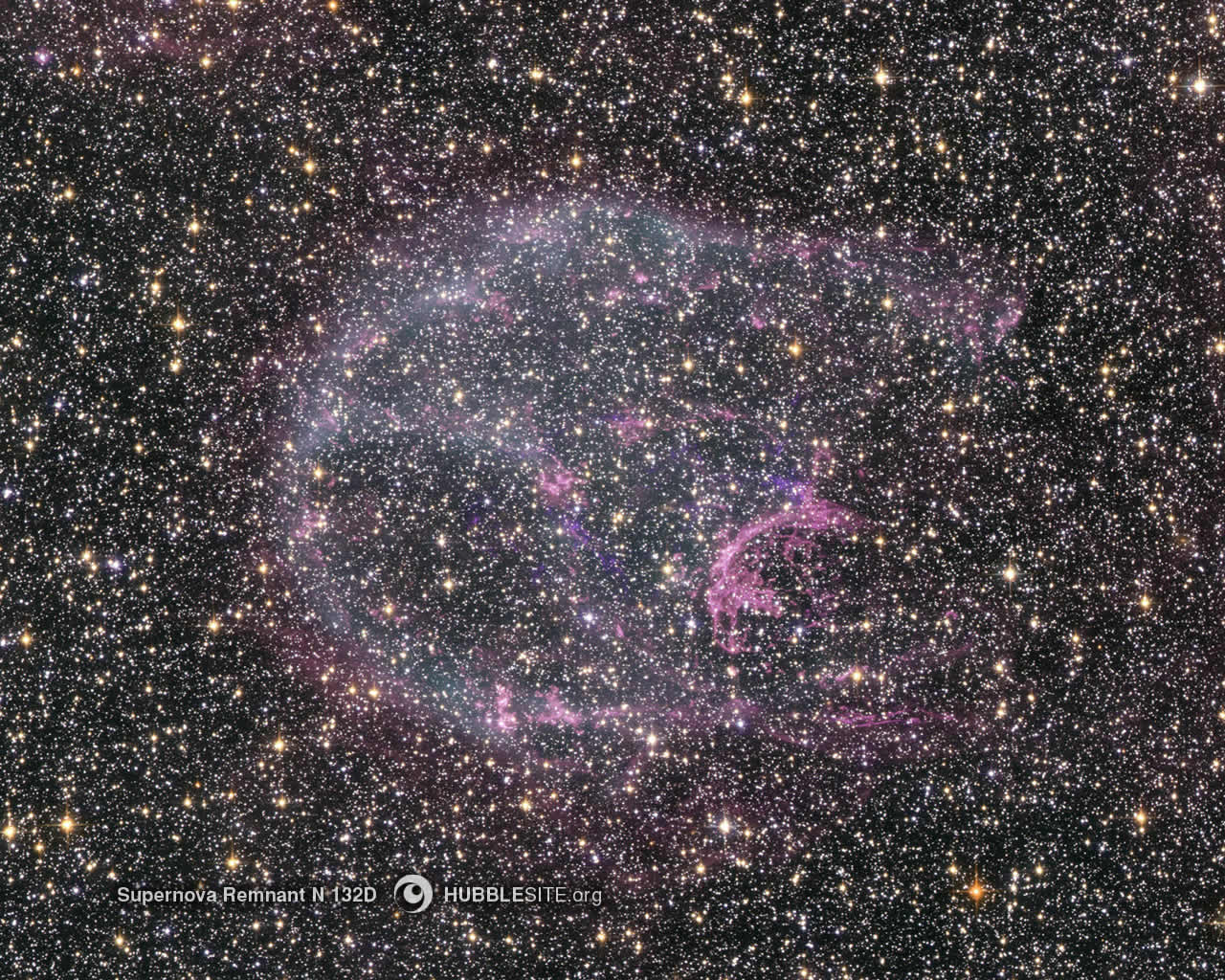
Supernova Remnant N132D in Optical and X Rays
Explanation: Thousands of years after a star exploded, its expanding remnant still glows brightly across the spectrum. Such is the case with N132D , a supernova remnant located in the neighboring Large Magellanic Cloud (LMC) galaxy. The expanding shell from this explosion now spans 80 light-years and has swept up about 600 Suns worth of mass. N132D was imaged recently in optical light and in great detail with the Hubble Space Telescope . The Hubble image was then combined with a position coincident detailed image in X-ray light taken by the Chandra X-ray Observatory . The combination, shown above in representative colors, shows a nearly spherical expanding shockwave highlighted by pink emission from hydrogen gas and purple emission from oxygen gas. A dense field of unrelated stars also from the LMC populates the image. Studying the image gives an opportunity to study material once hidden deep inside a star. N132D spans about 150 light years and lies about 160,000 light years away toward the constellation of Dorado .
| Date | October 25, 2005 |
|---|---|
| Credit |
Credit : NASA , ESA , and The Hubble Heritage Team ( STScI / AURA ) Acknowledgment: J.C. Green (Univ. of Colorado) and the Cosmic Origins Spectrograph (COS) GTO team ; NASA / CXO / SAO |
| Authors & editors: | Robert Nemiroff (MTU) & Jerry Bonnell (UMCP) |
| A service of: |
ASD at NASA / GSFC, NASA Science Activation & Michigan Tech. U. |