





















APOD
Astronomy Picture of the Day
Discover the cosmos! Each day a different image or photograph of our fascinating universe is featured, along with a brief explanation written by a professional astronomer.
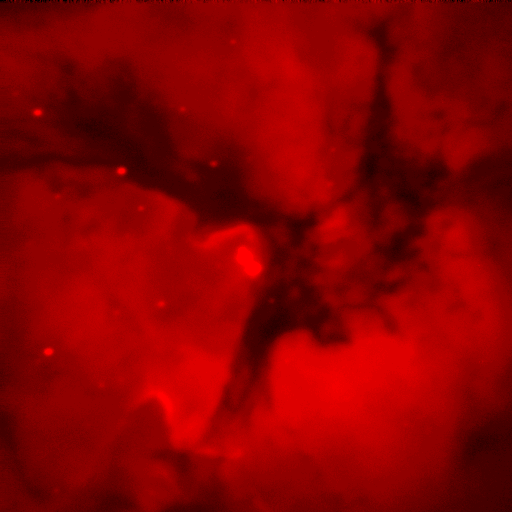
Hydrogen Trifid
Explanation: Clouds of glowing hydrogen gas mingle with dark dust lanes in the Trifid Nebula , a star forming region in the constellation Sagittarius. In this and other similar emission nebulae , energetic ultraviolet light from an embedded hot young star strips electrons from the surrounding hydrogen atoms . As the electrons and atoms recombine they emit longer wavelength, lower energy light in a well known characteristic pattern of bright spectral lines . At visible wavelengths, the strongest emission line in this pattern is in the red part of the spectrum and is known as “Hydrogen-alpha” or just H-alpha. This image of the nebula was taken using a filter to select only light near the H-alpha wavelength. It shows those regions with substantial emission from atomic hydrogen . The relative strength of this emission can trace the densities of atoms within the gas cloud.
| Date | August 28, 1998 |
|---|---|
| Credit | Credit and Copyright: David McDavid ( Limber Observatory) |
| Authors & editors: | Robert Nemiroff (MTU) & Jerry Bonnell (UMCP) |
| A service of: |
ASD at NASA / GSFC, NASA Science Activation & Michigan Tech. U. |