













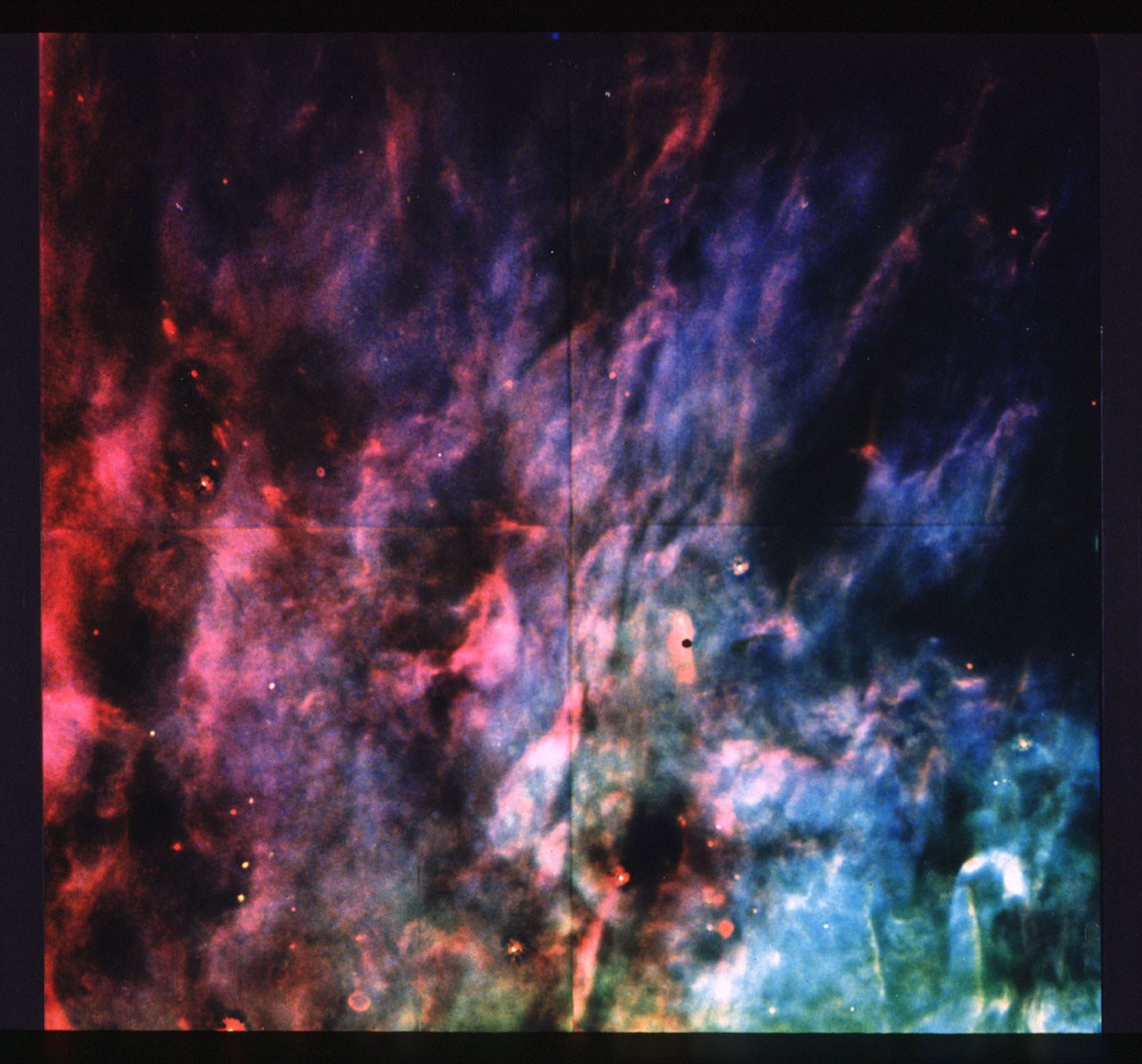
Orion Nebula
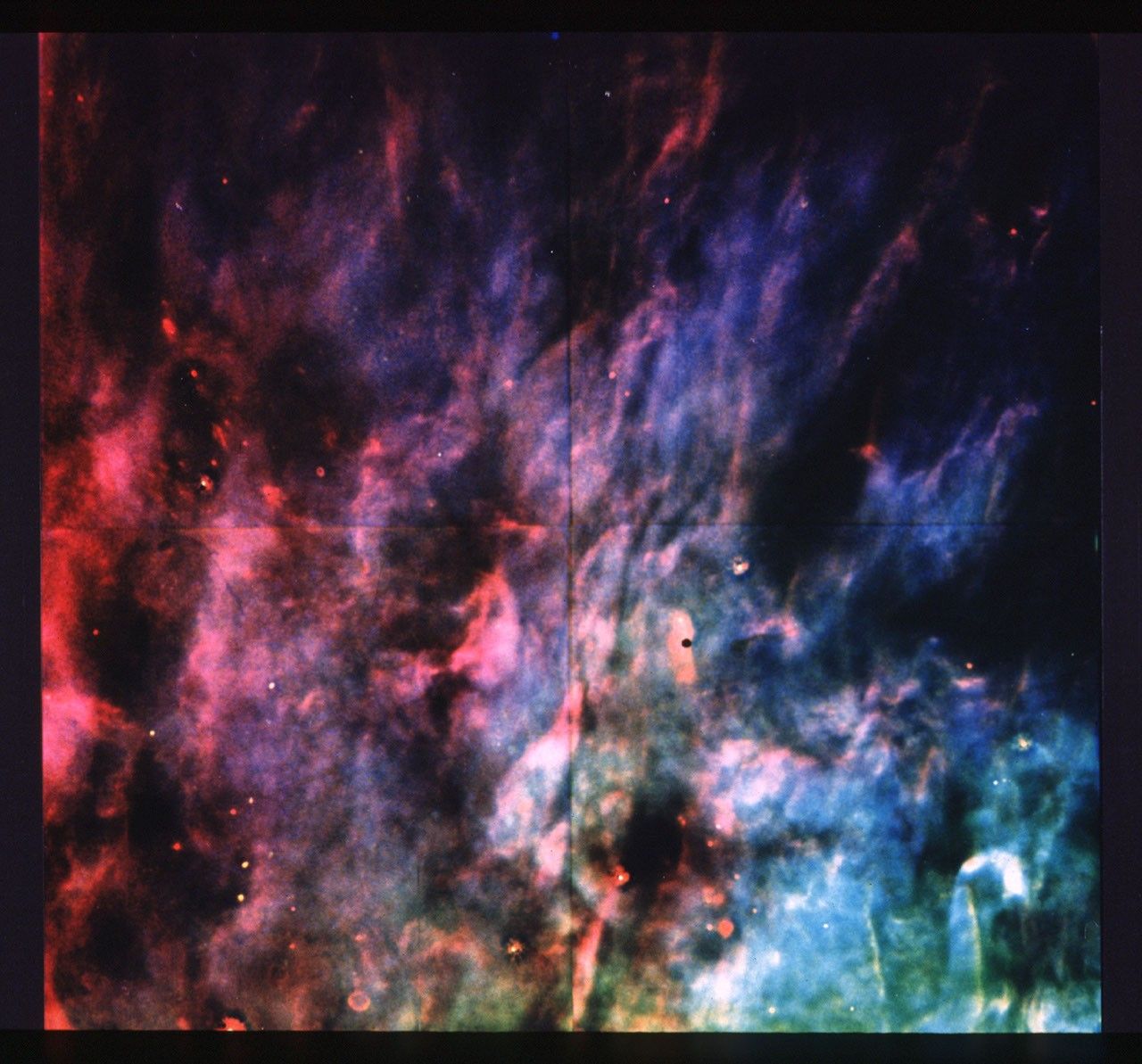
Images made with the Wide Field/Planetary Camera on NASA's Hubble Space Telescope have revealed the structure of a thin sheet of gas located at the edge of the famous "Great Nebula" in Orion, an estimated 1,500 light-years from Earth. Astronomers, who compare the appearance of this sheet of gas with that of a rippled window curtain, report that this emission traces the boundary between the hot, diffuse interior of the nebula and an adjacent dense, cool cloud. The sheet is seen in light emitted by atoms of gaseous sulfur (shown in red in the photograph). This emission is strongest under conditions that are intermediate between those in the interior of nebula and those in the dense cloud. The sulfur emission is seen to break into filamentary and clumpy structures with sizes down to the limit of what the telescope can show. In contrast, emission from gaseous oxygen and hydrogen (shown as blue and green, respectively) is favored in the interior of the nebula itself, and is distributed much more smoothly in the image. The Orion Nebula is a "stellar nursery" — a region where new stars are forming out of interstellar gas. The emission from the nebula is powered by the intense ultraviolet light from a cluster of particularly hot and luminous stars. The sulfur emission seen in the photograph is coming from the region where the light from these stars is "boiling off" material from the face of the dense cloud. This is the very cloud from which the hot stars formed, and is known to harbor additional ongoing star formation.
Image Credit: NASA, ESA, and STScI
- X
https://science.nasa.gov/image-detail/amf-cfe8d398-bf59-4160-a2ca-dfe1db383d90/
Image CreditNASA, ESA, and STScI
Size2748x2563px