












Pedal to the Metal: NASA’s Psyche Heads Toward Asteroid Belt

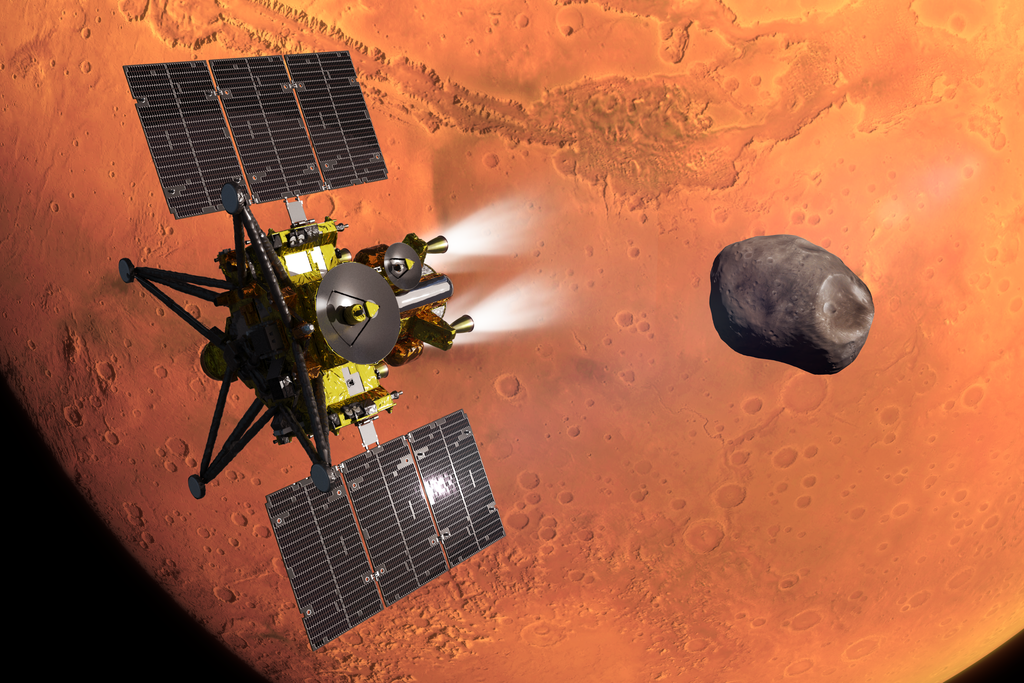
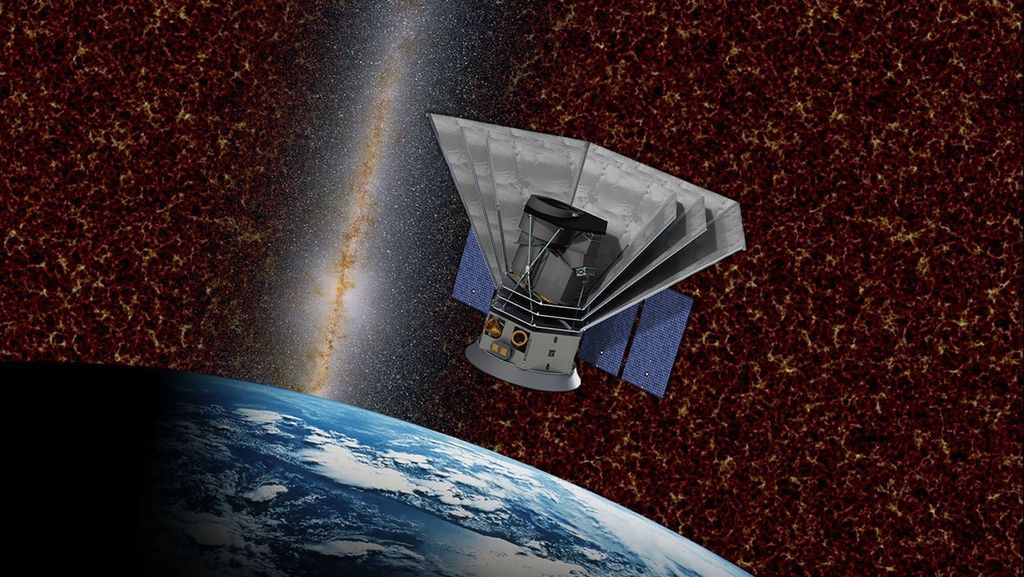
With a successful Mars gravity assist in its rearview mirror, NASA’s Psyche spacecraft has fired up its thrusters and is accelerating to the metal-rich asteroid of the same name. During the first leg of its journey, following an October 2023 launch, the mission used its electric propulsion system intermittently to maneuver to the right place for harnessing Mars’ gravity for a propellant-saving speed boost and a slight trajectory change.
On Sept. 28, the spacecraft began to use its propulsion system nearly continuously, pausing just once each week to check in with mission controllers on Earth. This keeps the mission on track for its rendezvous with the asteroid Psyche in the main asteroid belt by the summer of 2029.
“It’s now ‘pedal to the metal’ to the asteroid Psyche,” said Don Han, the Psyche mission’s navigation lead at NASA’s Jet Propulsion Laboratory in Southern California, which is managed for the agency by Caltech. “We will be running our propulsion system at every available opportunity, pausing only for necessary engineering activities. The thrusters will be operating nearly 90% of the time from now until we reach the asteroid.”
Xenon propellant efficiency
Where conventional spacecraft thrusters rely on large quantities of fuel to provide powerful bursts of thrust for relatively short periods of time, the Psyche spacecraft’s solar-powered propulsion system uses electromagnetic fields to steadily deliver up to 250 millinewtons of force — about the amount of force that you would feel from the weight of holding one AA battery.
The highly efficient system relies on a mechanism known as the Hall effect, in which charged atoms, or ions, of the inert gas xenon are expelled to create thrust — and a bright blue glow.
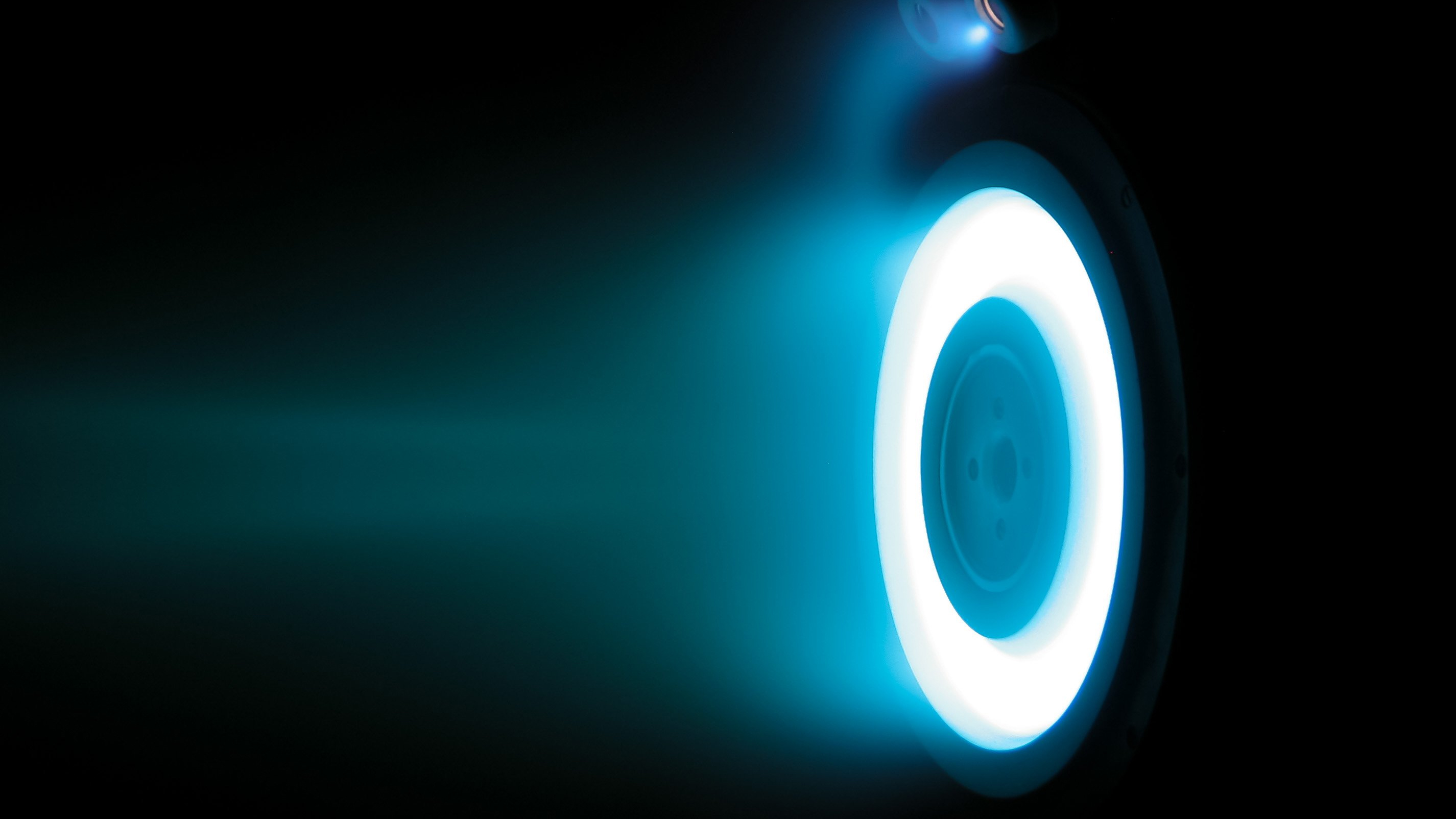
Each of the four thrusters operates one at a time. Though the thrust is tiny, it builds up over the course of the journey, enabling the spacecraft to gain speed as it travels through interplanetary space. At its maximum speed during cruise, the Psyche spacecraft will be traveling more than 100,000 mph (160,900 kph) relative to an observer on Earth.
The spacecraft uses its two five-panel, cross-shaped solar arrays — with a sunlight-collecting area of 800 square feet (75 square meters) — to generate electricity to charge its batteries and power its systems, including the propulsion system. The spacecraft launched with nearly 2,400 pounds (1,090 kilograms) of xenon in seven fuel tanks. In the three years since launch, it has used about one third of that supply, leaving plenty to reach its target and assist the spacecraft as it orbits the asteroid Psyche during a two-year prime science mission.
“There are some unique things that mission designers need to consider with a propulsion system that is powered by the Sun,” said Steve Snyder, the Psyche mission’s lead engineer for propulsion operations at JPL. “For the next three months, we’ll be thrusting at full power before we begin slowly throttling down to approximately half power as the spacecraft moves farther away and its solar arrays receive less sunlight and generate less power.”
Psyche swirl torque
Another consideration for mission designers: Despite how gentle the Hall-effect thrusters are, using them requires consistent management throughout cruise. As the thrusters expel xenon ions, the magnetic field generated causes the ions to swirl. These swirling ions can create a slight torque, or twisting force, that if left unchecked would interfere with the spacecraft’s pointing.
To compensate for the torque and absorb the excess angular momentum it generates, the Psyche spacecraft relies on reaction wheels to change their spin rate. After several hours, engineers command the spacecraft to turn off its thruster, rotate, and then run a different thruster at low power in a different direction for several minutes to remove the momentum that built up in the reaction wheels.
“For a propulsion engineer, it’s a fun thing that you can only measure this torque in space and not on Earth, as it’s so small,” said Snyder. “In fact, this is the first time anyone has been able to measure this effect on a Hall thruster as a function of power level and of operating time, and for such a long duration in space. The Psyche spacecraft is an excellent laboratory to test it.”
Cruising with confidence
When it arrives in 2029, the spacecraft will insert itself into orbit around the asteroid Psyche, which is thought to be the partial core of a planetesimal, a building block of an early planet. The spacecraft will map the asteroid and gather science data during a series of orbits that go lower and then higher in altitude around Psyche, which is about 173 miles (280 kilometers) across at its widest point.
If the asteroid proves to be an ancient planetesimal’s metallic core, it could offer a one-of-a-kind window into the interior of rocky planets like Earth.
“The Mars flyby was an incredible opportunity for the team to calibrate instruments and practice procedures for a planetary encounter ahead of arriving at the asteroid Psyche,” said Lindy Elkins-Tanton, principal investigator for the Psyche mission at the University of California, Berkeley. “Now we are cruising with confidence deeper into the solar system, powered by sunlight, ready to explore a mysterious new world in the asteroid belt.”