











N132D
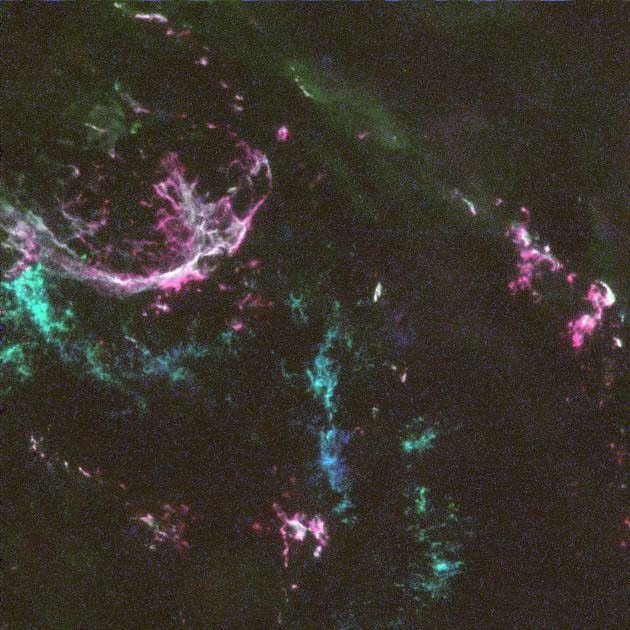
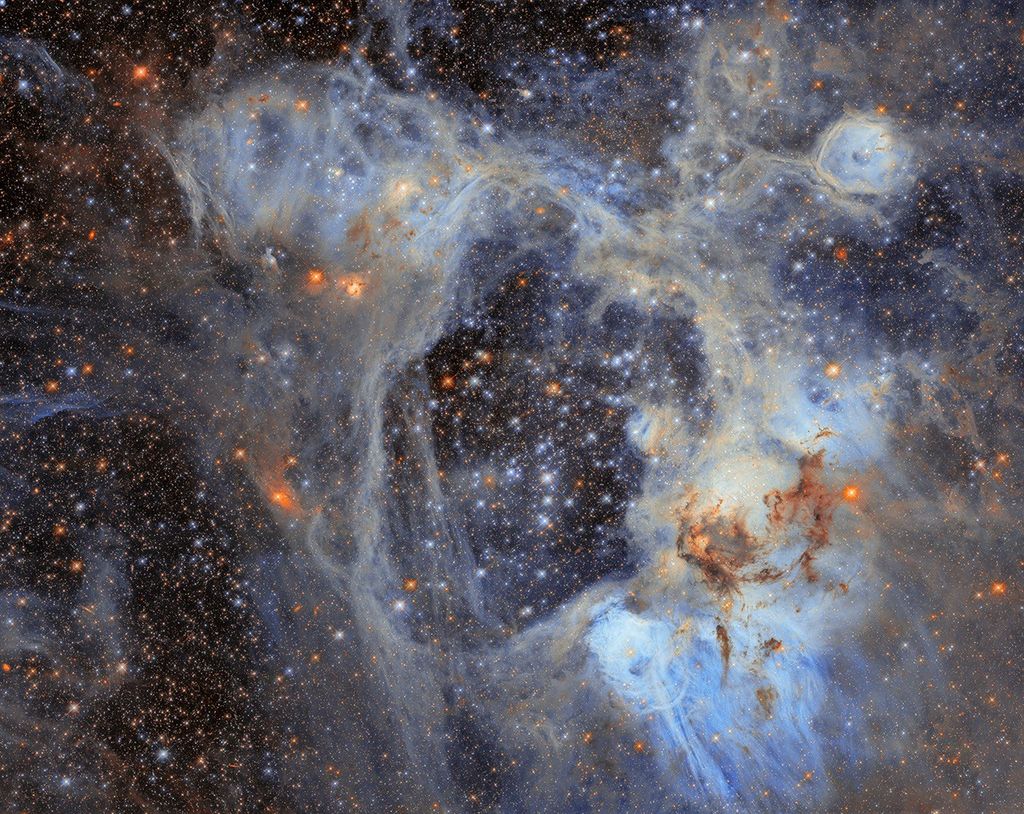
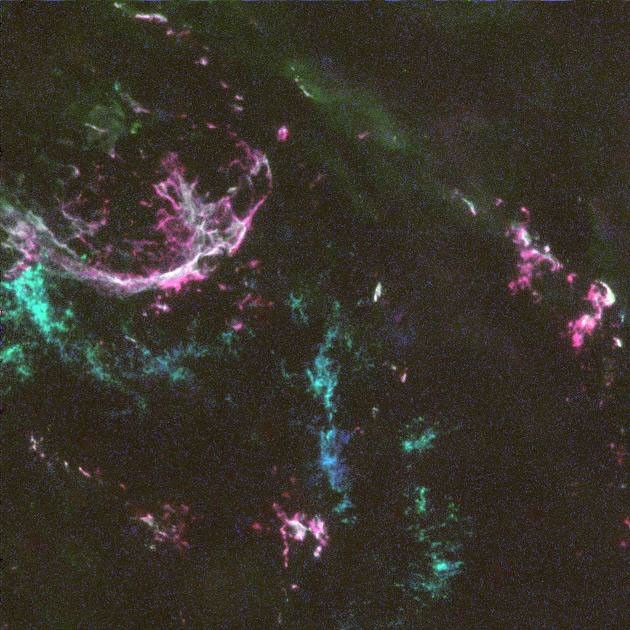
This is a Hubble Space Telescope image of the tattered debris of a star that exploded 3,000 years ago as a supernova. This supernova remnant, called N132D, lies 169,000 light-years away in a satellite galaxy called the Large Magellanic Cloud. This Wide Field Planetary Camera 2 image of the inner regions of the supernova remnant shows the complex collisions that take place as fast moving ejecta slam into cool, dense interstellar clouds. This level of detail in the expanding filaments could only be seen previously in much closer supernova remnants. Hubble's capabilities extended the detailed study of supernovae out to the distance of a neighboring galaxy. Supernova remnants provide a rare opportunity to observe directly the interiors of stars that are far more massive than our Sun. The precursor star to this remnant, which was located slightly below and left of center in the image, is estimated to have been 25 times the mass of our Sun. These stars "cook" heavier elements through nuclear fusion, including oxygen, nitrogen, carbon, iron, etc., and the titanic supernova explosions scatter this material back into space where it is used to create new generations of stars. This is the mechanism by which the gas and dust that formed our solar system became enriched with the elements that sustain life on this planet.
Image Credit: Jon A. Morse (STScI) and NASA; Investigating team: William P. Blair (PI; JHU), Michael A. Dopita (MSSSO), Robert P. Kirshner (Harvard), Knox S. Long (STScI), Jon A. Morse (STScI), John C. Raymond (SAO), Ralph S. Sutherland (UC-Boulder), and P. Frank Winkler (Middlebury)
- X
https://science.nasa.gov/image-detail/amf-1be668c3-096a-4760-beb1-65fbab0ee764/
Image CreditJon A. Morse (STScI) and NASA; Investigating team: William P. Blair (PI; JHU), Michael A. Dopita (MSSSO), Robert P. Kirshner (Harvard), Knox S. Long (STScI), Jon A. Morse (STScI), John C. Raymond (SAO), Ralph S. Sutherland (UC-Boulder), and P. Frank Winkler (Middlebury)
Size630x630px