

















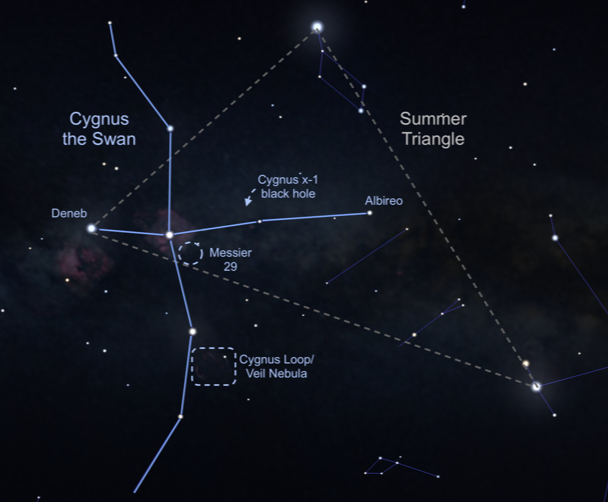
Bird constellations abound in the night sky, including Cygnus, the majestic swan. Easy to find with its dazzling stars, it is one of the few constellations that look like its namesake, and it is full of treasures. Visible in the Northern Hemisphere all summer long, there’s so much to see and even some things that can’t be seen. To locate Cygnus, start with the brightest star, Deneb, also the northeasternmost and dimmest star of the Summer Triangle. The Summer Triangle is made up of three bright stars from three different constellations – read more about it in the September 2022 issue of Night Sky Notes. “Deneb'' is an Arabic word meaning the tail. Then travel into the triangle until you see the star Albireo, sometimes called the “beak star” in the center of the summer triangle. Stretching out perpendicular from this line are two stars that mark the crossbar, or the wings, and there are also faint stars that extend the swan’s wings.
From light-polluted skies, you may only see the brightest stars, sometimes called the Northern Cross. In a darker sky, the line of stars marking the neck of the swan travels along the band of the Milky Way. A pair of binoculars will resolve many stars along that path, including a sparkling open cluster of stars designated Messier 29, found just south of the swan’s torso star. This grouping of young stars may appear reddish due to nearby excited gas.
Let’s go deeper. While the bright beak star Albireo is easy to pick out, a telescope will let its true beauty shine! Like a jewel box in the sky, magnification shows a beautiful visual double star, with a vivid gold star and a brilliant blue star in the same field of view. There’s another marvel to be seen with a telescope or strong binoculars – the Cygnus Loop. Sometimes known as the Veil Nebula, you can find this supernova remnant (the gassy leftovers blown off of a large dying star) directly above the final two stars of the swan’s eastern wing. It will look like a faint ring of illuminated gas about three degrees across (six times the diameter of the Moon).

Speaking of long-dead stars, astronomers have detected a high-energy X-ray source in Cygnus that we can’t see with our eyes or backyard telescopes, but that is detectable by NASA's Chandra X-ray Observatory. Discovered in 1971 during a rocket flight, Cygnus X-1 is the first X-ray source to be widely accepted as a black hole. This black hole is the final stage of a giant star’s life, with a mass of about 20 Suns. Cygnus X-1 is spinning at a phenomenal rate – more than 800 times a second – while devouring a nearby star. Astronomically speaking, this black hole is in our neighborhood, 6,070 light years away. But it poses no threat to us, just offers a new way to study the universe.
Check out the beautiful bird in your sky this evening, and you will be delighted to add Cygnus to your go-to summer viewing list and visit NASA’s Black Hole Basics page to learn more!
Originally posted by Dave Prosper: May 2023
Last Updated by Kat Troche: July 2026