

























Discover the cosmos! Each day a different image or photograph of our fascinating universe is featured, along with a brief explanation written by a professional astronomer.
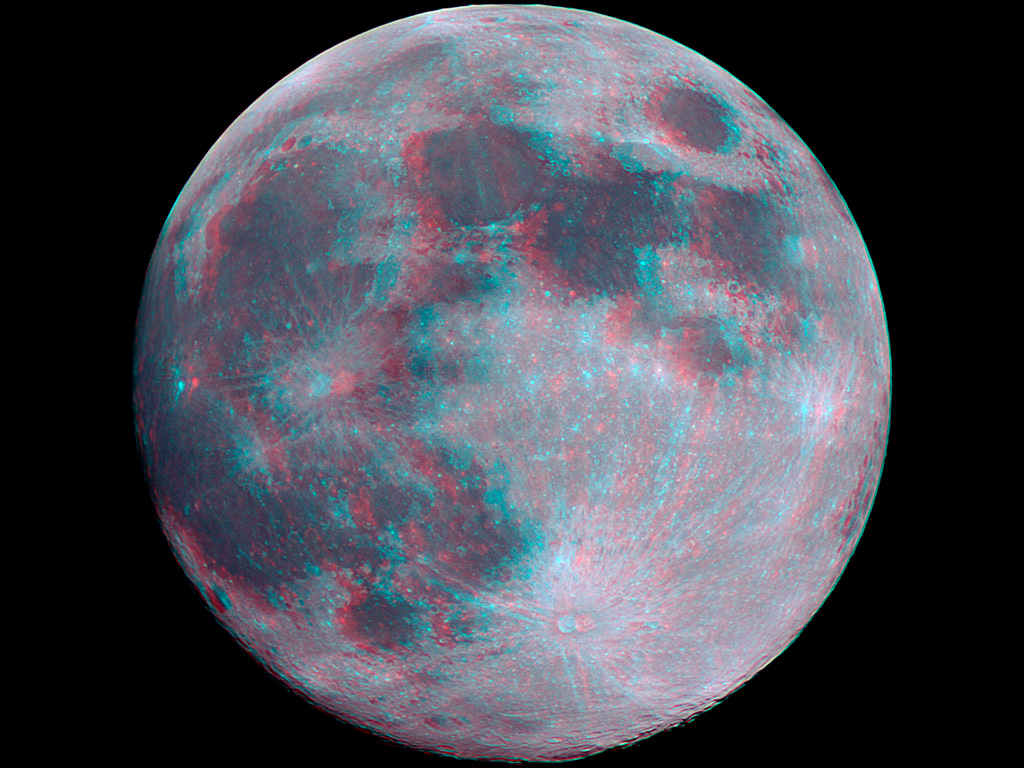
3D Full Moon
Explanation: Get out your red/blue glasses and check out this satisfying stereo anaglyph of the Full Moon. A corresponding stereo image pair, intended for cross-eyed viewing , is also available through this link . Regardless of your preferred technique for stereo viewing , the 3D effect comes from combining pictures of the same scene taken at different angles -- mimicking the slightly different perspective of each eye. Perhaps surprisingly for Earthdwellers , getting two pictures of the Full Moon from different angles only requires a little patience. In this case, photographer Laurent Laveder used pictures taken months apart, one in November 2006 and one in January 2007. He relied on the Moon's continuous libration or wobble as it orbits to produce two shifted images of a Full Moon .
| Date | June 2, 2007 |
|---|---|
| Credit | Credit & Copyright: Laurent Laveder ( PixHeaven.net ) |
| Authors & editors: | Robert Nemiroff (MTU) & Jerry Bonnell (UMCP) |
| A service of: |
ASD at NASA / GSFC, NASA Science Activation & Michigan Tech. U. |