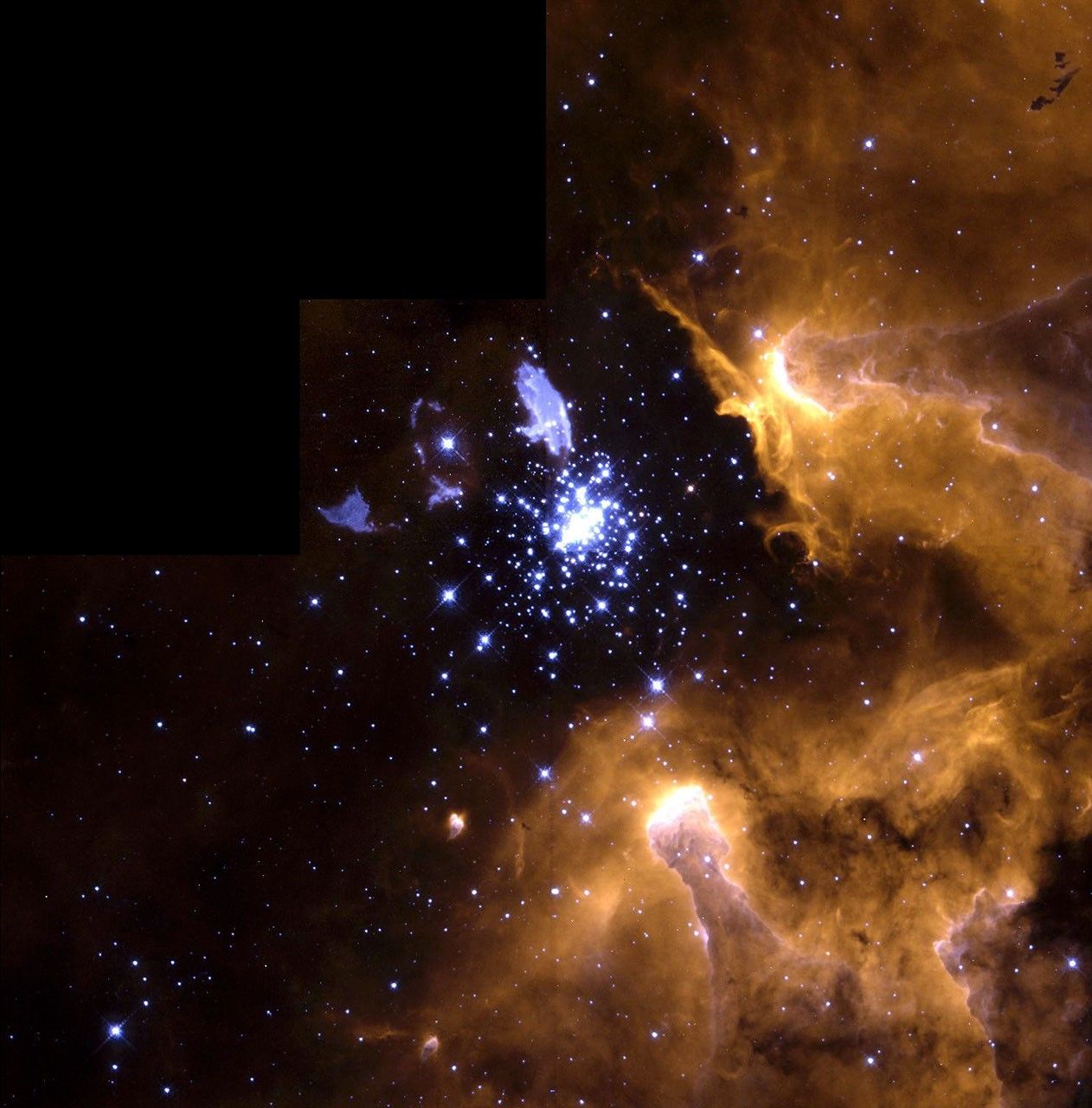














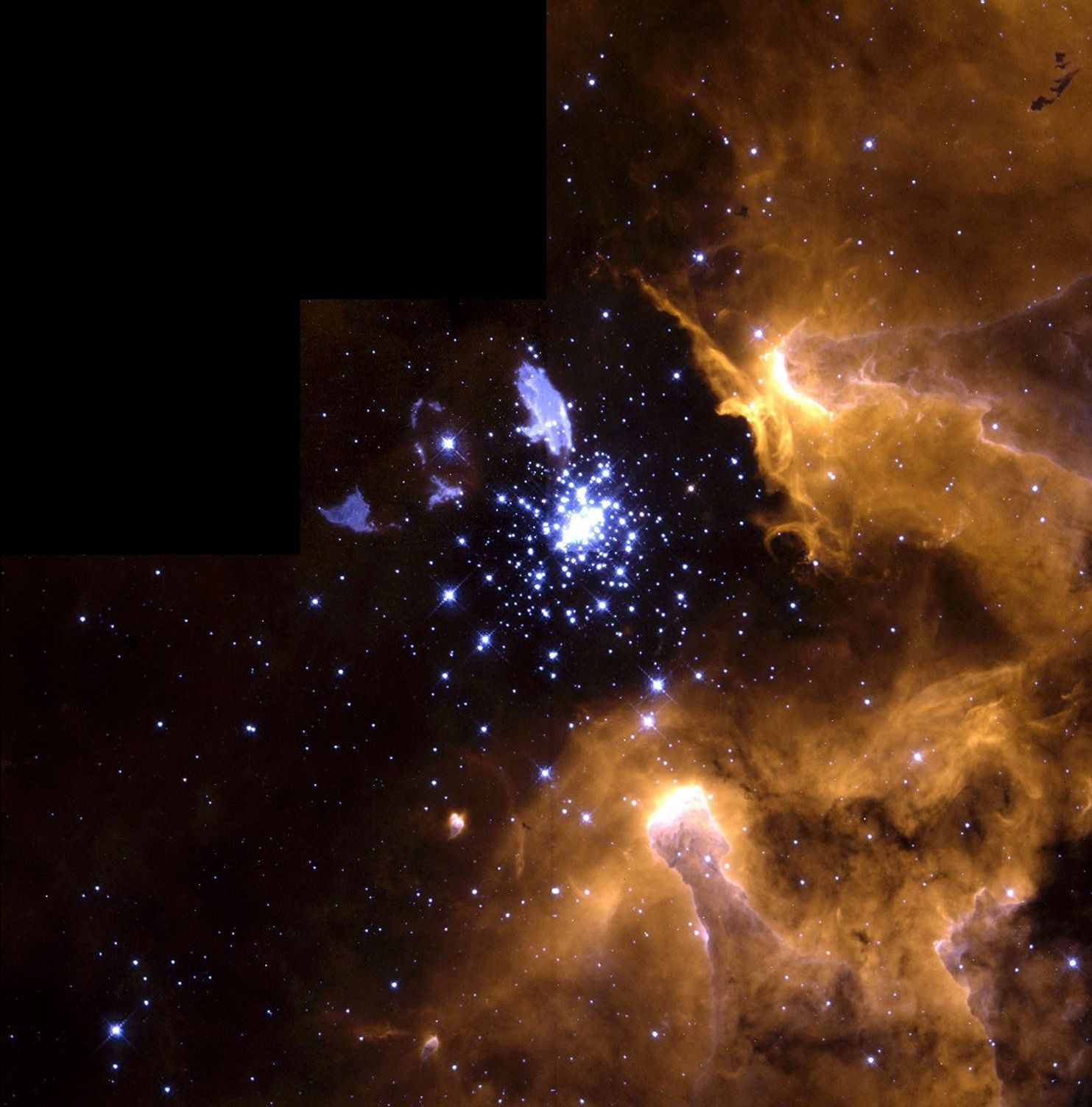
Starburst Cluster in Nebula NGC 3603
This stunning picture of the giant galactic nebula NGC 3603 captures various stages of the life cycle of stars in one single view. To the upper left of center is the evolved blue supergiant called Sher 25. The star has a unique circumstellar ring of glowing gas that is a galactic twin to the famous ring around the supernova SN 1987A. The grayish-bluish color of the ring and the bipolar outflows (blobs to the upper right and lower left of the star) indicates the presence of processed (chemically enriched) material. Near the center of the view is a so-called starburst cluster dominated by young, hot stars. A torrent of ionizing radiation and fast stellar winds from these massive stars has blown a large cavity around the cluster. The giant gaseous pillars to the right and lower right of the cluster provide the most spectacular evidence for the interaction of ionizing radiation with cold molecular-hydrogen cloud material. Dark clouds at the upper right are so-called Bok globules, which are probably in an earlier stage of forming stars. To the lower left of the cluster are two compact, tadpole-shaped emission nebulae. Similar structures were found by Hubble in the Orion Nebula, and have been interpreted as gas and dust evaporation from possibly protoplanetary disks, or "proplyds." The proplyds in NGC 3603 are 5 to 10 times larger and correspondingly more massive.
Image Credit: Wolfgang Brandner (JPL/IPAC), Eva K. Grebel (Univ. Washington), You-Hua Chu (Univ. Illinois Urbana-Champaign), and NASA
- X
https://science.nasa.gov/image-detail/amf-c26a2fc5-ca31-4050-b8c3-99fdf33eb6fc/
Image CreditWolfgang Brandner (JPL/IPAC), Eva K. Grebel (Univ. Washington), You-Hua Chu (Univ. Illinois Urbana-Champaign), and NASA
Size1483x1504px