






















APOD
Astronomy Picture of the Day
Discover the cosmos! Each day a different image or photograph of our fascinating universe is featured, along with a brief explanation written by a professional astronomer.
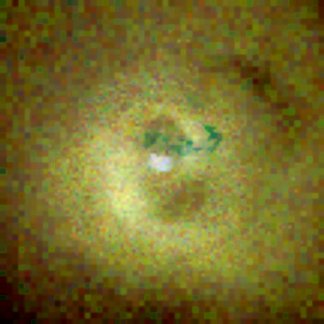
X-rays From The Perseus Cluster Core
Explanation: The Perseus Cluster of thousands of galaxies, 320 million light-years distant, is one of the most massive objects in the Universe . At its core lies the giant cannibal galaxy Perseus A (NGC 1275) , accreting matter as gas and galaxies fall into it. Representing low, medium, and high energy x-rays as red, green, and blue colours respectively, this Chandra X-ray Observatory image shows remarkable details of x-ray emission from this monster galaxy and surrounding hot (30-70 million degrees C) cluster gas . The bright central source is the supermassive black hole at the core of Perseus A itself. Dark circular voids just above and below the galaxy center, each about half the size of our own Milky Way Galaxy , are believed to be magnetic bubbles of energetic particles blown by the accreting black hole. Settling toward Perseus A , the cluster's x-ray hot gas piles up forming bright regions around the bubble rims. Dramatically, the long greenish wisp just above the galaxy's centre is likely the x-ray shadow produced by a small galaxy falling into the burgeoning Perseus A .
| Date | June 15, 2000 |
|---|---|
| Credit | Credit: A. Fabian ( IoA Cambridge ) et al., NASA |
| Authors & editors: | Robert Nemiroff (MTU) & Jerry Bonnell (UMCP) |
| A service of: |
ASD at NASA / GSFC, NASA Science Activation & Michigan Tech. U. |