















Streams of Star Formation in Hickson Compact Group 31
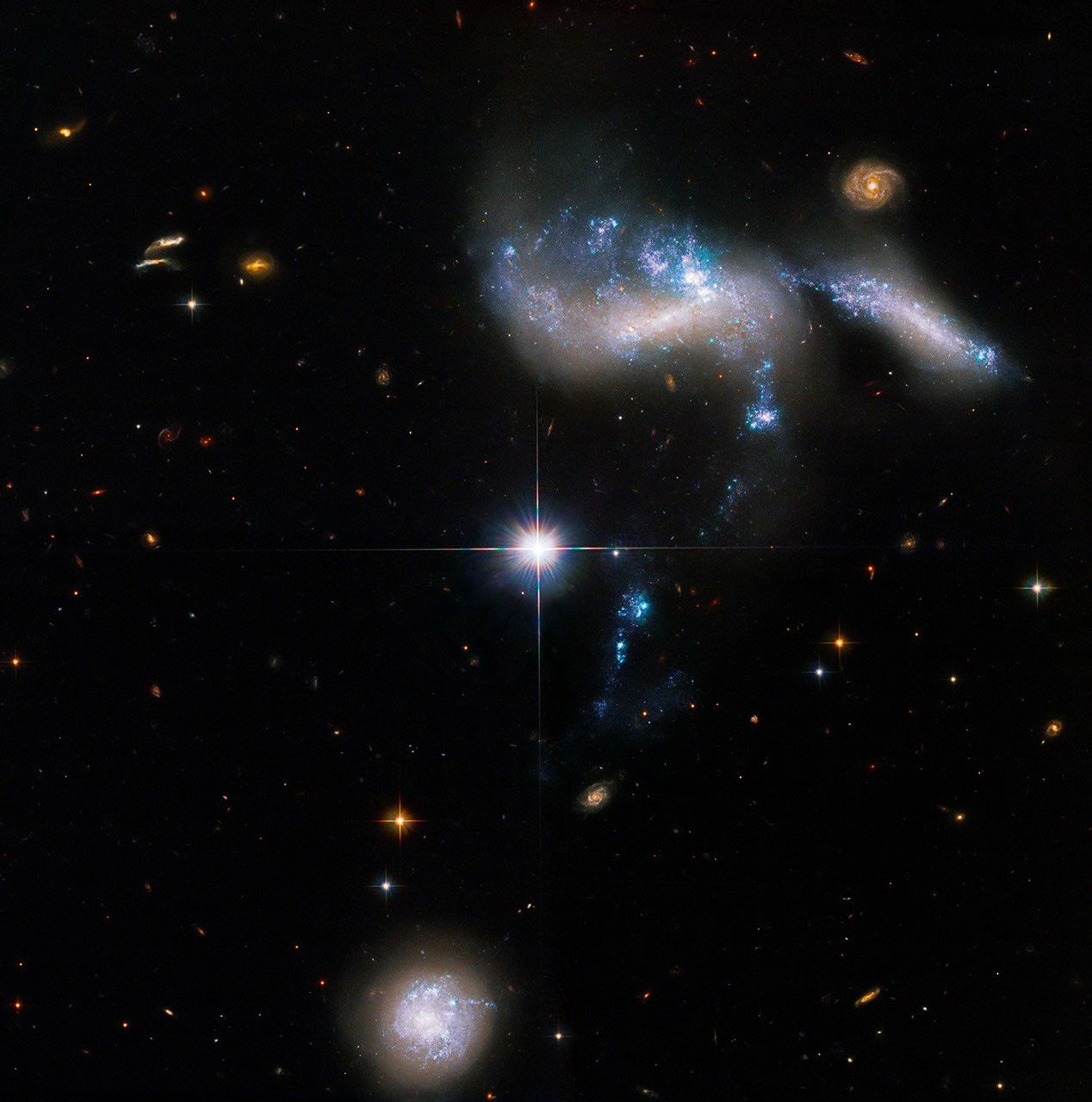
This image of the Hickson Compact Group 31 (HCG 31) of galaxies highlights streams of star-formation as four dwarf galaxies interact. The bright, distorted clump of young blue-white stars (top-right of center) is NGC 1741. Although it appears to be a single galaxy, NGC 1741 is actually a pair of colliding dwarf galaxies. Another dwarf, cigar-shaped galaxy to the pair’s right joins their dance with a thin, blue stream of stars that connects the trio. HGC 31’s fourth member is revealed by a stream of young blue stars that point to the galaxy (bottom-left of center) and indicate its interaction with the other three. The bright object in the center of the image is a star situated between Earth and HCG 31. Dwarf galaxy encounters are normally seen billions of light-years away, and therefore occurred billions of years ago, but HCG 31 is located some 166 million light-years from Earth, relatively close by cosmic standards. This image emphasizes star-forming regions spurred by the quartet’s gravitational dance. The color blue represents visible blue light and showcases young, hot, blue stars, while the color red represents near-infrared light.
Image Credit: NASA, ESA, and J. Charlton (Pennsylvania State University); Image processing: G. Kober (NASA Goddard/Catholic University of America)
- X
https://science.nasa.gov/image-detail/amf-f26800b4-fc12-496c-b01b-3901ddde0f55/
Image CreditNASA, ESA, and J. Charlton (Pennsylvania State University); Image processing: G. Kober (NASA Goddard/Catholic University of America)
Size4021x4057px