






















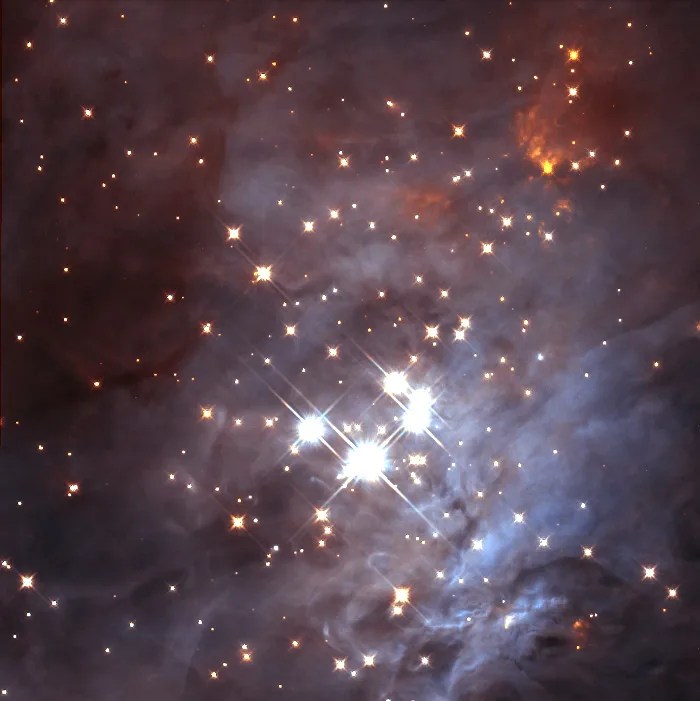
M42 – Orion Nebula Trapezium star cluster
Appearing like glistening precious stones, M42’s Trapezium cluster, named for the trapezoidal arrangement of its central massive stars, is seen in this infrared Hubble image. All of the members of the Trapezium were born together in this hotbed of star formation. Probing deep within this neighborhood stellar nursery, Hubble uncovered a swarm of newborn brown dwarfs. The orbiting observatory's near-infrared camera pierced clouds of gas and dust to reveal about 50 of these objects throughout the Orion Nebula's Trapezium cluster about 1,500 light-years from Earth.
Image Credit: NASA/ESA, K.L. Luhman (Harvard-Smithsonian Center for Astrophysics, Cambridge, Mass.); and G. Schneider, E. Young, G. Rieke, A. Cotera, H. Chen, M. Rieke, R. Thompson (Steward Observatory, University of Arizona, Tucson, Ariz.)
- X
https://science.nasa.gov/image-detail/appearing-like-glistening-precious-stones-the-trapezium-clusters-central-region-is-here-seen-through-the-eyes-of-the-nasa-esa-hubble-space-telescope-all-of-the-celestial-objects-in-the-trapezium-w/
Image CreditNASA/ESA, K.L. Luhman (Harvard-Smithsonian Center for Astrophysics, Cambridge, Mass.); and G. Schneider, E. Young, G. Rieke, A. Cotera, H. Chen, M. Rieke, R. Thompson (Steward Observatory, University of Arizona, Tucson, Ariz.)
Size700x701px