










Hubble Monitors Changing Weather and Seasons at Jupiter and Uranus
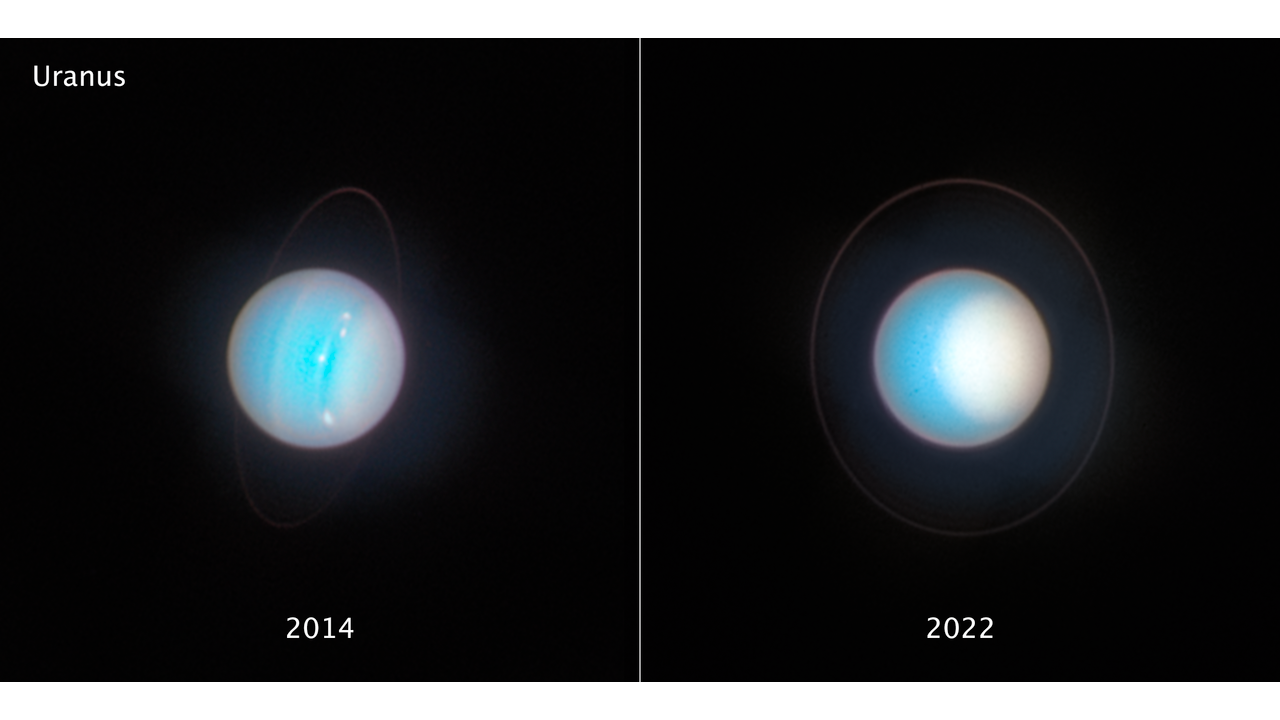
Planetary oddball Uranus rolls on its side around the Sun as it follows an 84-year orbit, rather than spinning in a more-vertical position as Earth does. Uranus has a weirdly tipped “horizontal” rotation axis angled just eight degrees off the plane of the planet’s orbit. A recent idea is that Uranus once had a massive moon that gravitationally destabilized it and then crashed into it. Other possibilities include giant impacts during planetary formation, or even giant planets exerting resonant torques on each other over time. The consequences of the planet’s tilt are that for stretches of time lasting up to 42 years, parts of one hemisphere are completely without sunlight. When the Voyager spacecraft visited during the 1980s the planet’s south pole was pointed almost directly at the Sun. Hubble’s latest view shows the northern pole now tipping toward the Sun. [left] This is a Hubble view of Uranus taken in 2014, seven years after northern spring equinox when the Sun was shining directly over the planet’s equator. [right] As seen in 2022, Uranus’ north pole is now capped by low methane humidity and a thickening photochemical haze that looks similar to the smog over cities. Several little storms can be seen near the edge of the polar haze boundary.
Image Credit: NASA, ESA, STScI, Amy Simon (NASA-GSFC), Michael H. Wong (UC Berkeley); Image Processing: Joseph DePasquale (STScI)
- X
https://science.nasa.gov/image-detail/amf-f146e11a-9b41-4abf-b2d5-055fd945cb48/
Image CreditNASA, ESA, STScI, Amy Simon (NASA-GSFC), Michael H. Wong (UC Berkeley); Image Processing: Joseph DePasquale (STScI)
Size1280x720px
