















Mission Studies
X-ray Astronomy Mission Concepts Study
2012 Architecting Study
A study initiated by NASA's Physics of the Cosmos Program to develop mission concepts that could meet some or all of the objectives outlined in the New Worlds, New Horizons decadal report.
About X-ray Astronomy Mission Concepts Study
New Mission Concepts to Meet New Objectives
The study began with the release of a formal Request for Information (RFI). In parallel, NASA released an open solicitation inviting members of the science community to participate in a Community Science Team (CST) for the X-ray mission.
A Physics of the Cosmos Program study team working with the CST identified the requirements relevant to each concept, defined the mission configuration options, executed mission design runs at mission design laboratories, refined the mission concepts, and drafted a mission concept study reports.
The X-ray Astronomy Mission Concepts Workshop about New Mission Concepts to Meet New Objectives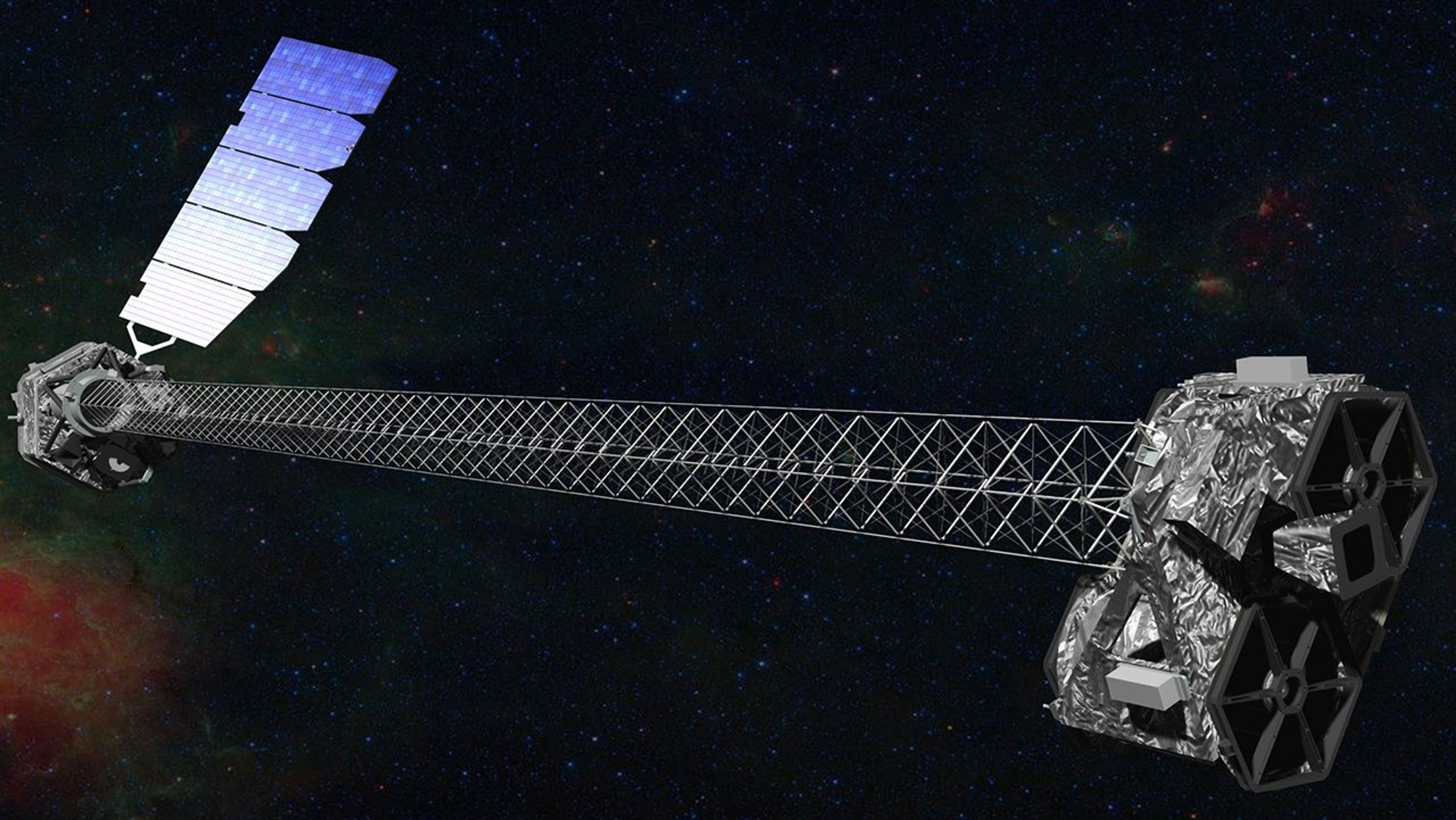
The Request for Information
The RFI, "Concepts for the Next NASA X-ray Astronomy Mission," was released on the NASA NSPIRES Web site on 13 September 2011, as solicitation number NNH11ZDA018L. Responses were due by 28 October 2011. The full text of this NASA research opportunity is posted at NASA NSPIRES web site.
Instrument Design Laboratory Studies
Instrument Design Laboratory (IDL) files under review
X-ray Mission Design Laboratory Studies
X-ray Mission Design Laboratory (MDL) files under review
The Community Science Team
NASA issued a call for Letters of Application for Membership in the Community Science Team for X-ray Astronomy Mission Concepts. The "Dear Colleague" letter can be found HERE. The deadline for responding was 19 October 2011 at 4:30pm EST.
Community Science Team Members
| Name | Institution |
|---|---|
| Mark Bautz | MIT |
| Stephen Murray | JHU |
| Joel Bregman (Chair) | Michigan |
| Paul Plucinsky | CfA |
| Dave Burrows | Penn State |
| Brian Ramsey | MSFC |
| Webster Cash | U Colorado |
| Ron Remillard | MIT |
| Christine Jones | CfA |
| Colleen Wilson-Hodge | MSFC |
A PhysCOS Program study team working with the CST identified the requirements relevant to each concept, defined the mission configuration options, executed mission design runs at mission design laboratories, refined the mission concepts, and drafted a mission concept study report.
Mission Concept Submissions in Response to the RFI
| Title | Submitted by | Presentation |
|---|---|---|
| ÆGIS — An Astrophysics Experiment for Grating and Imaging Spectroscopy | Bautz, Marshall | [PDF] |
| AXSIO — The Advanced X-ray Spectroscopic Imaging Observatory | Bookbinder, Jay | [PDF] |
| Development of Fast Readout Technology in Support of Future X-Ray Astronomy Missions | Burrows, David | [PDF] |
| The WHIMEx Mission Concept and Lessons Learned | Cash, Webster | [PDF] |
| Three Meter Capacity Diamond Turning Machine For X-Ray Telescope Components | Casstevens, John | [PDF] |
| Precision-Deployable, Stable, Optical Benches for Cost-Effective Space Telescopes | Danner, Rolf | [PDF] |
| REDUX: A Flexible Path for X-ray Astronomy | Elvis, Martin | [PDF] |
| EPE: The Extreme Physics Explorer | Garcia, Michael | [PDF] |
| A Hard X-Ray Telescope for an X-Ray Spectroscopy Mission, Extending the Bandwidth | Gorenstein, Paul | [PDF] |
| Epoch of Reionization Energetic X-ray Survey (EREXS) | Grindlay, Jonathan | [PDF] |
| The High Energy X-ray Probe (HEX-P) | Harrison, Fiona | [PDF] |
| Critical-Angle Transmission Gratings for High Resolution, Large Area Soft X-ray Spectroscopy | Heilmann, Ralf | [PDF] |
| Enabling Technologies for the High Resolution Imaging Spectrometer of the Next NASA X-ray Astronomy Mission: Options, Status, and Roadmap | Kilbourne, Caroline | [PDF] |
| Xenia: A Probe of Cosmic Chemical Evolution | Kouveliotou, Chryssa | [PDF] |
| The Black Hole Evolution and Space Time (BEST) Observatory | Krawczynski, Henric | [PDF] |
| The Warm-Hot Intergalactic Medium Explorer (WHIMex) | Lillie, Charles | [PDF] |
| Soft X-ray Polarimetry | Marshall, Herman | [PDF] |
| Reflection Grating Spectrometers | McEntaffer, Randall | [PDF] |
| Space Communication Rates at Multi-GBPS | McIntyre, Todd | [PDF] |
| Wide Field X-Ray Telescope Mission | Murray, Stephen | [PDF] |
| Active Pixel X-ray Sensor Technology Development for SMART-X Focal Plane | Murray, Stephen | [PDF] |
| SAHARA: Spectral Analysis with High Angular Resolution Astronomy | Mushotzky, Richard | [PDF] |
| Improving X-Ray Optics Through Differential Deposition | Ramsey, Brian | [PDF] |
| Super Mon & Black Hole Tracker | Rao, A.R. | [PDF] |
| The Advanced X-ray Timing Array (AXTAR) | Ray, Paul | [PDF] |
| 5-Stage Continuous ADR for Future X-Ray Missions | Shirron, Peter | [PDF] |
| Concept for an orbiting wide field X-ray imaging spectrometer (WFXIS) | Ullmer, Melvin | [PDF] |
| Improving the performance of X-ray optics with magnetostrictive films | Ullmer, Melvin | [PDF] |
| SMART-X, Square Meter, Arcsecond Resolution X-ray Telescope | Vikhlinin, Alexey | [PDF] |
| Next Generation X-ray Optics: High-resolution, Light-weight, and Low-cost | Zhang, William | [PDF] |
Downloads
The 2012 Architecting Studies
NASA's Physics of the Cosmos (PhysCOS) Program initiated two studies to develop mission concepts that could meet some or all of the objectives outlined in the New Worlds, New Horizons decadal report for the areas of X-ray astronomy and gravitational-wave science. The PhysCOS Program worked with these communities to define mission concepts that achieve these science objectives at multiple price points.
This began with the release of a formal Request for Information (RFI) on each topic. In parallel, NASA released an open solicitation inviting members of the science community to participate in a Community Science Team (CST) for the X-ray mission or the gravitational-wave mission. The Program Office worked with each CST to review the RFI responses. In December 2012, workshops, which were open to the community, were held to discuss the RFI responses and define the mission concepts to be studied.
A PhysCOS Program study team, working with each CST, identified the requirements relevant to each concept, defined the mission configuration options, executed mission design runs at mission design laboratories, refined the mission concepts, and drafted a mission concept study reports.
News Straight to Your Inbox
Subscribe to your community email news list
We will never share your email address.