


















Great Debates in Astronomy
Following in the footsteps of the famous April 1920 'Great Debate' between Harlow Shapley and Heber Curtis, this series of debates among leaders in the astronomical community highlight major quests in astronomy and astrophysics in an open forum at the turn of the millennium. Each of the 20th century debates were held in April in the Baird auditorium of the Smithsonian's Museum of Natural History, the site of the original 1920 Shapley - Curtis debate. This delightful auditorium's general appearance has remained remarkably constant since the 1920s. Its large, central ceiling electrolier is the debate series logo.
In a celebration of the 100th anniversary of the Shapley - Curtis debate, the 2020 Life in the Universe debate was held online (and non-live) with text and video contributions from many. The debate question was "How will humanity first discover extraterrestrial life?"
These pages feature background information, educational material, and published proceedings for each debate.
Great Debates
-
The Scale of the Universe (1920); Curtis, Shapley
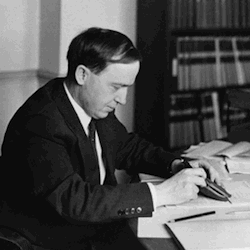
Although the `Great Debate' is important to different people for different reasons, it is a clear example of humanity once again striving to find its place within the cosmic order. "The Shapley-Curtis debate makes interesting reading even today. It is important, not only as a historical document, but also as a glimpse into the reasoning processes of eminent scientists engaged in a great controversy for which the evidence on both sides is fragmentary and partly faulty. This debate illustrates forcefully how tricky it is to pick one's way through the treacherous ground that characterizes research at the frontiers of science." (Shu, F., 1982, The Physical Universe, An Introduction to Astronomy, (University Science Books, Mill Valley, California) p. 286)
-
The Distance Scale to Gamma-ray Bursts (1995); Paczynski, Lamb
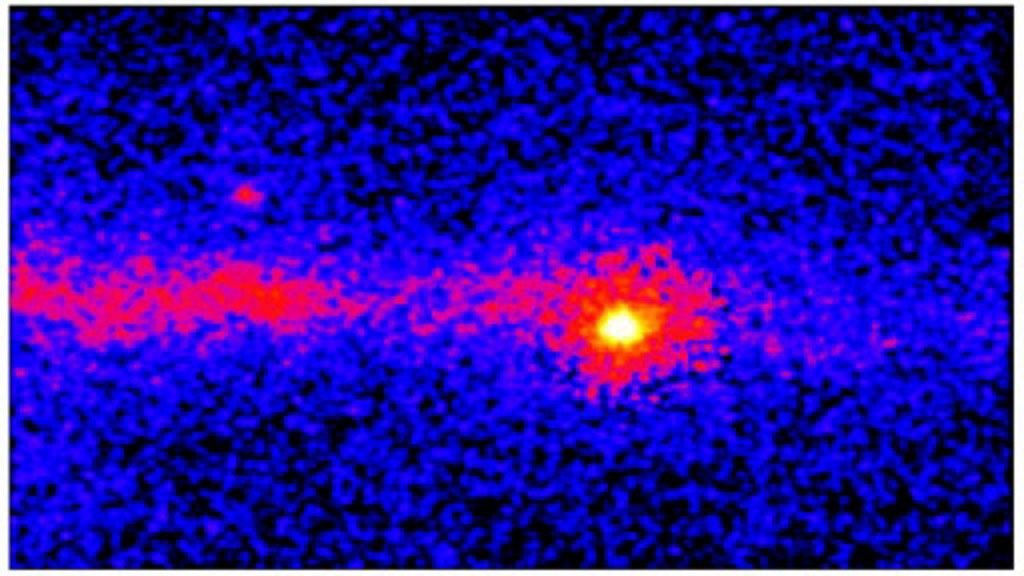
In April 1920, Harlow Shapley and Heber D. Curtis first debated The Scale of the Universe in the main auditorium of Smithsonian's Natural History Museum in Washington, DC. In April 1995, this debate was commemorated by holding another debate on a topic with marked similarities. In 1995, the distance scale to gamma-ray bursts were as uncertain as the distance scale to spiral nebulae was in 1920. Evidence appeared to be mounting that GRBs occur in our Galaxy, but conflicting evidence also appeared to be mounting that GRBs occur at cosmological distances.
-
The Scale of the Universe (1996); Tammann, van den Bergh
In April 1920, Harlow Shapley and Heber D. Curtis first debated The Scale of the Universe in the main auditorium of Smithsonian's Natural History Museum in Washington, DC. In April 1996, Sidney van den Bergh and Gustav A. Tammann again debated "The Scale of the Universe" in the same auditorium.
 The nebula, located 20,000 light-years away in the constellation Carina, contains a central cluster of huge, hot stars, called NGC 3603. This Hubble Space Telescope image was captured in August 2009 and December 2009 with the Wide Field Camera 3 in both visible and infrared light, which trace the glow of sulfur, hydrogen, and iron.NASA, ESA, R. O'Connell (University of Virginia), F. Paresce (National Institute for Astrophysics, Bologna, Italy), E. Young (Universities Space Research Association/Ames Research Center), the WFC3 Science Oversight Committee, and the Hubble Heritage Team (STScI/AURA)
 -
The Nature of the Universe (1998); Peebles, Turner
The 1998 debate subtitle was "Cosmology Solved?." The debate centered on recent controversies surrounding the determinations of Omega and Lambda, the mass density of the universe, and the corresponding geometry of the universe. At the 1998 debate, Peebles and Turner argued opposing points of view on whether recent measurements have solved the long standing quest for the determination of the major cosmological parameters and the large-scale geometry of our Universe.
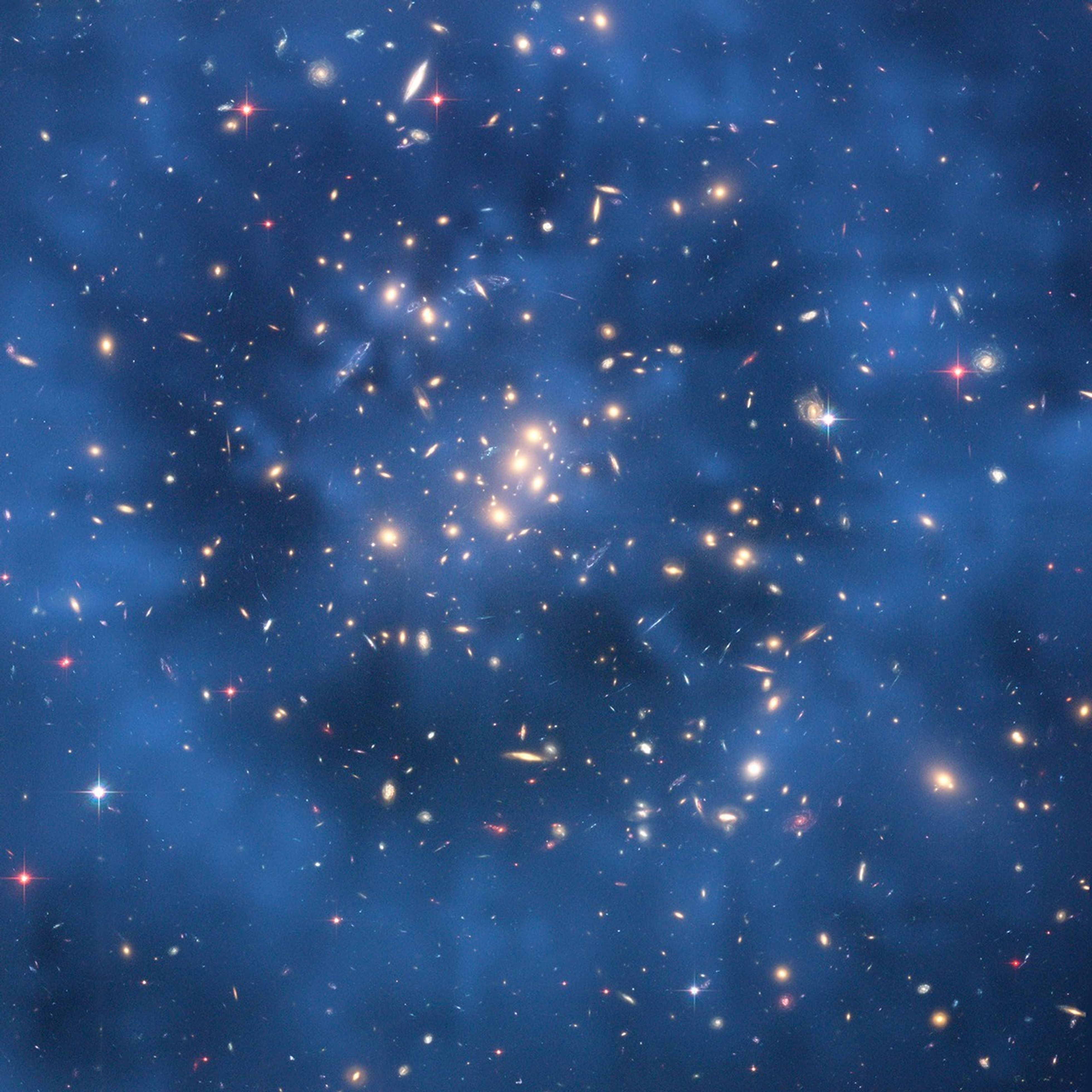 This Hubble Space Telescope composite image shows a ghostly "ring" of dark matter in the galaxy cluster ZwCl0024+1652.NASA, ESA, M.J. Jee and H. Ford (Johns Hopkins University)
 -
Life in the Universe (2020); Many contributors
This "Life in the Universe" debate in 2020 has a quite different format than the commemorated "Scale of the Universe" debate in 1920. Here, instead of just two debaters, several noted scientists are giving their "best guess" as to how ET life will first be discovered. One reason for this is because there are several possible ways that ET life may be discovered, not just two.
Why "Life in the Universe"? We feel this topic, as with the 1920 debate, is momentous, dividing the astronomical community, and carries a good possibility of being resolved within the next decade -- or two. The resolution of the 1920 debate helped define humanity's place in the universe physically. It seems to us that the resolution of the 2020 debate will help define humanity's place in the universe biologically.