
























7.3. How do we discover worlds around other stars?
A core learning question from the Astrobiology Learning Progressions
Astrobiology Learning Progressions Navigation


Grades K-2 or Adult Naive Learner
As we look into the night sky and see so many stars it’s also amazing to think about how many of those stars have planets. Maybe some of those planets are similar to the planets in our own solar system. Maybe some are even similar to our Earth.
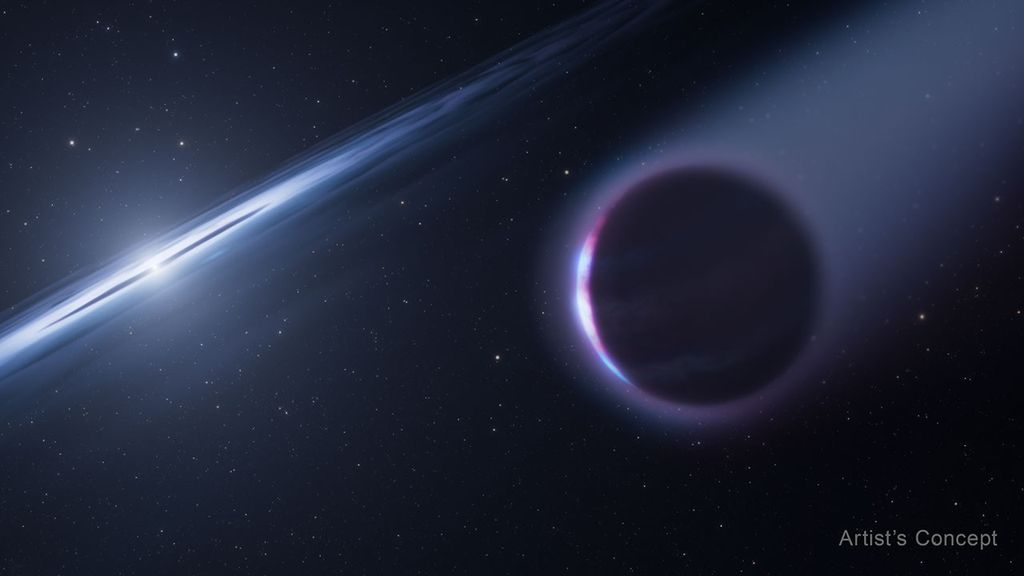
A planet that orbits a star other than our Sun is called an exoplanet. Telescopes can see stars very well, but seeing planets around other stars is actually pretty hard. However, there are ways for us to find out about something without seeing it directly. Sometimes, an exoplanet will move in front of its star. When this happens, it blocks a really small amount of the light from the star. And we can actually see that and it lets us know that there is an exoplanet there. Also, when planets orbit around stars, they tug and pull at the star and make it move around a little bit. We can also measure this and use it to find exoplanets!
We’ve now discovered thousands of exoplanets orbiting other stars, and we keep finding more and more all of the time. Most of them that we’ve found are really big planets, like Jupiter and Saturn, but we’re also finding planets that are smaller and closer to the size of Earth. Some of us even wonder if we might soon find an exoplanet that also has signs of life on it. Wouldn’t that be amazing?!
Disciplinary Core Ideas
PS3.A: Definitions of Energy: Temperature is a measure of the average kinetic energy of particles of matter. The relationship between the temperature and the total energy of a system depends on the types, states, and amounts of matter present. (MS-PS3-3, MS-PS3-4)
PS3.D: Energy in Chemical Processes and Everyday Life: The chemical reaction by which plants produce complex food molecules (sugars) requires an energy input (i.e., from sunlight) to occur. In this reaction, carbon dioxide and water combine to form carbon-based organic molecules and release oxygen.
LS2.C: Ecosystem Dynamics, Functioning, and Resilience: Biodiversity describes the variety of species found in Earth’s terrestrial and oceanic ecosystems. The completeness or integrity of an ecosystem’s biodiversity is often used as a measure of its health. (MS-LS2-5)
ESS1.A: The Universe and Its Stars: Patterns of the apparent motion of the Sun, the Moon, and stars in the sky can be observed, described, predicted, and explained with models. (MS-ESS1-1) ▪ Earth and its solar system are part of the Milky Way galaxy, which is one of many galaxies in the universe. (MS-ESS1-2)
ESS1.B: Earth and the Solar System: The solar system consists of the Sun and a collection of objects, including planets, their moons, and asteroids that are held in orbit around the Sun by its gravitational pull on them. (MS-ESS1-2, MS-ESS1-3)
ESS2.A: Earth’s Materials and Systems: All Earth processes are the result of energy flowing and matter cycling within and among the planet’s systems. This energy is derived from the Sun and Earth’s hot interior. The energy that flows and matter that cycles produce chemical and physical changes in Earth’s materials and living organisms. (MS-ESS2-1)
ESS2.C: The Roles of Water in Earth’s Surface Processes: Water continually cycles among land, ocean, and atmosphere via transpiration, evaporation, condensation and crystallization, and precipitation, as well as downhill flows on land. (MS-ESS2-4) ▪ Global movements of water and its changes in form are propelled by sunlight and gravity. (MS-ESS2-4)
ESS3.A: Natural Resources: Humans depend on Earth’s land, ocean, atmosphere, and biosphere for many different resources. Minerals, fresh water, and biosphere resources are limited, and many are not renewable or replaceable over human lifetimes. These resources are distributed unevenly around the planet as a result of past geologic processes. (MS-ESS3-1)
ESS2.D: Weather and Climate: Weather and climate are influenced by interactions involving sunlight, the ocean, the atmosphere, ice, landforms, and living things. These interactions vary with latitude, altitude, and local and regional geography, all of which can affect oceanic and atmospheric flow patterns. (MS-ESS2-6) ▪ The ocean exerts a major influence on weather and climate by absorbing energy from the Sun, releasing it over time, and globally redistributing it through ocean currents. (MS-ESS2-6)
Crosscutting Concepts
Patterns: Similarities and differences in patterns can be used to sort, classify, communicate and analyze simple rates of change for natural phenomena. (5-ESS1-2)
Scale, Proportion, and Quantity: Natural objects exist from the very small to the immensely large. (5-ESS1-1)
Big Ideas: Stars seen from Earth likely have planets surrounding them. Some of these planets have the potential to house life. Planets that orbit stars other than the Sun are called exoplanets. Exoplanets are very difficult to detect. Most exoplanets are really big like Jupiter, smaller exoplanets that are closer to the size of Earth have also been found.
Boundaries: At this level, the focus is on the variety of exoplanets, both in terms of their size and location.
No appropriate content for this grade level. Please use the navigation arrows to switch levels.

Grades 3-5 or Adult Emerging Learner
As we look into the night sky and see so many stars it’s also amazing to think about how many of those stars have planets. Maybe some of those planets are similar to the planets in our own solar system. Maybe some are even similar to our Earth.
A planet that orbits a star other than our Sun is called an exoplanet. Telescopes can see stars very well, but seeing planets around other stars is actually pretty hard. However, there are ways for us to find out about something without seeing it directly. Sometimes, an exoplanet will move in front of its star. When this happens, it blocks a really small amount of the light from the star. And we can actually see that and it lets us know that there is an exoplanet there. Also, when planets orbit around stars, they tug and pull at the star and make it move around a little bit. We can also measure this and use it to find exoplanets!
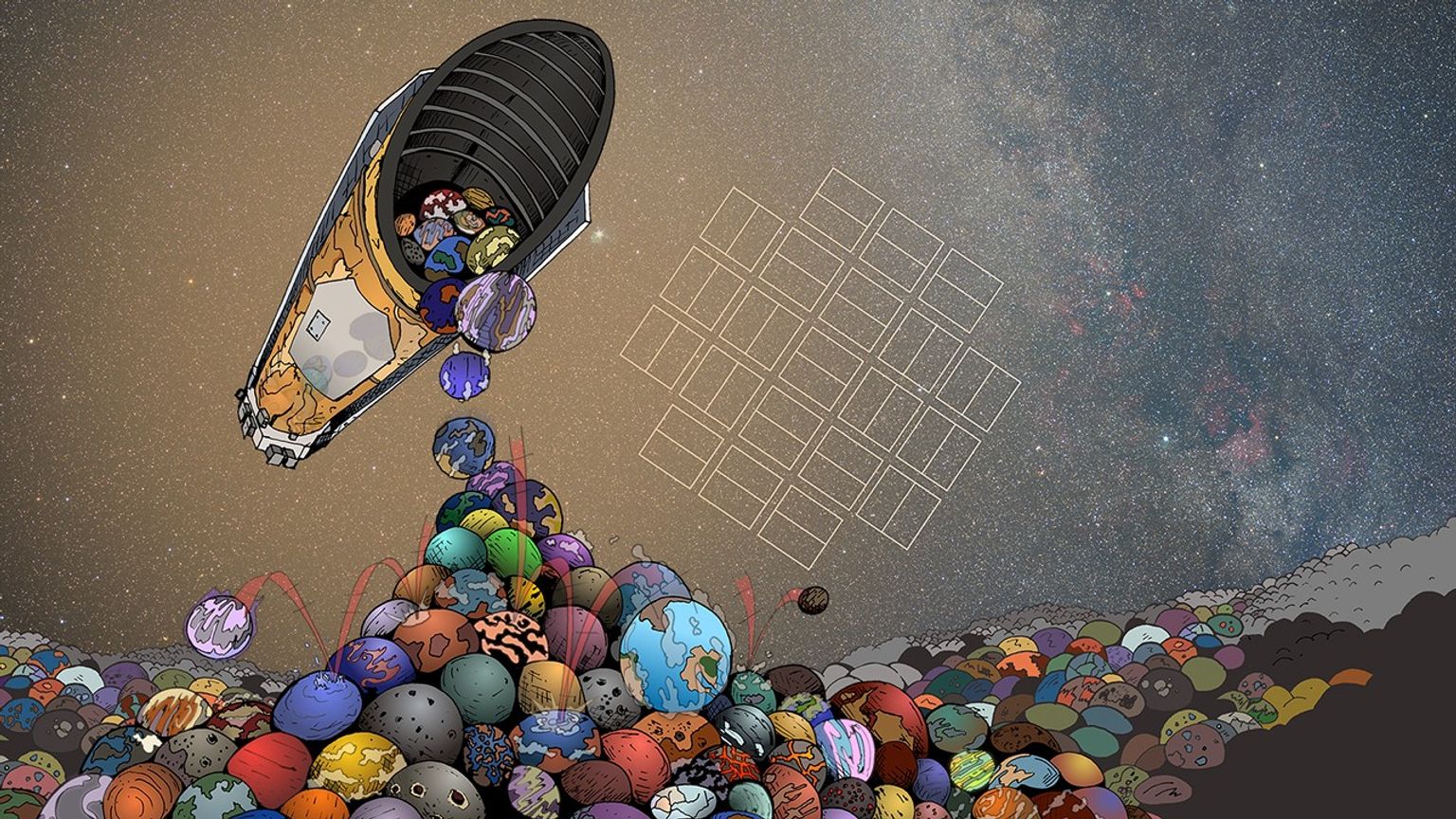
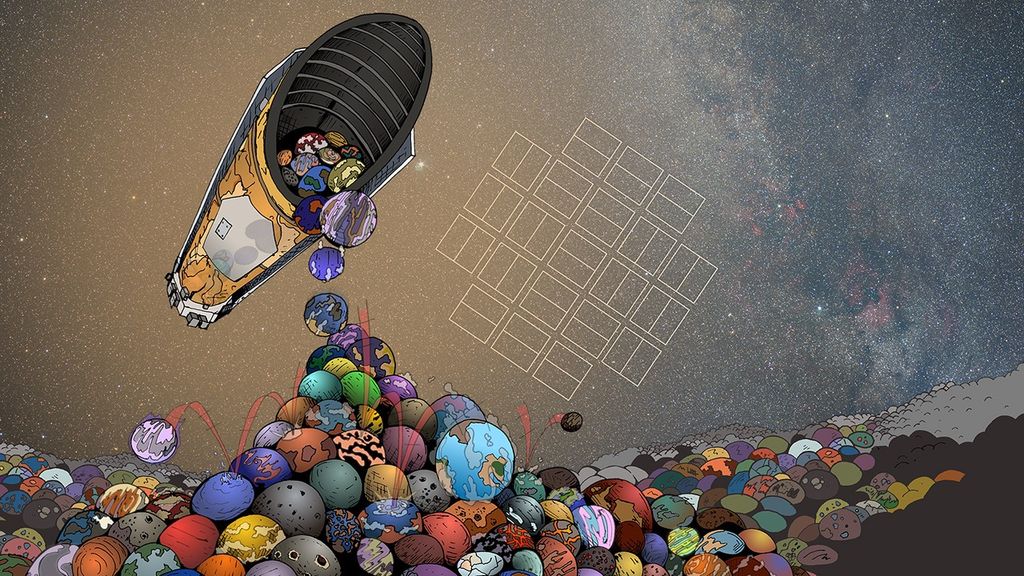
Most of the thousands of exoplanets that have been detected so far were found by the Kepler mission. Kepler was a space telescope that looked at just a very small region of the sky (if you hold your hand out with a straight arm at night and point it to the sky, the region covered by your hand is roughly the size of the area that Kepler was looking at!).
We’ve now discovered thousands of exoplanets orbiting other stars, and we keep finding more and more all of the time. Most of them that we’ve found are really big planets, like Jupiter and Saturn, but we’re also finding planets that are smaller and closer to the size of Earth. Some of us even wonder if we might soon find an exoplanet that also has signs of life on it. Wouldn’t that be amazing?!
Disciplinary Core Ideas
PS3.A: Definitions of Energy: Temperature is a measure of the average kinetic energy of particles of matter. The relationship between the temperature and the total energy of a system depends on the types, states, and amounts of matter present. (MS-PS3-3, MS-PS3-4)
PS3.D: Energy in Chemical Processes and Everyday Life: The chemical reaction by which plants produce complex food molecules (sugars) requires an energy input (i.e., from sunlight) to occur. In this reaction, carbon dioxide and water combine to form carbon-based organic molecules and release oxygen.
LS2.C: Ecosystem Dynamics, Functioning, and Resilience: Biodiversity describes the variety of species found in Earth’s terrestrial and oceanic ecosystems. The completeness or integrity of an ecosystem’s biodiversity is often used as a measure of its health. (MS-LS2-5)
ESS1.A: The Universe and Its Stars: Patterns of the apparent motion of the Sun, the Moon, and stars in the sky can be observed, described, predicted, and explained with models. (MS-ESS1-1) ▪ Earth and its solar system are part of the Milky Way galaxy, which is one of many galaxies in the universe. (MS-ESS1-2)
ESS1.B: Earth and the Solar System: The solar system consists of the Sun and a collection of objects, including planets, their moons, and asteroids that are held in orbit around the Sun by its gravitational pull on them. (MS-ESS1-2, MS-ESS1-3)
ESS2.A: Earth’s Materials and Systems: All Earth processes are the result of energy flowing and matter cycling within and among the planet’s systems. This energy is derived from the Sun and Earth’s hot interior. The energy that flows and matter that cycles produce chemical and physical changes in Earth’s materials and living organisms. (MS-ESS2-1)
ESS2.C: The Roles of Water in Earth’s Surface Processes: Water continually cycles among land, ocean, and atmosphere via transpiration, evaporation, condensation and crystallization, and precipitation, as well as downhill flows on land. (MS-ESS2-4) ▪ Global movements of water and its changes in form are propelled by sunlight and gravity. (MS-ESS2-4)
ESS3.A: Natural Resources: Humans depend on Earth’s land, ocean, atmosphere, and biosphere for many different resources. Minerals, fresh water, and biosphere resources are limited, and many are not renewable or replaceable over human lifetimes. These resources are distributed unevenly around the planet as a result of past geologic processes. (MS-ESS3-1)
ESS2.D: Weather and Climate: Weather and climate are influenced by interactions involving sunlight, the ocean, the atmosphere, ice, landforms, and living things. These interactions vary with latitude, altitude, and local and regional geography, all of which can affect oceanic and atmospheric flow patterns. (MS-ESS2-6) ▪ The ocean exerts a major influence on weather and climate by absorbing energy from the Sun, releasing it over time, and globally redistributing it through ocean currents. (MS-ESS2-6)
Crosscutting Concepts
Patterns: Similarities and differences in patterns can be used to sort, classify, communicate and analyze simple rates of change for natural phenomena. (5-ESS1-2)
Scale, Proportion, and Quantity: Natural objects exist from the very small to the immensely large. (5-ESS1-1)
Big Ideas: Stars seen from Earth likely have planets surrounding them. Some of these planets have the potential to house life. Planets that orbit stars other than the Sun are called exoplanets. Exoplanets are very difficult to detect. Most exoplanets are really big like Jupiter, smaller exoplanets that are closer to the size of Earth have also been found.
Boundaries: At this level, the focus is on the variety of exoplanets, both in terms of their size and location.
3-5 SpaceMath Problem 465: Comparing Planets Orbiting other Stars. Students use simple fraction arithmetic to determine the relative sizes of several new planets recently discovered by the Kepler mission, and compare these sizes to that of Jupiter and Earth. [Topics: scale models; proportions; fractions] https://spacemath.gsfc.nasa.gov/astrob/8Page41.pdf
4-6 SpaceMath Problem 325: Kepler Spies Five New Planets. Students count squares on a Bizarro Star to study the transit of a planet, and determine the diameter of the planet. This demonstrates the basic principle used by NASA ’s Kepler satellite to search for Earth-sized planets orbiting distant stars. [Topics: counting; graphing; area of a square] https://spacemath.gsfc.nasa.gov/astrob/6Page113.pdf
5-12 Exoplanet Travel Bureau. . Downloadable posters and visuals of the surface. A charming combination of gorgeous posters that depict images of travel to worlds orbiting stars other than our own Sun and artist renditions of what it would look like to stand on these distant worlds. Just as mid-century travel posters enticed would-be travelers to exotic locales such as the islands of the Caribbean and South Pacific, we are similarly beckoned to consider places beyond our imagination – beyond our Solar System! NASA . https://exoplanets.nasa.gov/alien-worlds/exoplanet-travel-bureau/
5-12 Eyes on Exoplanets. . Get set for launch with this web interactive. “Eyes on Exoplanets” flies you to any planet you wish—as long as it’s far beyond our solar system. This fully rendered 3D universe is scientifically accurate, allowing you to zoom in for a close look at more than 1,000 exotic planets known to orbit distant stars. Highly interactive and immersive, students let their curiosity guide them into the wonderful world of exoplanets and their stars. Students can find facts, hypothesize patterns and explore the habitable zone of each star system. JPL /NASA. https://eyes.jpl.nasa.gov/eyes-on-exoplanets.html
5-12 Astrobiology Graphic Histories. Issue 6: Living Beyond the Solar System. 7.4. These astrobiology related graphic books are ingenious and artfully created to tell the story of astrobiology in a whole new way. The complete series illustrates the backbone of astrobiology from extremophiles, to exploration within and beyond the solar system. This issue reaches out beyond the Solar System to explore life’s potential on worlds that orbit distant stars. In recent decades, astronomers have discovered a huge number of such worlds known as exoplanets. NASA . https://astrobiology.nasa.gov/resources/graphic-histories/
Grades 6-8 or Adult Building Learner
As we look into the night sky and see so many stars, it’s also amazing to think about how many of those stars have planets. Maybe some of those planets are similar to the planets in our own solar system. Maybe some are even similar to our Earth. A planet that orbits another star is called an exoplanet. Telescopes can see stars very well, but seeing planets around other stars is actually pretty hard. The light that comes from a planet is mostly reflected starlight and that little bit is overwhelmed by the amount of light coming from the star. But we can observe some exoplanets directly, especially younger planets that are a little further from their stars. That’s because younger planets emit more infrared light for us to see and if they’re a little further away from their star then the starlight isn’t so overwhelming. Still, the list of planets we’ve observed directly is only a small fraction of the thousands of exoplanets that we’ve found.
How do we find most exoplanets without seeing them directly? Sometimes an exoplanet will move in front of its star. When this happens, it blocks a very small amount of the light from the star. And we can actually see that and it lets us know that there is an exoplanet there. This is the main way that we’ve found exoplanets so far. However, we can also look for exoplanets by seeing how they tug and pull at their stars. It turns out that stars appear to wobble a little bit due to the way that gravity causes them to interact with their planets (our Earth makes our own Sun wobble, but just a very little bit). We can measure this interaction and use it to infer the presence of exoplanets.
Most of the thousands of exoplanets that have been detected so far were found by the Kepler mission. Kepler was a space telescope that looked at just a very small region of the sky (if you hold your hand out with a straight arm at night and point it to the sky, the region covered by your hand is roughly the size of the area that Kepler was looking at!). By measuring the light from around 100,000 stars all at once for a long time, scientists were able to use transit photometry to find a large number of exoplanets.
We’ve now discovered thousands of exoplanets orbiting other stars, and we keep finding more and more all of the time. Most of them that we’ve found are really big planets, like Jupiter and Saturn, but we’re also finding planets that are smaller and closer to the size of Earth. Some of us even wonder if we might soon find an exoplanet that also has signs of life on it. Wouldn’t that be amazing?!
Disciplinary Core Ideas
PS3.A: Definitions of Energy: Temperature is a measure of the average kinetic energy of particles of matter. The relationship between the temperature and the total energy of a system depends on the types, states, and amounts of matter present. (MS-PS3-3, MS-PS3-4)
PS3.D: Energy in Chemical Processes and Everyday Life: The chemical reaction by which plants produce complex food molecules (sugars) requires an energy input (i.e., from sunlight) to occur. In this reaction, carbon dioxide and water combine to form carbon-based organic molecules and release oxygen.
LS2.C: Ecosystem Dynamics, Functioning, and Resilience: Biodiversity describes the variety of species found in Earth’s terrestrial and oceanic ecosystems. The completeness or integrity of an ecosystem’s biodiversity is often used as a measure of its health. (MS-LS2-5)
ESS1.A: The Universe and Its Stars: Patterns of the apparent motion of the Sun, the Moon, and stars in the sky can be observed, described, predicted, and explained with models. (MS-ESS1-1) ▪ Earth and its solar system are part of the Milky Way galaxy, which is one of many galaxies in the universe. (MS-ESS1-2)
ESS1.B: Earth and the Solar System: The solar system consists of the Sun and a collection of objects, including planets, their moons, and asteroids that are held in orbit around the Sun by its gravitational pull on them. (MS-ESS1-2, MS-ESS1-3)
ESS2.A: Earth’s Materials and Systems: All Earth processes are the result of energy flowing and matter cycling within and among the planet’s systems. This energy is derived from the Sun and Earth’s hot interior. The energy that flows and matter that cycles produce chemical and physical changes in Earth’s materials and living organisms. (MS-ESS2-1)
ESS2.C: The Roles of Water in Earth’s Surface Processes: Water continually cycles among land, ocean, and atmosphere via transpiration, evaporation, condensation and crystallization, and precipitation, as well as downhill flows on land. (MS-ESS2-4) ▪ Global movements of water and its changes in form are propelled by sunlight and gravity. (MS-ESS2-4)
ESS3.A: Natural Resources: Humans depend on Earth’s land, ocean, atmosphere, and biosphere for many different resources. Minerals, fresh water, and biosphere resources are limited, and many are not renewable or replaceable over human lifetimes. These resources are distributed unevenly around the planet as a result of past geologic processes. (MS-ESS3-1)
ESS2.D: Weather and Climate: Weather and climate are influenced by interactions involving sunlight, the ocean, the atmosphere, ice, landforms, and living things. These interactions vary with latitude, altitude, and local and regional geography, all of which can affect oceanic and atmospheric flow patterns. (MS-ESS2-6) ▪ The ocean exerts a major influence on weather and climate by absorbing energy from the Sun, releasing it over time, and globally redistributing it through ocean currents. (MS-ESS2-6)
Crosscutting Concepts
Patterns: Patterns can be used to identify cause and effect relationships. (MS-ESS1-1)
Scale, Proportion, and Quantity: Time, space, and energy phenomena can be observed at various scales using models to study systems that are too large or too small. (MS-ESS1-3)
Big Ideas: Planets that orbit stars other than the Sun are called exoplanets. Stars seen from Earth likely have many planets in orbit around them. Some of these planets have the potential to house life. Exoplanets are very difficult to detect. Most of the exoplanets discovered are really big like Jupiter. Smaller exoplanets that are closer to the size of Earth have also been found. There have been more than 3,700 exoplanets discovered so far and that number is growing. Exoplanets vary greatly in size and distance to their Suns.
Boundaries: At this level, the discussion can focus on the exoplanets, where they have been found, and how we think we know about their characteristics.
4-6 SpaceMath Problem 325: Kepler Spies Five New Planets. Students count squares on a Bizarro Star to study the transit of a planet, and determine the diameter of the planet. This demonstrates the basic principle used by NASA ’s Kepler satellite to search for Earth-sized planets orbiting distant stars. [Topics: counting; graphing; area of a square] https://spacemath.gsfc.nasa.gov/astrob/6Page113.pdf
5-12 Exoplanet Travel Bureau. . Downloadable posters and visuals of the surface. A charming combination of gorgeous posters that depict images of travel to worlds orbiting stars other than our own Sun and artist renditions of what it would look like to stand on these distant worlds. Just as mid-century travel posters enticed would-be travelers to exotic locales such as the islands of the Caribbean and South Pacific, we are similarly beckoned to consider places beyond our imagination – beyond our Solar System! NASA . https://exoplanets.nasa.gov/alien-worlds/exoplanet-travel-bureau/
5-12 Eyes on Exoplanets. . Get set for launch with this web interactive. “Eyes on Exoplanets” flies you to any planet you wish—as long as it’s far beyond our solar system. This fully rendered 3D universe is scientifically accurate, allowing you to zoom in for a close look at more than 1,000 exotic planets known to orbit distant stars. Highly interactive and immersive, students let their curiosity guide them into the wonderful world of exoplanets and their stars. Students can find facts, hypothesize patterns and explore the habitable zone of each star system. JPL /NASA. https://eyes.jpl.nasa.gov/eyes-on-exoplanets.html
5-12 Astrobiology Graphic Histories. Issue 6: Living Beyond the Solar System. 7.4. These astrobiology related graphic books are ingenious and artfully created to tell the story of astrobiology in a whole new way. The complete series illustrates the backbone of astrobiology from extremophiles, to exploration within and beyond the solar system. This issue reaches out beyond the Solar System to explore life’s potential on worlds that orbit distant stars. In recent decades, astronomers have discovered a huge number of such worlds known as exoplanets. NASA . https://astrobiology.nasa.gov/resources/graphic-histories/
6-8 SpaceMath Problem 213: Kepler: The hunt for Earth-like planets. Students compare the area of a star with the area of a planet to determine how the star’s light is dimmed when the planet passes across the star as viewed from Earth. This is the basis for the ‘transit’ method used by NASA ’s Kepler satellite to detect new planets. [Topics: area of circle; ratios; percents] https://spacemath.gsfc.nasa.gov/astrob/5Page87.pdf
6-8 SpaceMath Problem 405: Discovering Earth-like Worlds by their Color. Students use recent measurements of the reflected light from solar system bodies to graph their colors and to use this in classifying new planets as Earth-like, moon-like or Jupiter-like [Topics: graphing tabular data; interpreting graphical data] https://spacemath.gsfc.nasa.gov/astrob/7Page68.pdf
6-8 SpaceMath Problem 360: Kepler’s First Look at 700 Transiting Planets. A statistical study of the 700 transits seen during the first 43 days of the mission. [Topics: percentages; area of circle] https://spacemath.gsfc.nasa.gov/astrob/7Page7.pdf
6-9 Rising Stargirls Teaching and Activity Handbook. Design your own exoplanet (page 37). In this activity, students think creatively and critically about the types of exoplanets that may exist, what planets might look like and why, and what elements of a planet might be conducive to life or detrimental to life. Rising Stargirls is a 10-day workshop dedicated to encouraging girls of all backgrounds to learn, explore, and discover the universe through interactive astronomy using theater, writing, and visual art. This provides an avenue for individual self-expression and personal exploration that is interwoven with scientific engagement and discovery. Rising Stargirls. https://static1.squarespace.com/static/54d01d6be4b07f8719d7f29e/t/5748c58ec2ea517f705c7cc6/1464386959806/Rising_Stargirls_Teaching_Handbook.compressed.pdf
6-9 Planet Hunters Education Guide. Lesson 4: Exoplanet detection. (page 53). In this lesson, students first engage in an activity that offers an opportunity to use various methods of observation to identify an object without being able to directly observe it with their eyes. Next, students are asked to research and present to the class one of the direct or indirect methods that scientists use to detect planets around distant stars. This lesson is part of a nine lesson unit that takes learners through engaging activities that feature habitability, identifying and characterizing exoplanets, and citizen science. NASA . https://s3.amazonaws.com/zooniverse-resources/zoo-teach/production/uploads/resource/attachment/122/Planet_Hunters_Educator_Guide.pdf
6-10 SpaceMath Problem 197: Hubble Sees a Distant Planet. Students study an image of the dust disk around the star Fomalhaut and determine the orbit period and distance of a newly-discoveblack planet orbiting this young star. [Topics: calculating image scales; circle circumferences; unit conversions; distance-speed-time] https://spacemath.gsfc.nasa.gov/astrob/5Page62.pdf
6-12 Astrobiology Math. This collection of math problems provides an authentic glimpse of modern astrobiology science and engineering issues, often involving actual research data. Students explore concepts in astrobiology through calculations. Relevant topics include Kepler-The hunt for Earth-like planets (page 63) and Earth-like Planets by the Score! (page 69). NASA . https://www.nasa.gov/pdf/637832main_Astrobiology_Math.pdf
6-12 Science Fiction Stories with Good Astronomy & Physics: A Topical List: Exoplanets. 7.3 The Astronomical Society of the Pacific created this list of short stories and novels that use more or less accurate science and can be used for teaching or reinforcing astronomy or physics concepts including planets orbiting other stars. https://astrosociety.org/file_download/inline/621a63fc-04d5-4794-8d2b-38e7195056e9
8-10 SpaceMath Problem 458: Playing Baseball on the Earth-like Planet Kepler-22b! The recently-confirmed Earth-like planet Kepler-22b by the Kepler Observatory is a massive planet orbiting its star in the temperature zone suitable for liquid water. This problem explores the gravity and mass of this planet, and some implications for playing baseball on its surface! [Topics: scale models; proportions; scientific notation; metric math; evaluating equations] https://spacemath.gsfc.nasa.gov/astrob/8Page31.pdf
8-12 SpaceMath Problem 333: Hubble: Seeing a Dwarf Planet Clearly. Based on a recent press release, students use the published photos to determine the sizes of the smallest discernible features and compare them to the sizes of the 48 states in the USA . They also estimate the density of Pluto and compare this to densities of familiar substances to create a “model” of Pluto’s composition. A supplementary Inquiry Problem asks students to model the interior in terms of two components and estimate what fraction of Pluto is composed of rock or ice. [Topics: scales and ratios; volume of sphere; density=mass/volume] https://spacemath.gsfc.nasa.gov/astrob/6Page143.pdf
Grades 9-12 or Adult Sophisticated Learner
As we look into the night sky and see so many stars, it’s also amazing to think about how many of those stars have planets. Maybe some of those planets are similar to the planets in our own solar system. Maybe some are even similar to our Earth. A planet that orbits another star is called an exoplanet. Telescopes can see stars very well, but seeing planets around other stars is actually pretty hard. The light that comes from a planet is mostly reflected starlight and that little bit is overwhelmed by the amount of light coming from the star. But we can observe some exoplanets directly, especially younger planets that are a little further from their stars. That’s because younger planets emit more infrared light for us to see and if they’re a little further away from their star then the starlight isn’t so overwhelming. Still, the list of planets we’ve observed directly is only a small fraction of the thousands of exoplanets that we’ve found.
How do we find most exoplanets without seeing them directly? There are several ways to find exoplanets without seeing them directly, but the two that we’ve used to find the most planets so far are called “transit photometry” and “Doppler spectroscopy.” Transit photometry is used to measure how a planet blocks a star’s light. We call the passage of a planetary body (or even a spacecraft or satellite) in front of a star a “transit”, and the word “photometry” implies that we’re measuring light (light exists as discrete units of energy called “photons”). Transit photometry is a tool that we use to measure how a transiting exoplanet changes the measured light from its star. We’ve actually gotten quite good at measuring the little dip in the amount of light coming from a star when a planet passes in front of it. The other main method we’ve used for finding planets so far is Doppler spectroscopy (also called the “radial velocity” method). If you’ve ever heard a firetruck coming down the street, did you notice how the sound appeared to change from when the firetruck was coming toward you to when it was going away from you? The sound is a little higher in pitch as it comes toward you and a little bit lower as it travels away. The same thing happens with the cars at a racetrack. This is called the Doppler effect. And it turns out that it works for waves of light just as it does for sound. When something that emits light is moving toward you, it causes the light to be a little bit high pitched (to have a little bit more energy). If something emitting light is moving away from you, the light appears to have a little bit less energy. Blue visible light has the most energy of the colors of the rainbow and red visible light has the lowest. Because of this, we call the light that appears with a little bit more energy “blue-shifted” and the light with apparently a little less energy “red-shifted.” These shifts in the apparent energies of light allow us to measure the motions of stars and galaxies. We’ve used this “shifting” of light to determine that our universe is expanding andt to detect the presence of exoplanets. In Doppler spectroscopy, we measure small changes in the energy of light coming from a star that’s being tugged on by its planets. It turns out that stars appear to wobble a little bit due to the way that gravity causes them to interact with their planets. The bigger the planet, the more it causes the star to appear to wobble. In our solar system, Earth makes our own Sun wobble, but not nearly as much as Jupiter. We can detect the blue-shifting and red-shifting from planets causing their stars to wobble and we can even measure how big the planets must be based on how much the star wobbles. It’s really rather incredible!
Most of the thousands of exoplanets that have been detected so far were found by the Kepler mission. Kepler was a space telescope that looked at just a very small region of the sky (if you hold your hand out with a straight arm at night and point it to the sky, the region covered by your hand is roughly the size of the area that Kepler was looking at!). By measuring the light from around 100,000 stars all at once for a long time, scientists were able to use transit photometry to find a large number of exoplanets. However, there’s also an issue with this method that we call “observational bias.” Observational bias is when your method of measurement causes you to only be looking at a smaller number of the possible things you could be looking at. For instance, if you wanted to measure the number of people who visit a museum in one day, but your method is to count the number of adult tickets that were sold, you’d have an observational bias toward only the adult visitors and you’d be missing out on children, senior citizens, and other special kinds of tickets that museums sell or give away. With the Kepler mission, we had an observational bias toward exoplanets that were very big and that were very close to their stars. Many of the planets found early on have been about the size of Jupiter (and even bigger) and are very close to their stars (where there’s more radiation) so we’ve called them ‘Hot Jupiters’. The reason for this bias is that planets that are close to their star cause the dips in the light to happen more often, so we have more data to use to make a detection. The bigger the world, the more light that it blocks, making it easier for us to tell that there’s a planet from the data. Even with the biases that we’ve had so far, we’re starting to make more and more detections of smaller exoplanets and exoplanets that are further from their stars. We’ve discovered rocky planets that are bigger than Earth (known as super-earths), and we’re starting to discover more Earth-sized exoplanets. These detections are making many of us wonder if we might soon find an exoplanet that also has signs of life on it. Wouldn’t that be amazing?!
Disciplinary Core Ideas
SS1.A: The Universe and Its Stars: The star called the Sun is changing and will burn out over a lifespan of approximately 10 billion years. (HS-ESS1-1) ▪ The study of stars’ light spectra and brightness is used to identify compositional elements of stars, their movements, and their distances from Earth. (HS-ESS1-2, HS-ESS1-3)
SS1.B: Earth and the Solar System: Kepler’s laws describe common features of the motions of orbiting objects, including their elliptical paths around the Sun. Orbits may change due to the gravitational effects from, or collisions with, other objects in the solar system. (HS-ESS1-4)
PS3.A: Definitions of Energy: Energy is a quantitative property of a system that depends on the motion and interactions of matter and radiation within that system. That there is a single quantity called energy is due to the fact that a system’s total energy is conserved, even as, within the system, energy is continually transferred from one object to another and between its various possible forms. (HS-PS3-1, HS-PS3-2) At the macroscopic scale, energy manifests itself in multiple ways, such as in motion, sound, light, and thermal energy. (HS-PS3-2, HS-PS3-3) ▪ These relationships are better understood at the microscopic scale, at which all of the different manifestations of energy can be modeled as a combination of energy associated with the motion of particles and energy associated with the configuration (relative position of the particles). In some cases, the relative position energy can be thought of as stored in fields (which mediate interactions between particles). This last concept includes radiation, a phenomenon in which energy stored in fields moves across space. (HS-PS3-2)
PS4.B: Electromagnetic Radiation: Electromagnetic radiation (e.g., radio, microwaves, light) can be modeled as a wave of changing electric and magnetic fields or as particles called photons. The wave model is useful for explaining many features of electromagnetic radiation, and the particle model explains other features. (HS-PS4-3) ▪ When light or longer wavelength electromagnetic radiation is absorbed in matter, it is generally converted into thermal energy (heat). Shorter wavelength electromagnetic radiation (ultraviolet, X-rays, gamma rays) can ionize atoms and cause damage to living cells. (HS-PS4-4) ▪ Photoelectric materials emit electrons when they absorb light of a high-enough frequency. (HS-PS4-5)
PS4.C: Information Technologies and Instrumentation: Multiple technologies based on the understanding of waves and their interactions with matter are part of everyday experiences in the modern world (e.g., medical imaging, communications, scanners) and in scientific research. They are essential tools for producing, transmitting, and capturing signals and for storing and interpreting the information contained in them. (HS-PS4-5)
Crosscutting Concepts
Scale, Proportion, and Quantity: The significance of a phenomenon is dependent on the scale, proportion, and quantity at which it occurs. (HS-ESS1-1)
Big Ideas: Planets that orbit stars other than the Sun are called exoplanets. Stars seen from Earth likely have many planets in orbit around them. Some of these planets have the potential to house life. Most of the exoplanets discovered are quite large like Jupiter. Smaller exoplanets that are closer to the size of Earth have also been found. There have been more than 3,700 exoplanets discovered so far and that number is growing. Exoplanets vary greatly in size and distance to their Suns. Exoplanets are very difficult to detect and most have to be found without seeing them directly. Transit photometry is a tool that is used to measure how a transiting exoplanet changes the measured light from its star. Doppler spectroscopy (or the “radial velocity” method) uses shifting of light to detect the presence of exoplanets. It measure small changes in the energy of light coming from a star that’s being tugged on by its planets. Most exoplanets that have been detected were found by the Kepler Mission. Kepler was a space telescope that looked at a very small region of the sky and measured the light from around 100,000 stars all at once over an extended period of time.
Boundaries: Students in this grade band begin to use astronomical evidence of light spectra, motion of distant galaxies, and composition of matter in the universe. Emphasis is on the astronomical evidence of the red shift of light from galaxies as an indication that the universe is currently expanding, the cosmic microwave background as the remnant radiation from the big bang, and the observed composition of ordinary matter of the universe, primarily found in stars and interstellar gases.
5-12 Exoplanet Travel Bureau. . Downloadable posters and visuals of the surface. A charming combination of gorgeous posters that depict images of travel to worlds orbiting stars other than our own Sun and artist renditions of what it would look like to stand on these distant worlds. Just as mid-century travel posters enticed would-be travelers to exotic locales such as the islands of the Caribbean and South Pacific, we are similarly beckoned to consider places beyond our imagination – beyond our Solar System! NASA . https://exoplanets.nasa.gov/alien-worlds/exoplanet-travel-bureau/
5-12 Eyes on Exoplanets. . Get set for launch with this web interactive. “Eyes on Exoplanets” flies you to any planet you wish—as long as it’s far beyond our solar system. This fully rendered 3D universe is scientifically accurate, allowing you to zoom in for a close look at more than 1,000 exotic planets known to orbit distant stars. Highly interactive and immersive, students let their curiosity guide them into the wonderful world of exoplanets and their stars. Students can find facts, hypothesize patterns and explore the habitable zone of each star system. JPL /NASA. https://eyes.jpl.nasa.gov/eyes-on-exoplanets.html
5-12 Astrobiology Graphic Histories. Issue 6: Living Beyond the Solar System. 7.4. These astrobiology related graphic books are ingenious and artfully created to tell the story of astrobiology in a whole new way. The complete series illustrates the backbone of astrobiology from extremophiles, to exploration within and beyond the solar system. This issue reaches out beyond the Solar System to explore life’s potential on worlds that orbit distant stars. In recent decades, astronomers have discovered a huge number of such worlds known as exoplanets. NASA . https://astrobiology.nasa.gov/resources/graphic-histories/
6-9 Rising Stargirls Teaching and Activity Handbook. Design your own exoplanet (page 37). In this activity, students think creatively and critically about the types of exoplanets that may exist, what planets might look like and why, and what elements of a planet might be conducive to life or detrimental to life. Rising Stargirls is a 10-day workshop dedicated to encouraging girls of all backgrounds to learn, explore, and discover the universe through interactive astronomy using theater, writing, and visual art. This provides an avenue for individual self-expression and personal exploration that is interwoven with scientific engagement and discovery. Rising Stargirls. https://static1.squarespace.com/static/54d01d6be4b07f8719d7f29e/t/5748c58ec2ea517f705c7cc6/1464386959806/Rising_Stargirls_Teaching_Handbook.compressed.pdf
6-9 Planet Hunters Education Guide. Lesson 4: Exoplanet detection. (page 53). In this lesson, students first engage in an activity that offers an opportunity to use various methods of observation to identify an object without being able to directly observe it with their eyes. Next, students are asked to research and present to the class one of the direct or indirect methods that scientists use to detect planets around distant stars. This lesson is part of a nine lesson unit that takes learners through engaging activities that feature habitability, identifying and characterizing exoplanets, and citizen science. NASA . https://s3.amazonaws.com/zooniverse-resources/zoo-teach/production/uploads/resource/attachment/122/Planet_Hunters_Educator_Guide.pdf
6-10 SpaceMath Problem 197: Hubble Sees a Distant Planet. Students study an image of the dust disk around the star Fomalhaut and determine the orbit period and distance of a newly-discoveblack planet orbiting this young star. [Topics: calculating image scales; circle circumferences; unit conversions; distance-speed-time] https://spacemath.gsfc.nasa.gov/astrob/5Page62.pdf
6-12 Astrobiology Math. This collection of math problems provides an authentic glimpse of modern astrobiology science and engineering issues, often involving actual research data. Students explore concepts in astrobiology through calculations. Relevant topics include Kepler-The hunt for Earth-like planets (page 63) and Earth-like Planets by the Score! (page 69). NASA . https://www.nasa.gov/pdf/637832main_Astrobiology_Math.pdf
6-12 Science Fiction Stories with Good Astronomy & Physics: A Topical List: Exoplanets. 7.3 The Astronomical Society of the Pacific created this list of short stories and novels that use more or less accurate science and can be used for teaching or reinforcing astronomy or physics concepts including planets orbiting other stars. https://astrosociety.org/file_download/inline/621a63fc-04d5-4794-8d2b-38e7195056e9
8-10 SpaceMath Problem 458: Playing Baseball on the Earth-like Planet Kepler-22b! The recently-confirmed Earth-like planet Kepler-22b by the Kepler Observatory is a massive planet orbiting its star in the temperature zone suitable for liquid water. This problem explores the gravity and mass of this planet, and some implications for playing baseball on its surface! [Topics: scale models; proportions; scientific notation; metric math; evaluating equations] https://spacemath.gsfc.nasa.gov/astrob/8Page31.pdf
8-12 SpaceMath Problem 333: Hubble: Seeing a Dwarf Planet Clearly. Based on a recent press release, students use the published photos to determine the sizes of the smallest discernible features and compare them to the sizes of the 48 states in the USA . They also estimate the density of Pluto and compare this to densities of familiar substances to create a “model” of Pluto’s composition. A supplementary Inquiry Problem asks students to model the interior in terms of two components and estimate what fraction of Pluto is composed of rock or ice. [Topics: scales and ratios; volume of sphere; density=mass/volume] https://spacemath.gsfc.nasa.gov/astrob/6Page143.pdf
9-12 SpaceMath Problem 492: Alpha Centauri Bb – a nearby extrasolar planet? Students plot data for the orbiting planet and determine its orbit period. They use this in a simple formula to determine its distance, then they estimate its surface temperature at this distance. [Topics: graphing periodic data; finding periods; evaluating simple formulae] https://spacemath.gsfc.nasa.gov/astrob/9Page17.pdf
9-12 SpaceMath Problem 331: Webb Space Telescope: Detecting dwarf planets. The ‘JWST ’ will be launched some time in 2014. One of its research goals is to detect new dwarf planets beyond the orbit of Pluto. In this problem, students use three functions to predict how far from the sun a body such as Pluto could be detected, by calculating its temperature and the amount of infrared light it emits. [Topics: evaluating square-roots and base-e exponentials] https://spacemath.gsfc.nasa.gov/astrob/6Page146.pdf9-12Exploring Solar Systems across the Universe.Students investigate, compare, and describe patterns in Solar System data through three lessons. They then hypothesize about the formation of the Solar System based on data. The next lesson has students complete a hands-on investigation that shows how extrasolar planets can be discovered.NASA.http://messenger.jhuapl.edu/Learn/pdf/MissionDesign_G9-12_L1.pdf