

























2.1. What was the Earth like right after it formed?
A core learning question from the Astrobiology Learning Progressions
Astrobiology Learning Progressions Navigation


Grades K-2 or Adult Naive Learner
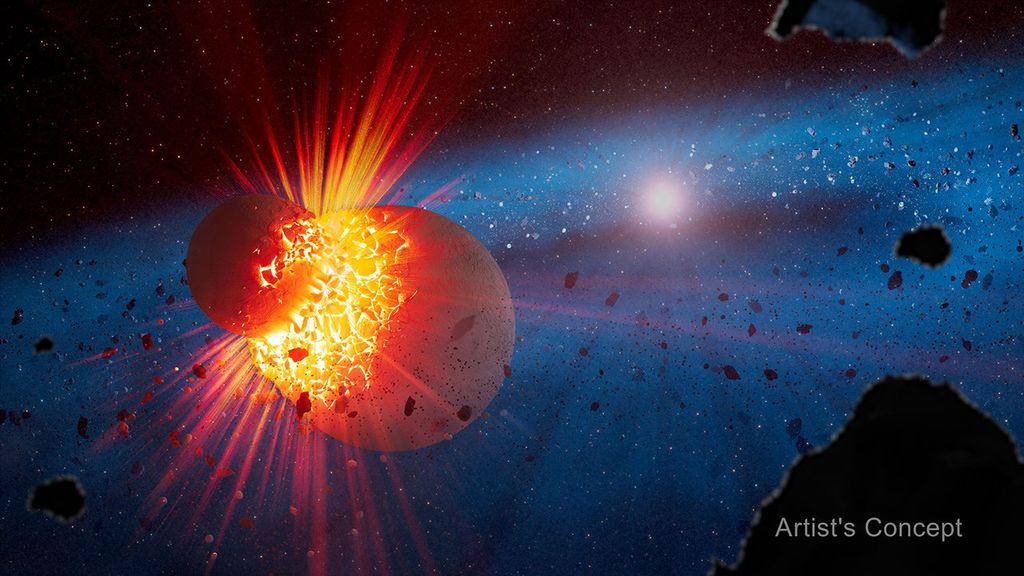
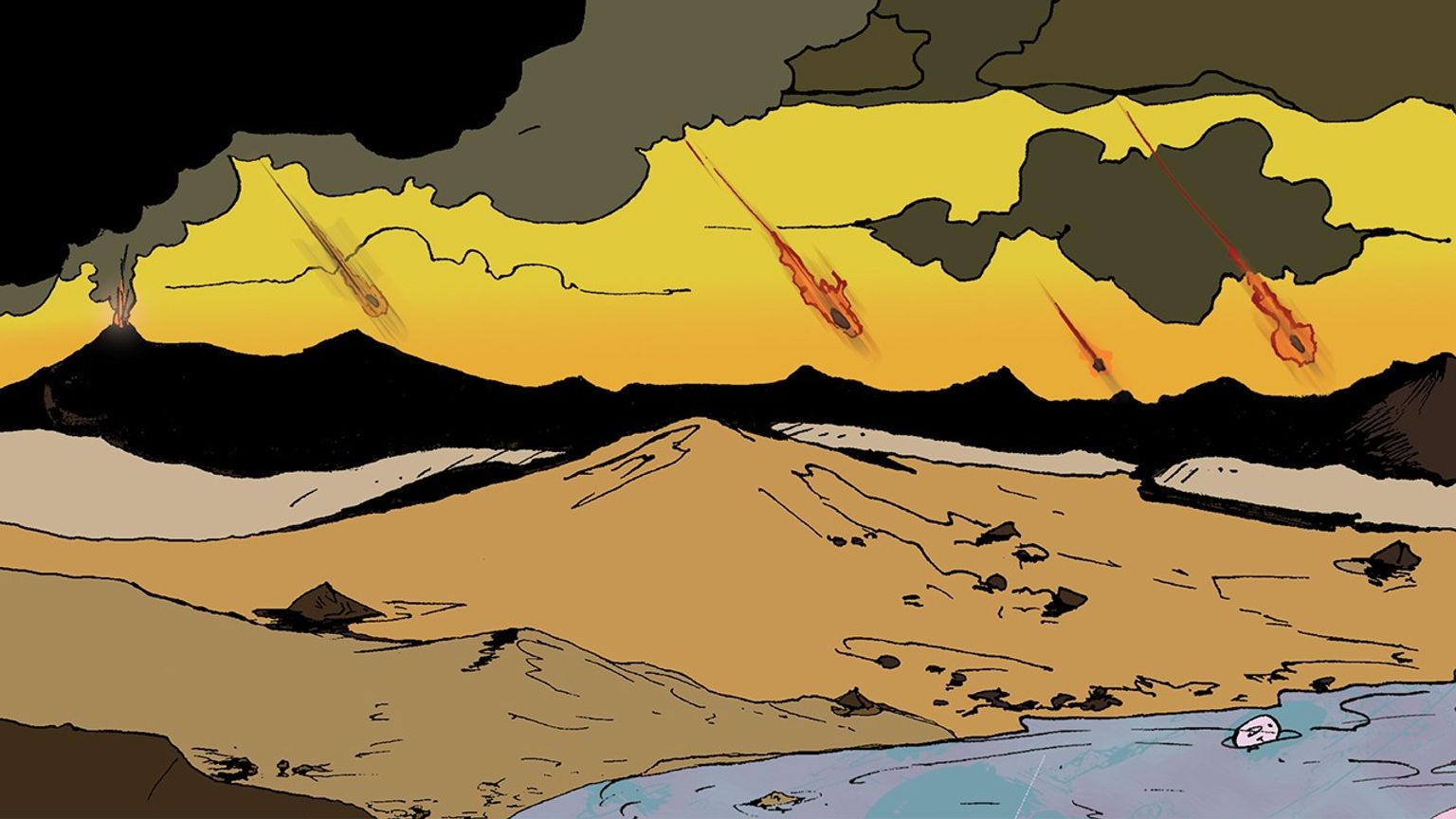
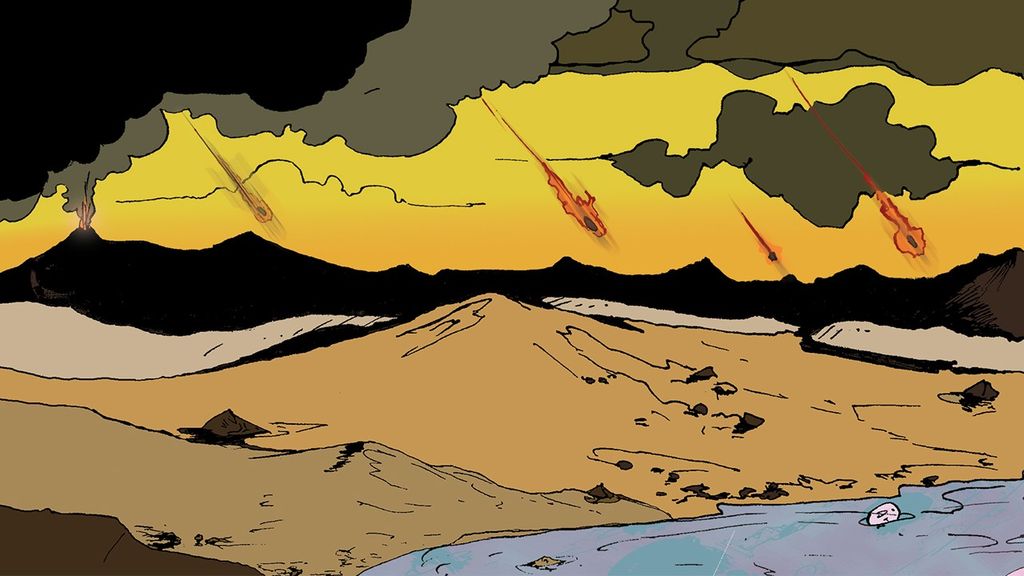
When our planet was really young, there were rocks from space crashing into it pretty often. One very large rock that might have been about as big as Mars hit Earth… but instead of destroying our planet, it created the Moon. If there were things living on Earth at that time, they might not have survived that crash!
As time went on there were fewer and fewer crashes, and things settled down. The air and the oceans began to form. Living things on Earth need water so having oceans was probably really important for Earth to be a place where life could live.
Disciplinary Core Ideas
ESS1.A: The Universe and its Stars: Patterns of the motion of the Sun, moon, and stars in the sky can be observed, described, and predicted. (1-ESS1-1)
ESS1.C: The History of Planet Earth: Some events on Earth occur quickly and some slowly, over a time period much longer than one can observe. (2-ESS1-1)
ESS2.C: The Roles of Water in Earth’s Surface Processes: Water is found in the ocean, rivers, lakes, and ponds. Water exists as solid ice and in liquid form. (2-ESS2-3)
ESS3.A: Natural Resources: Living things need water, air, and resources from the land, and they live in places that have the things they need. Humans use natural resources for everything they do. (K-ESS3-1)
LS2.A: Interdependent Relationships in Ecosystems: Plants depend on water and light to grow. (2-LS2-1)
Crosscutting Concepts
Stability and Change: Things may change slowly or rapidly. (2-ESS1-1), (2-ESS2-1)
Big Ideas: Rocks from space frequently crashed into the early Earth. Creation of Earth’s moon occurred when an extremely large rock hit Earth. As time went on, fewer crashes on Earth made way for oceans to form on Earth. Since water is critical for life, this was an important step towards making Earth habitable.
Boundaries: Grade level appropriate examples of slow events on Earth include erosion of rocks, while quick events on Earth include earthquakes and volcanic explosions. Assessment does not include quantitative measurements of timescales. (2-ESS1-1)
2-8 Space Update. This software for interactive displays uses real-time data and supporting lessons about space weather, the solar system, the sky tonight, and deep space objects (from Hubble). This activity helps students recognize Earth’s position in the solar system and the far distances of planets. The lessons are hands-on and experiential. NASA /Space Update. Paid subscription required after free 30-day demo. http://spaceupdate.com/software_spaceupdate.php

Grades 3-5 or Adult Emerging Learner
When the Sun and planets were very young, there were lots of smaller pieces of rock flying around that hadn’t yet become part of a planet. Like the asteroids that we know now, but a lot more of them. Many of these pieces of rock crashed into the planets, bombarding them over and over again. One day, a huge piece of rock about the size of the planet Mars smashed into Earth. Instead of destroying our planet, it created our Moon. If there was any life on Earth at that time, it may not have survived.
Over time, the bombarding slowed down and Earth began to look less like a fireball and more like a planet. Early volcanoes put out gases that helped create the atmosphere. Some of the rocks that hit Earth came from far away, beyond Jupiter and Saturn, and had ice in them. When they crashed into Earth, the ice melted, helping to create Earth’s oceans. This is especially important because living things on Earth need water to survive. So even when Earth was still very new, it was a place where life could have gotten started.
Disciplinary Core Ideas
ESS1.B: Earth and the Solar System: The orbits of Earth around the Sun and of the Moon around Earth, together with the rotation of Earth about an axis between its North and South poles, cause observable patterns. (5-ESS1-2)
ESS1.C: The History of Planet Earth: Local, regional, and global patterns of rock formations reveal changes over time due to earth forces, such as earthquakes. (4-ESS1-1) Features on Earth can be used to order events that change the landscape.
ESS2.B: Plate Tectonics and Large-Scale System Interactions: Earth’s physical features occur in patterns. Most earthquakes and volcanoes occur in bands that are often along the boundaries between continents and oceans. (4-ESS2-2)
ESS2.C: The Roles of Water in Earth’s Surface Processes: Nearly all of Earth’s available water is in the ocean. Most freshwater is in glaciers or underground; only a tiny fraction is in streams, lakes, wetlands, and the atmosphere. (5-ESS2-2)
PS2.B: Types of Interactions: The gravitational force of Earth acting on an object near Earth’s surface pulls that object toward the planet’s center. (5-PS2-1)
PS3.D: Energy in Chemical Processes and Everyday Life: The energy released [from] food was once energy from the Sun that was captured by plants in the chemical process that forms plant matter (from air and water). (5-PS3-1)
Crosscutting Concepts
Cause and effect relationships are routinely identified, tested, and used to explain change (3-ESS3-1) A system can be describe in terms of its components and their interactions. (3-LS4-4) Systems and System Models- A system can be described in terms of its components and their interactions. (5-ESS2-1),(5-ESS3-1)
Big Ideas: Rocks from space frequently crashed into the early Earth. The rocks from the early solar system that crashed into Earth contained ice and began to accumulate on Earth’s surface. Creation of Earth’s moon occurred when an extremely large rock hit Earth. As Earth cooled, liquid water began to pool into oceans making life possible.
Boundaries: By the end of 5th grade, students understand that Earth has changed over time. Students begin to describe the influence the ocean has on the geosphere, biosphere, hydrosphere, and/or atmosphere. (5-ESS2-1)
2-8 Space Update. This software for interactive displays uses real-time data and supporting lessons about space weather, the solar system, the sky tonight, and deep space objects (from Hubble). This activity helps students recognize Earth’s position in the solar system and the far distances of planets. The lessons are hands-on and experiential. NASA /Space Update. Paid subscription required after free 30-day demo. http://spaceupdate.com/software_spaceupdate.php
3-5 SpaceMath Problem 543:Timeline for Planet Formation. Students calculate time intervals in millions and billions of years from a timeline of events [Topics: time calculations; integers] https://spacemath.gsfc.nasa.gov/Grade35/10Page6.pdf
3-8 Time Travelers. In this interactive lesson, students explore the history of the Earth and Moon as they figure out the correct timeline of events. They read comic books about the work lunar scientists are pursuing and create their own comic strip focused on the Moon. JPL /NASA. http://www.lpi.usra.edu/education/explore/marvelMoon/activities/intro/timeTravelers/
4-8 SpaceMath Problem 300: Does Anybody Really Know What Time It Is? Students use tabulated data for the number of days in a year from 900 million years ago to the present, to estimate the rate at which an Earth day has changed using a linear model. [Topics: graphing; finding slopes; forecasting] https://spacemath.gsfc.nasa.gov/earth/6Page58.pdf
Grades 6-8 or Adult Building Learner
The collisions that produced the planets and moons of our solar system continued after they formed. There was still a lot of rocky material in the disk that hadn’t yet been incorporated into a planet or moon. This stuff was just like asteroids and comets that we have in the solar system today.
These “leftover” pieces of rock fell regularly to Earth, bombarding it repeatedly. Some of the pieces that hit Earth came from the cold outer solar system, and contained gases and water in the form of ice. A huge chunk of rock (maybe about the size of Mars) hit Earth and resulted in the formation of our Moon. If there was any life on Earth at that time, scientists aren’t sure if it could have survived.
As the bombardments from space slowed down, Earth began changing. Water and gases erupted at the surface of the planet through volcanoes to form the atmosphere and oceans. Heat from down in the core came to the surface, keeping Earth warm. A lot of chemical reactions between the rocks, the water, and the air started happening. Not long after our Earth began to form, it became a place where life could get started.
Disciplinary Core Ideas
ESS2.A: Earth’s Materials and Systems: The planet’s systems interact over scales that range from microscopic to global in size, and they operate over fractions of a second to billions of years. These interactions have shaped Earth’s history and will determine its future. (MS-ESS2-2)
ESS1.C: The History of Planet Earth: The geologic time scale interpreted from rock strata provides a way to organize Earth’s history. Analyses of rock strata and the fossil record provide only relative dates, not an absolute scale. (MS-ESS1-4) *Tectonic processes continually generate new ocean sea floor at ridges and destroy old seafloor at trenches. (HS.ESS1.C GBE )
ESS2.B: Plate Tectonics and Large-Scale System Interactions: Maps of ancient land and water patterns, based on investigations of rocks and fossils, make clear how Earth’s plates have moved great distances, collided, and spread apart. (MS-ESS2-3)
ESS2.C: The Roles of Water in Earth’s Surface Processes: Water’s movements – both on the land and underground — cause weathering and erosion, which change the land’s surface features and create underground formations. (MS-ESS2-2)
PS1.B: Chemical Reactions: Substances react chemically in characteristic ways. In a chemical process, the atoms that make up the original substances are regrouped into different molecules, and these new substances have different properties from those of the reactants. (MS-PS1-3). Some chemical reactions release energy, others store energy. (MS-PS1-6)
PS3.B: Conservation of Energy and Energy Transfer: When the motion energy of an object changes, there is inevitably some other change in energy at the same time. (MS-PS3-5). *The amount of energy transfer needed to change the temperature of a matter sample by a given amount depends on the nature of the matter, the size of the sample, and the environment. (MS-PS3-4). *Energy is spontaneously transferred out of hotter regions or objects and into colder ones. (MS-PS3-3)
Crosscutting Concepts
Patterns: Macroscopic patterns are related to the nature of microscopic and atomic-level structure. (MS-PS1-2) Scale, Proportion, & Quantity- Time, space, and energy phenomena can be observed at various scales using models to study systems that are too large or too small. (MS-PS1-1)
Big Ideas: Rocks, asteroids, comets and other material from space repeatedly cashed into the early Earth. Additional materials in solar system left over after planetary formation contributed water and additional material to Earth. Impact with a Mars sized object led to the formation of Earth’s moon. Slowing of the bombardment allowed for a cooler Earth and the accumulation of water. Water and gases released through volcanoes contributed to the formation of the oceans and atmosphere. With a a liquid water supply and the right atmosphere, environmental conditions existed on early Earth to support early life.
Boundaries: By the end of 8th grade, the geological time scale interpreted from rock strata provides a way to organize Earth’s history. Relative dates of major events in Earth’s history range from very recent (the last Ice Age) to very old (the formation of Earth). (MS-ESS1-4). Many geoscience processes (such as earthquakes, volcanoes, and meteor impacts) usually behave gradually but are punctuated by catastrophic events. (MS-ESS2-2) Emphasis is on relative amounts of thermal/potential/kinetic energy rather than calculations of energy.
2-8 Space Update. This software for interactive displays uses real-time data and supporting lessons about space weather, the solar system, the sky tonight, and deep space objects (from Hubble). This activity helps students recognize Earth’s position in the solar system and the far distances of planets. The lessons are hands-on and experiential. NASA /Space Update. Paid subscription required after free 30-day demo. http://spaceupdate.com/software_spaceupdate.php
3-8 Time Travelers. In this interactive lesson, students explore the history of the Earth and Moon as they figure out the correct timeline of events. They read comic books about the work lunar scientists are pursuing and create their own comic strip focused on the Moon. JPL /NASA. http://www.lpi.usra.edu/education/explore/marvelMoon/activities/intro/timeTravelers/
4-8 SpaceMath Problem 300: Does Anybody Really Know What Time It Is? Students use tabulated data for the number of days in a year from 900 million years ago to the present, to estimate the rate at which an Earth day has changed using a linear model. [Topics: graphing; finding slopes; forecasting] https://spacemath.gsfc.nasa.gov/earth/6Page58.pdf
6-8 SpaceMath Problem 542: The Late Heavy Bombardment Era. Students estimate the average arrival time of large asteroids that impacted the moon. They work with the formula for the volume of a sphere to estimate how much additional mass was added to the moon and Earth during this era. [Topics: volume of spheres; proportions] https://spacemath.gsfc.nasa.gov/earth/10Page5.pdf
6-12 A New Spin on Solar Wind: The Moon, Magnetosphere, and ARTEMIS . In this activity (2-3 lessons), students work in small groups to build their own model of the Sun-Earth-Moon system. Students use the model to demonstrate how the Earth is protected from particles streaming out of the Sun (solar wind) by a magnetic shield called the magnetosphere, and that the Moon is periodically protected from these particles as it moves in its orbit around the Earth. University of California, Berkeley/NASA. http://cse.ssl.berkeley.edu/artemis/epo-classroom-g69_NewSpinSolarWind.html
6-12 Astrobiology Math. This collection of math problems provides an authentic glimpse of modern astrobiology science and engineering issues, often involving actual research data. Students explore concepts in astrobiology through calculations. Relevant problems include Albedo and Heat Balance (page 43) and The Moon’s Atmosphere! (page 37). NASA . https://www.nasa.gov/pdf/637832main_Astrobiology_Math.pdf
7-9 SpaceMath Problem 8: Making a Model Planet. Students use the formula for a sphere, and the concept of density, to make a mathematical model of a planet based on its mass, radius and the density of several possible materials (ice, silicate rock, iron, basalt). [Topics: volume of sphere; mass = density x volume; decimal math; scientific notation] https://spacemath.gsfc.nasa.gov/astrob/Week14.pdf
7-12 SciJinks: How did the Atmosphere Form? This informational web article allows students and teachers to read about how the atmosphere of Earth changes through three main stages, including very early Earth. This information supports the continued story of how Earth became a habitable planet. NOAA /NASA. http://scijinks.gov/atmosphere-formation/
8-10 SpaceMath Problem 449: A simple model for the origin of Earth’s ocean water. Students create a simple model of the arrival of water to Earth using three sizes of cometary bodies and their arrival rates. [Topics: volume of a sphere; rates of change] https://spacemath.gsfc.nasa.gov/earth/8Page22.pdf
Grades 9-12 or Adult Sophisticated Learner
As the planets were getting larger and larger, there were still a lot of diffuse gases and rocky particles present in the disk of material around the Sun. These rocky particles ranged in sizes from very small clumps of rock to being bigger than many of our modern-day asteroids. They contained different kinds of minerals, gases, and some even contained water in the form of ice. We know from modern studies of meteorites, asteroids, and comets that some of these materials in the early solar system even contained simple chemical compounds such as formaldehyde, ammonia, and amino acids. These compounds were synthesized via chemical reactions in the giant molecular cloud and pre-solar nebula from which the Solar System originally formed. (See 1.1, 1.2)
The young planets were continually bombarded by these smaller chunks of rock, which in turn “delivered” water, gases, and carbon-containing compounds (organics) to the early Earth – critical components to the chemical reactions that would ultimately give rise to life. It was during this time of heavy bombardment of Earth that the Moon formed. The current theory about how Earth’s moon formed is that an extremely large chunk of rock, about the size of Mars (and nicknamed Theia), collided with the young Earth. Material was blasted off Earth’s surface but didn’t go far because of Earth’s gravitational pull and eventually coalesced to form the Moon. Thus, Earth-Moon relationship has been in effect almost since the time of Earth’s formation. The Moon’s gravitational pull on Earth influences the behavior of oceans (tides) but may also have played a role in the development of plate tectonics, a process critical to the cycling of elements and potentially necessary for the evolution of life as we know it.
The bombardments continued, and more organics, gases, and water were “delivered” to Earth. However, the continual impacts removed so many asteroids and comets that the period of heavy bombardment slowed, and Earth began to change. Water and gases, such as carbon dioxide, were emitted from volcanoes to form the early atmosphere. As Earth continued cooling, much of that steam may have condensed and contributed to the formation of global oceans. In a relatively short period of time after Earth had formed, it could have been habitable for life as we know it and definitely contained the raw materials and energy needed to give rise to life.
Disciplinary Core Ideas
ESS2.B: Plate Tectonics and Large-Scale System Interactions: Plate tectonics is the unifying theory that explains the past and current movements of the rocks at Earth’s surface and provides a framework for understanding its geologic history. (ESS2.B Grade 8 GBE ) The solar system consists of the Sun and a collection of objects of varying sizes and conditions — including planets and their moons — that are held in orbit around the Sun by its gravitational pull on them. This system appears to have formed from a disk of dust and gas, drawn together by gravity.
LS4.C: Adaptation: Changes in the physical environment, whether naturally occurring or human induced, have thus contributed to the expansion of some species, the emergence of new distinct species as populations diverge under different conditions, and the decline – and sometimes the extinction – of some species. (HS-LS4-6)
PS2.A: Forces and Motion: Newton’s second law accurately predicts changes in the motion of macroscopic objects. (HS-PS2-1) *Momentum is defined for a particular frame of reference; it is the mass times the velocity of the object. (HS-PS2-2) *If a system interacts with objects outside itself, the total momentum of the system can change; however, any such change is balanced by changes in the momentum of objects outside the system. (HS-PS2-2, HS-PS2-3)
PS2.B: Types of Interactions: Newton’s law of universal gravitation and Coulomb’s law provide the mathematical models to describe and predict the effects of gravitational and electrostatic forces between distant objects. (HS-PS2-4) *Forces at a distance are explained by fields (gravitational, electric, and magnetic) permeating space that can transfer energy through space. (HS-PS2-4,HS-PS2-5)
PS1.B: Chemical Reactions: Chemical processes, their rates, and whether or not energy is stored or released can be understood in terms of the collisions of molecules and the rearrangements of atoms into new molecules, with consequent changes in the sum of all bond energies in the set of molecules that are matched by changes in kinetic energy. (HS-PS1-4),(HS-PS1-5)
ESS1.C: The History of Planet Earth: Although active geologic processes, such as plate tectonics and erosion, have destroyed or altered most of the very early rock record on Earth, other objects in the solar system, such as lunar rocks, asteroids, and meteorites, have changed little over billions of years. Studying these objects can provide information about Earth’s formation and early history. (HS-ESS1-6)
Crosscutting Concepts
Patterns: Different patterns may be observed at each of the scales at which a system is studied and can provide evidence for causality in explanations of phenomena. (HS-PS2-4) Systems and System Models- When investigating or describing a system, the boundaries and initial conditions of the system need to be defined. (HS-PS2-2)
Big Ideas: Rocks, asteroids, comets and other material left over after planetary formation in space repeatedly crashed into the early Earth. These rocky particles transported water, gases, and carbon-containing compounds (organics) to the early Earth – critical components to the chemical reactions that would ultimately give rise to life. Impact with a Mars sized object led to the formation of Earth’s moon. Slowing of the bombardment allowed for a cooler Earth and the accumulation of water. Water and gases released through volcanoes contributed to the formation of the oceans and atmosphere. The liquid water supply and the right atmosphere helped create the environmental conditions on early Earth to support early life.
Boundaries: By the end of 12th grade, students learn how Newton’s second law accurately predicts changes in the motion of macroscopic objects. No details of quantum physics or relativity are included at this grade level.
6-12 A New Spin on Solar Wind: The Moon, Magnetosphere, and ARTEMIS . In this activity (2-3 lessons), students work in small groups to build their own model of the Sun-Earth-Moon system. Students use the model to demonstrate how the Earth is protected from particles streaming out of the Sun (solar wind) by a magnetic shield called the magnetosphere, and that the Moon is periodically protected from these particles as it moves in its orbit around the Earth. University of California, Berkeley/NASA. http://cse.ssl.berkeley.edu/artemis/epo-classroom-g69_NewSpinSolarWind.html
6-12 Astrobiology Math. This collection of math problems provides an authentic glimpse of modern astrobiology science and engineering issues, often involving actual research data. Students explore concepts in astrobiology through calculations. Relevant problems include Albedo and Heat Balance (page 43) and The Moon’s Atmosphere! (page 37). NASA . https://www.nasa.gov/pdf/637832main_Astrobiology_Math.pdf
7-9 SpaceMath Problem 8: Making a Model Planet. Students use the formula for a sphere, and the concept of density, to make a mathematical model of a planet based on its mass, radius and the density of several possible materials (ice, silicate rock, iron, basalt). [Topics: volume of sphere; mass = density x volume; decimal math; scientific notation] https://spacemath.gsfc.nasa.gov/astrob/Week14.pdf
7-12 SciJinks: How did the Atmosphere Form? This informational web article allows students and teachers to read about how the atmosphere of Earth changes through three main stages, including very early Earth. This information supports the continued story of how Earth became a habitable planet. NOAA /NASA. http://scijinks.gov/atmosphere-formation/
8-10 SpaceMath Problem 449: A simple model for the origin of Earth’s ocean water. Students create a simple model of the arrival of water to Earth using three sizes of cometary bodies and their arrival rates. [Topics: volume of a sphere; rates of change] https://spacemath.gsfc.nasa.gov/earth/8Page22.pdf
9-11 SpaceMath Problem 302: How to Build a Planet from the Inside Out. Students model a planet using a spherical core and shell with different densities. The goal is to create a planet of the right size, and with the correct mass using common planet building materials. [Topics: geometry; volume; scientific notation; mass=density x volume] https://spacemath.gsfc.nasa.gov/astrob/6Page72.pdf
Storyline Extensions
Theia and Selene
The most accepted current idea for how our moon formed is called the Giant-Impact Hypothesis. According to this hypothesis, a world about the size of Mars collided with Earth somewhere within the first 100 million years after Earth had first formed, and this collision launched a bunch of material into space around Earth that eventually formed the Moon. Some scientists refer to the potential Mars-sized world that crashed into Earth as “Theia”, named after a Titan in Greek mythology who was also the mother of Selene, goddess of the Moon.