





















5.1. How did life first emerge on Earth?
A core learning question from the Astrobiology Learning Progressions
Astrobiology Learning Progressions Navigation


Grades K-2 or Adult Naive Learner
Have you ever had a mystery to solve? Like a time when you knew something happened, but you didn’t really know how? Maybe you felt like you needed to find some clues to figure out what happened. That’s how scientists feel about figuring out how life got going here on Earth long ago. If you have a mystery and are curious, you start looking for clues. Scientists are doing that right now. They may not figure it all out before you are a grown up. When you get older maybe you could help find clues to this mystery as well. What kinds of clues do you think would be helpful in learning about things that happened long ago?
Disciplinary Core Ideas
ESS1.C: The History of Planet Earth: Some events happen very quickly; others occur very slowly, over a time period much longer than one can observe. (2-ESS1-1)
ESS3.A: Natural Resources: Living things need water, air, and resources from the land, and they live in places that have the things they need. Humans use natural resources for everything they do. (K-ESS3-1)
Crosscutting Concepts
Patterns: Patterns in the natural and human designed world can be observed and used as evidence. (K-LS1-1)
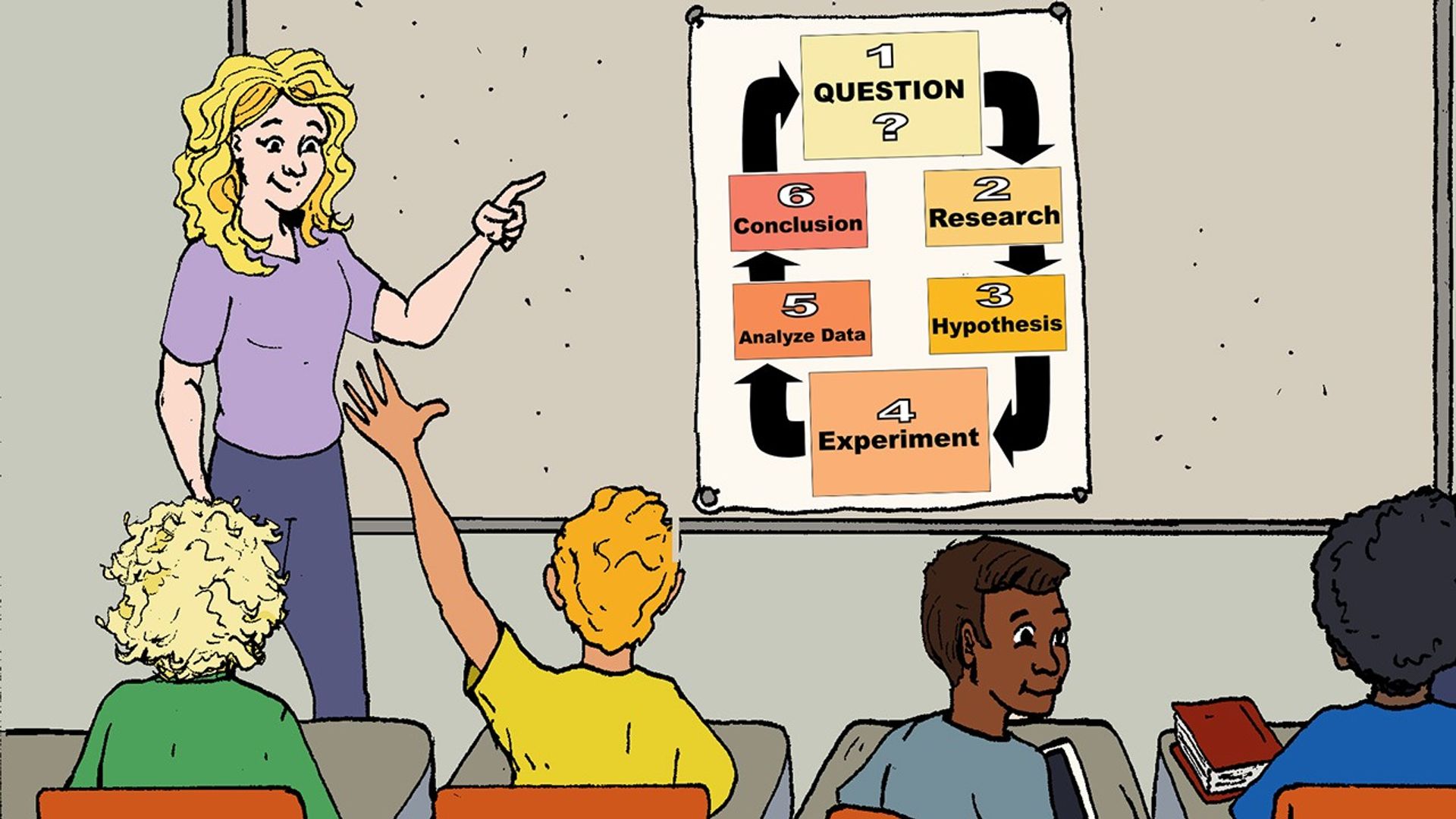
Big Ideas: How life got started on Earth is a mystery. Scienists are piecing together the clues to learn more about how life began on Earth.
Boundaries: In this grade band, Earth events are described in terms of relative time rather than quantitative measurements of timescales. (2-ESS1-1)
No appropriate content for this grade level. Please use the navigation arrows to switch levels.

Grades 3-5 or Adult Emerging Learner
The Earth is really old. It’s older than any grownups you know, it’s older than human civilization, and it’s older than the time when the dinosaurs were alive. But, as old as Earth is, we’ve found evidence that tells us that living things have been around on Earth for almost as long as our planet has been here.
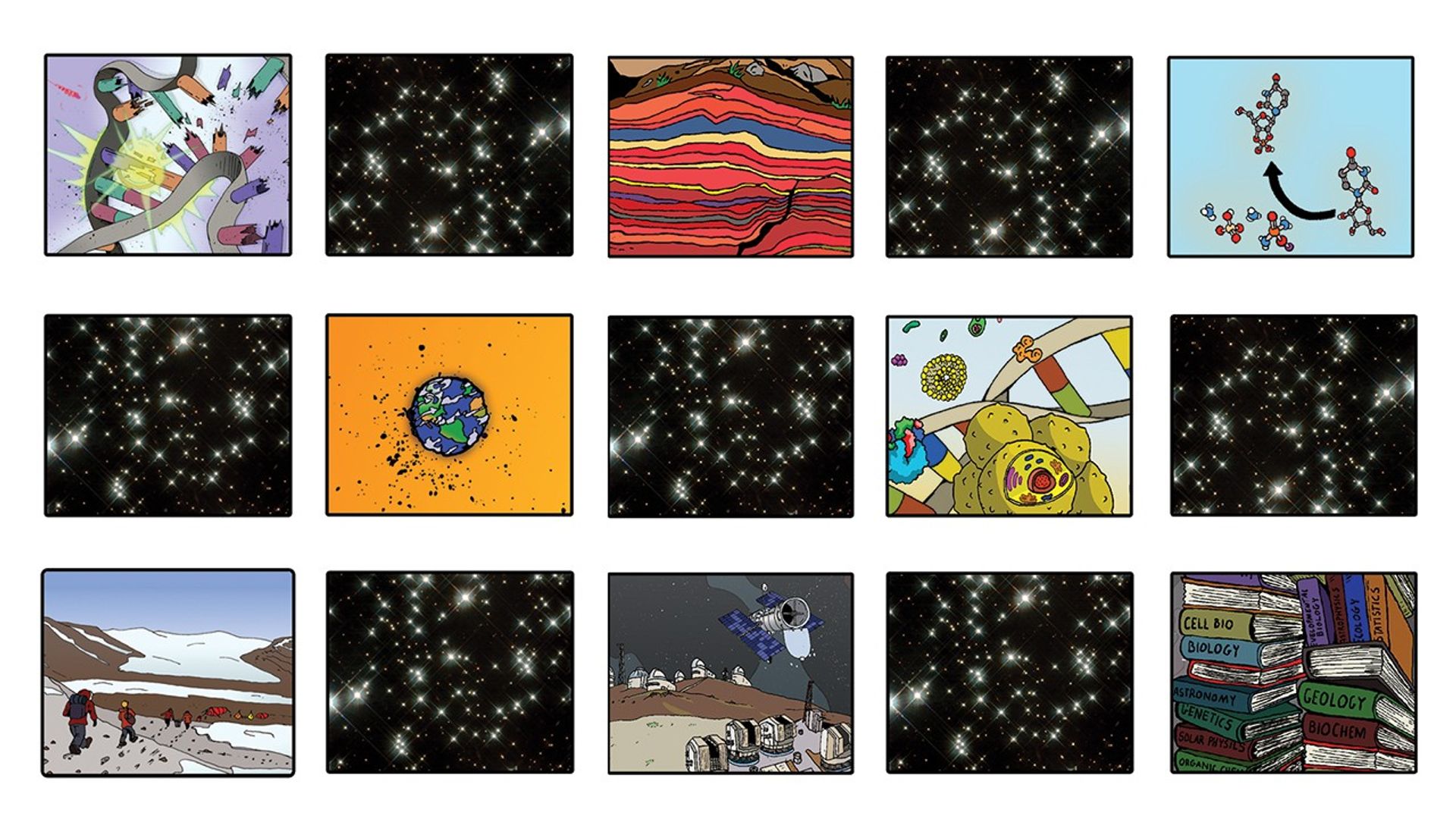
Life started on Earth so long ago that it’s hard for us to know exactly how it started. But there are scientists out there who are collecting information from old rocks, running experiments in laboratories, and using computer programs to test their ideas in order to learn more about the origin of life on Earth. It’s a pretty big mystery to try to uncover and we might never know for sure how life started, but we’re getting closer and closer to understanding how it could have happened.
Disciplinary Core Ideas
ESS1.C: The History of Planet Earth: Local, regional, and global patterns of rock formations reveal changes over time due to Earth forces, such as earthquakes. The presence and location of certain fossil types indicate the order in which rock layers were formed. (4-ESS1-1)
LS2.B: Cycles of Matter and Energy Transfer in Ecosystems: Matter cycles between the air and soil and among plants, animals, and microbes as these organisms live and die. Organisms obtain gases, and water, from the environment, and release waste matter (gas, liquid, or solid) back into the environment. (5-LS2-1)
ESS2.E: Biogeology: Living things affect the physical characteristics of their regions. (4-ESS2-1)
Crosscutting Concepts
Patterns: Patterns can be used as evidence to support an explanation. (4-ESS1-1, 4-ESS2-2)
Big Ideas: The Earth has been around for a very long time. Scientists are investigating the early Earth environment and possible ways life started on Earth. Certain features, like rocks, can be analyzed to order events that have occurred on Earth.
Boundaries: Examples of information obtained from old rocks include rock layers with marine shell fossils above rock layers with plant fossils and no shells, indicating a change from land to water over time; and, a canyon with different rock layers in the walls and a river in the bottom, indicating that over time a river cut through the rock. Emphasis is on relative time. (4-ESS1-1)
No appropriate content for this grade level. Please use the navigation arrows to switch levels.
Grades 6-8 or Adult Building Learner
The Earth is really old. Using the tools of science, we have learned that Earth is about 4.5 billion years old. As old as Earth is, we’ve found evidence that tells us that living things have been around on Earth for almost as long as our planet has been here. We have evidence that tells us that life may have been on Earth as far back as about 4 billion years ago.
Life started on Earth so long ago that it’s hard for us to know exactly how it started. But there are scientists out there who are trying to figure that out. They include people who study the fossils of ancient bacteria or look for other signs of ancient life in old rocks. There are also people who are running experiments in laboratories to see how the basic building blocks of life can come together to make living things. And there are people who use computer programs to test our ideas about how life might have started.
Uncovering the origin of life on Earth is a pretty big mystery to try to solve. We might never actually know for sure how life started, but we’re getting closer and closer to understanding how it could have happened here on Earth and possibly on other worlds as well.
Disciplinary Core Ideas
ESS1.C: The History of Planet Earth: The geologic time scale interpreted from rock strata provides a way to organize Earth’s history. Analyses of rock strata and the fossil record provide only relative dates, not an absolute scale. (MS-ESS1-4)
ESS2.A: Earth’s Materials and Systems: The planet’s systems interact over scales that range from microscopic to global in size, and they operate over fractions of a second to billions of years. These interactions have shaped Earth’s history and will determine its future. (MS-ESS2-2) All Earth processes are the result of energy flowing and matter cycling within and among the planet’s systems. This energy is derived from the Sun and Earth’s hot interior. The energy that flows and matter that cycles produce chemical and physical changes in Earth’s materials and living organisms. (MS-ESS2-1)
ESS2.B: Plate Tectonics and Large-Scale System Interactions: Maps of ancient land and water patterns, based on investigations of rocks and fossils, make clear how Earth’s plates have moved great distances, collided, and spread apart. (MS-ESS2-3)
Crosscutting Concepts
Scale Proportion and Quantity: Time, space, and energy phenomena can be observed at various scales using models to study systems that are too large or too small. (MS-ESS1-4, MS-ESS2-2)
Big Ideas: The Earth has been around for a very long time. Scientists are investigating the early Earth environment and possible ways life started on Earth. Certain features, like rocks, can be used to order events that have occurred on Earth. There are still many aspects of early life that are unknown. Uncovering how life began on Earth can help with understanding how life could have possibly began on other worlds.
Boundaries: Emphasis is on how analyses of rock formations and the fossils they contain are used to establish relative ages of major events in Earth’s history. Examples of Earth’s major events could range from being very recent (such as the last Ice Age or the earliest fossils of homo sapiens) to very old (such as the formation of Earth or the earliest evidence of life). Examples can include the formation of mountain chains and ocean basins, the evolution or extinction of particular living organisms, or significant volcanic eruptions. Assessment does not include recalling the names of specific periods or epochs and events within them. (MS-ESS1-4)
6-12 Astrobiology Math. This collection of math problems provides an authentic glimpse of modern astrobiology science and engineering issues, often involving actual research data. Students explore concepts in astrobiology through calculations. Relevant topics include The Origin of Life (page 3) and Miller-Urey Experiment: Complex Organic Molecules (page 13) where students explore concepts in science through calculations. NASA . https://www.nasa.gov/pdf/637832main_Astrobiology_Math.pdf
Grades 9-12 or Adult Sophisticated Learner
One of the greatest mysteries about life on our planet is when and how it first started. Life appears to have been here for a very long time. Using the tools of science, we have learned that Earth is about 4.5 billion years old. And, as old as Earth is, we’ve found evidence that tells us that living things have been around on Earth for almost as long as our planet has been here. We have evidence that tells us that life may have been on Earth as far back as about 4 billion years ago and maybe even before that.
Life started on Earth so long ago that it’s hard for us to know exactly how it started. But there are scientists out there who are trying to figure that out. They include field scientists who study the fossils of ancient bacteria or look for other signs of ancient life in old rocks. For instance, they sometimes will look at the isotopes of elements like carbon that are trapped in old rocks to see if they imply biological activity. If they find such evidence, they can then also use other information from the rocks to figure out what kind of environment was available for the potential living things that were around when the rock formed. There are also scientists who are running experiments in laboratories to see how the basic building blocks of life can come together to make living things. For example, some lab experiments can be set up to figure out what conditions would be necessary for cell membranes to form without life. It turns out that some molecules can come together to make pockets just like cells under the right conditions. Outside of studying clues that we can find in the rocks and running experiments in labs, we can also use computer programs to test our ideas about how life might have started. All of these kinds of research projects have helped us to learn a lot more about how life might have come about on our planet.
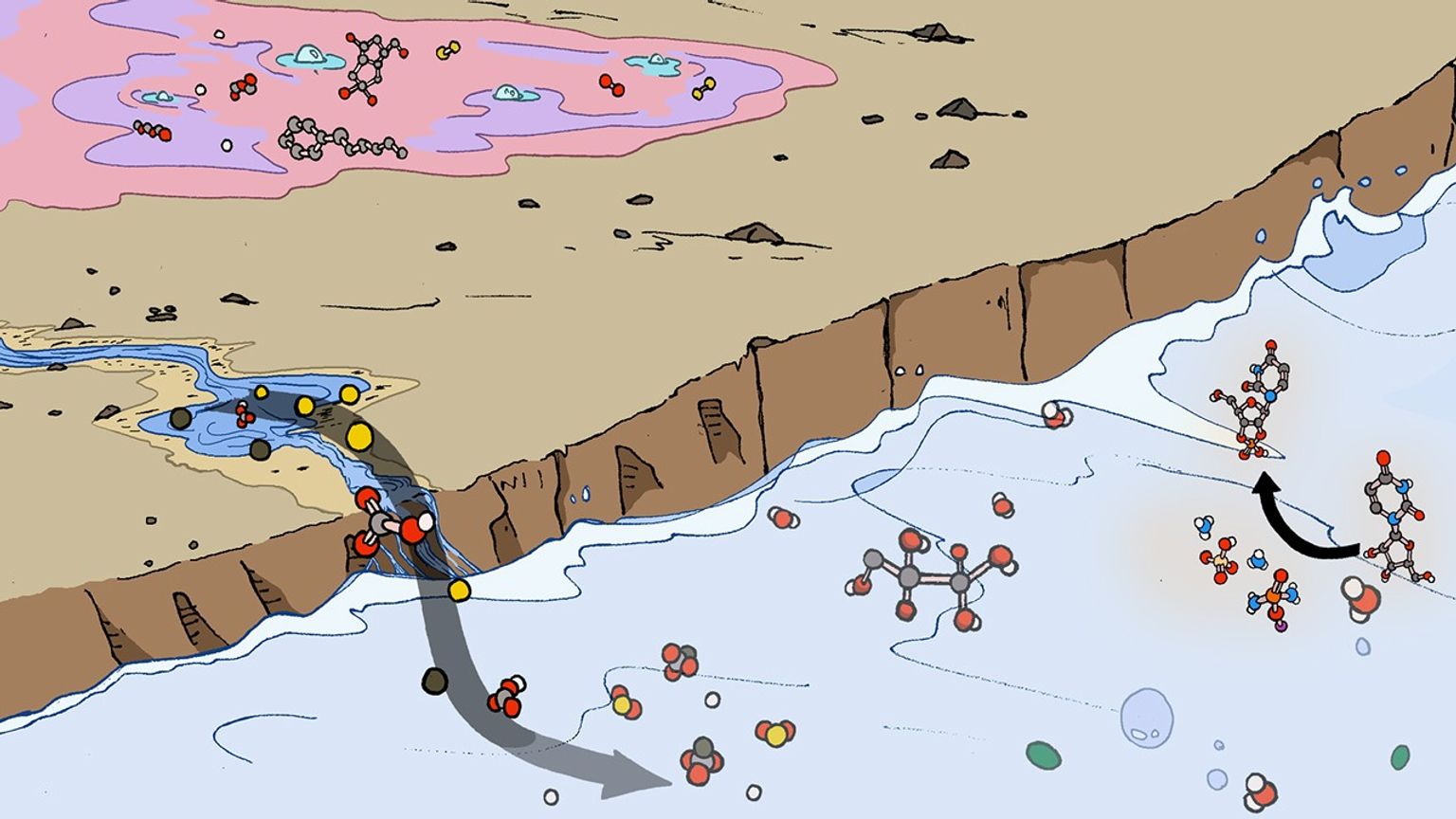
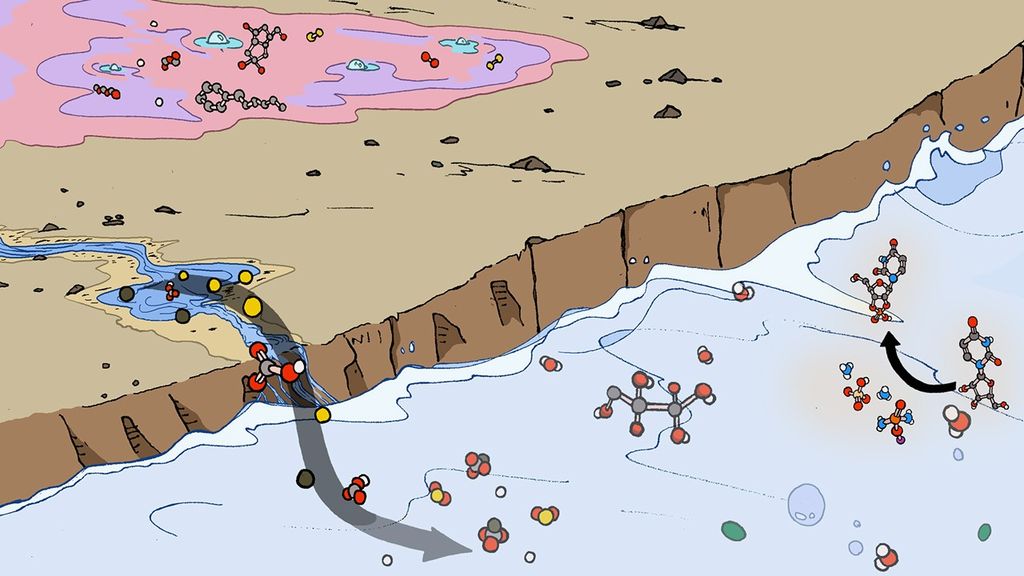
Many scientists agree that the earliest life would have needed a good bit of water, the fundamental CHNOPS elements present to make organic molecules, and some way to concentrate simple organic molecules (since that would be necessary to make more complex molecules for biological processes). This can happen in tidal zones around the ocean, in little droplets of water that get sprayed into the atmosphere from ocean waves, where hydrothermal vents form on the ocean floor, or maybe even in small ponds or lakes when they dry up. It would also have been necessary to bring these molecules together in just the right way to make some chemical reactions more likely to occur. It turns out that some minerals, including pyrite (made of iron and sulfur) and many clays, are really good at orienting molecules in ways that causes them to react with each other. Life as we know it is based on cells, so an environment where life emerges would also need naturally-made containers with an inside and outside. It turns out that little enclosures with lipid membranes, just like cells, can form without life (also called “abiotically”). Depending on the chemistry of the fluid involved, these non-living cells can form automatically.
Environmental niches being investigated as potential places for the origin of life on Earth include surface waters such as lakes and ponds, sea ice, hydrothermal vents, tide pools, and hot springs. All of these areas currently have living things thriving in them, many of which are considered to be extremophiles. Investigations on the genetics of known organisms on Earth has suggested that the earliest life might have been thermophilic (adapted to hotter environments), which has caused a lot of people to suspect that hydrothermal systems might be important for the formation of life. As we learn more about how life on Earth may have started, it helps us to better understand the places we should first look at on other worlds in our solar system and beyond if we want to see if alien life exists. For instance, the possibility for hydrothermal vents to be active and possible sites of living processes in the oceans of Europa and Enceladus make these two moons really important places for us to study.
Uncovering the origin of life on Earth is a pretty big mystery to try to solve. We might never actually know for sure how life started, but we’re getting closer and closer to understanding how it could have happened here on Earth and possibly on other worlds as well. Perhaps the emergence of life on a world isn’t just something that happens on it, but rather to it. Some people suspect that the development of life is a natural process that occurs for many worlds in the Universe, but we can’t test that idea or figure out how common life may be until we’ve first discovered whether or not we’re alone.
Disciplinary Core Ideas
ESS1.C: The History of Planet Earth: Continental rocks, which can be older than 4 billion years, are generally much older than the rocks of the ocean floor, which are less than 200 million years old. (HS-ESS1-5) *Although active geologic processes, such as plate tectonics and erosion, have destroyed or altered most of the very early rock record on Earth, other objects in the solar system, such as lunar rocks, asteroids, and meteorites, have changed little over billions of years. Studying these objects can provide information about Earth’s formation and early history. (HS-ESS1-6)
ESS2.A: Earth Materials and Systems: Earth’s systems, being dynamic and interacting, cause feedback effects that can increase or decrease the original changes. (HS-ESS2-1)
ESS2.C: The Roles of Water in Earth’s Surface Processes: The abundance of liquid water on Earth’s surface and its unique combination of physical and chemical properties are central to the planet’s dynamics. These properties include water’s exceptional capacity to absorb, store, and release large amounts of energy, transmit sunlight, expand upon freezing, dissolve and transport materials, and lower the viscosities and melting points of rocks. (HS-ESS2-5)
ESS2.E: Biogeology: The many dynamic and delicate feedbacks between the biosphere and other Earth systems cause a continual co-evolution of Earth’s surface and the life that exists on it. (HS-ESS2-7)
PS1.B: Chemical Reactions: Chemical processes, their rates, and whether or not energy is stored or released can be understood in terms of the collisions of molecules and the rearrangements of atoms into new molecules, with consequent changes in the sum of all bond energies in the set of molecules that are matched by changes in kinetic energy. (HS-PS1-4, HS-PS1-5) *In many situations, a dynamic and condition-dependent balance between a reaction and the reverse reaction determines the numbers of all types of molecules present. (HS-PS1-6)
PS3.A: Definitions of Energy: Energy is a quantitative property of a system that depends on the motion and interactions of matter and radiation within that system. That there is a single quantity called energy is due to the fact that a system’s total energy is conserved, even as, within the system, energy is continually transferred from one object to another and between its various possible forms. (HS-PS3-1, HS-PS3-2)
LS1.A: Structure and Function: Systems of specialized cells within organisms help them perform the essential functions of life. (HS-LS1-1) *All cells contain genetic information in the form of DNA molecules. Genes are regions in the DNA that contain the instructions that code for the formation of proteins, which carry out most of the work of cells. (HS-LS1-1)
Crosscutting Concepts
Systems and System Models: Models (e.g., physical, mathematical, computer models) can be used to simulate systems and interactions — including energy, matter, and information flows — within and between systems at different scales. (HS-LS1-2)
Big Ideas: The Earth has been around for about 4.5 billion years. Evidence indicates living things have been on Earth for about 4 billion years. Scientists are investigating the early Earth environment and possible ways life started on Earth. Certain features, like rocks, can be used to order events that have occurred on Earth. Environmental niches with rather extreme conditions are being studied as locations for early Earth life. There are still many aspects of early life that are unknown. Uncovering how life began on Earth can help with understanding how life could have possibly began on other worlds.
Boundaries: In this grade band, emphasis is placed on using available evidence within the solar system to reconstruct the early history of Earth, which formed along with the rest of the solar system 4.6 billion years ago. Examples of evidence include the absolute ages of ancient materials (obtained by radiometric dating of meteorites, moon rocks, and Earth’s oldest minerals), the sizes and compositions of solar system objects, and the impact cratering record of planetary surfaces. (HS-ESS1-6)
6-12 Astrobiology Math. This collection of math problems provides an authentic glimpse of modern astrobiology science and engineering issues, often involving actual research data. Students explore concepts in astrobiology through calculations. Relevant topics include The Origin of Life (page 3) and Miller-Urey Experiment: Complex Organic Molecules (page 13) where students explore concepts in science through calculations. NASA . https://www.nasa.gov/pdf/637832main_Astrobiology_Math.pdf
9-10 Voyages through Time: Origin of Life. Through the Origin of Life module students address questions such as: What is life? What is the evidence for early evolution of life on Earth? How did life begin? Sample lesson on the website and the curriculum is available for purchase. SETI . http://www.voyagesthroughtime.org/origin/index.html
10-12 Is Anyone Out There? In this 20-minute TED talk, John Delano speaks to the early Earth the beginning of life on Earth as a mystery that illuminates the possibilities for life to be found beyond Earth. He outlines the evidence and continued areas of study for four main questions: Where did the prebiotic molecules come from? How were they assembled into complex molecules? When did life originate? and What does life remember about the old days (implying evidence for the circumstances of the origin of life)? John Delano/TED. https://www.youtube.com/watch?v=qrQY7vQy50M