





















4.2. What are the sources of life's building blocks within the Earth?
A core learning question from the Astrobiology Learning Progressions
Astrobiology Learning Progressions Navigation


Grades K-2 or Adult Naive Learner
If you want to make a meal using a recipe, then you’ll have to use all of the right ingredients. Well, just like that, living things all over Earth need to be able to get the right ingredients for their survival. Living things have been on Earth for a really long time so it makes sense that the ingredients for life have also been available the entire time, just like having the right ingredients available at the grocery store.
Disciplinary Core Ideas
LS1.C: Organization for Matter and Energy Flow in Organisms: All animals need food in order to live and grow. They obtain their food from plants or from other animals. Plants need water and light to live and grow. (K-LS1-1)
ESS3.A: Natural Resources: Living things need water, air, and resources from the land, and they live in places that have the things they need. Humans use natural resources for everything they do. (K-ESS3-1)
LS1.A: Structure and Function: All organisms have external parts. Different animals use their body parts in different ways to see, hear, grasp objects, protect themselves, move from place to place, and seek, find, and take in food, water and air. Plants also have different parts (roots, stems,leaves, flowers, fruits) that help them survive and grow. (1-LS1-1)
LS2.A: Interdependent Relationships in Ecosystems: Plants depend on water and light to grow. (2-LS2-1)
ESS2.C: The Roles of Water in Earth’s Surface Processes: Water is found in the ocean, rivers, lakes, and ponds. Water exists as solid ice and in liquid form. (2-ESS2-3)
Crosscutting Concepts
Patterns: Patterns in the natural world can be observed. (2-ESS2-2, 2-ESS2-3)
Big Ideas: Living things need food and water to survive. The Earth has just the right ingredients for life.
Boundaries: Students in this grade band make observations to construct an evidence-based account of how an object made of a small set of pieces can be disassembled and made into a new object. Examples of pieces could include blocks, building bricks, or other assorted small objects. (2-PS1-3)
No appropriate content for this grade level. Please use the navigation arrows to switch levels.

Grades 3-5 or Adult Emerging Learner
A family might go to the grocery store in order to find the right ingredients for the meals of the week. Similarly, living things all over Earth need to have certain ingredients to survive, but those ingredients can be found all over. For instance, plants need water and air and the nutrients in the soil. Living things have also been on this Earth for many years, therefore it must mean that the ingredients needed for living things have also been here for many years.
Disciplinary Core Ideas
LS1.C: Organization for Matter and Energy Flow in Organisms: Food provides animals with the materials they need for body repair and growth and the energy they need to maintain body warmth and for motion. (5-PS3-1) Plants acquire their material for growth chiefly from air and water. (5-LS1-1)
LS2.A: Interdependent Relationships in Ecosystems: The food of almost any kind of animal can be traced back to plants. Organisms are related in food webs in which some animals eat plants for food and other animals eat the animals that eat plants. (5-LS2-1)
LS4.A: Evidence of Common Ancestry and Diversity: Some kinds of plants and animals that once lived on Earth are no longer found anywhere. (3-LS4-1) Fossils provide evidence about the types of organisms that lived long ago and also about the nature of their environments. (3-LS4-1)
LS4.C: Adaptation: For any particular environment, some kinds of organisms survive well, some survive less well, and some cannot survive at all. (3-LS4-3)
LS4.D: Biodiversity and Humans: Populations live in a variety of habitats, and change in those habitats affects the organisms living there. (3-LS4-4)
LS2.D: Social Interactions and Group Behavior: Being part of a group helps animals obtain food, defend themselves, and cope with changes. Groups may serve different functions and vary dramatically in size. (Note: Moved from K – 2) (3-LS2-1)
ESS2.A: Earth Materials and Systems: Rainfall helps to shape the land and affects the types of living things found in a region. Water, ice, wind, living organisms, and gravity break rocks, soils, and sediments into smaller particles and move them around. (4-ESS2-1)
PS3.D: Energy in Chemical Processes and Everyday Life: The energy released [from] food was once energy from the Sun that was captured by plants in the chemical process that forms plant matter (from air and water). (5-PS3-1)
Crosscutting Concepts
Patterns: Patterns in the natural and human designed world can be observed and used as evidence. (K-LS1-1)
Big Ideas: Organisms need certain things to survive. Their survival depends on their ability to obtain food and water. Life has evolved to use the ingredients available on Earth.
Boundaries: Grade level appropriate examples of the particles that make up matter that are too small to be seen could include adding air to expand a basketball, compressing air in a syringe, dissolving sugar in water, and evaporating salt water. (5-PS1-1)
3-12 A Guide to Collecting Micrometeorites. This lesson has complete directions for the collection, identification and measurement of micrometeorites. It could be used as a rich hands-on investigation of the solar system origins, the formation of the Earth, the interaction of Earth and space and/or the delivery of the ingredients necessary for life ( CHNOPS ). ScienceSouth.org/NASA. http://www.sciencesouth.org/wp-content/uploads/2011/06/2016VF-A-Guide-to-Collecting-Micrometeorites- JMM -1.pdf
5-12 Exploring Meteorite Mysteries: Changes Inside Planets (11.1). In this lesson, students conduct an experiment using gelatin and food that illustrates planetary differentiation. Earth is differentiated into core, mantle and crust. Differentiation is a critical step in the formation of a habitable planet Earth. NASA . https://er.jsc.nasa.gov/seh/Exploring_Meteorite_Mysteries.pdf
5-12 Life on Earth . Although the exact process by which life formed on Earth is not well understood, the origin of life requires the presence of carbon-based molecules, liquid water and an energy source. Because some Near-Earth Objects contain carbon-based molecules and water ice, collisions of these object with Earth have significant agents of biologic as well as geologic change.
Grades 6-8 or Adult Building Learner
Investigating life on Earth has shown us that all living things need certain elements for their cellular processes, such as growth and metabolism (getting and using energy). For instance, the CHNOPS elements (carbon, hydrogen, nitrogen, oxygen, phosphorus, and sulfur) are known to be part of every living thing. These ingredients for life as we know it work kind of like a recipe, where you have to put the ingredients together in the right way to make the recipe work. So if we want to understand how life works, it’s important for us to know where the ingredients are at and when they’re put together in the right way for life.
Fossil evidence shows life thriving well over 3.5 billion years ago. This implies that the ingredients for life were available very early in the history of Earth. We know that water, with both hydrogen and oxygen, was available back then based on the evidence left in the rock record. Also, the CHNOPS elements along with a lot of metals and other important elements for life were present in the rocks of the crust and mantle of Earth, back then as well as now. This tells us that the ingredients for life have always been available on Earth.
We also know that Earth is pretty good at recycling the elements that are present at the surface through processes like plate tectonics and volcanism. Plate tectonics are when the large plates of rock that make up the crust shift around and sometimes create new mountains or drive old rock down into the mantle. Volcanism includes all of the processes that make volcanoes and cause them to erupt. While plate tectonics can send some elements down into the mantle and bring new elements up when forming mountains, volcanism can bring some elements back to the surface as well as to the atmosphere. We also know that the breakdown of rocks, known as weathering, is important for getting the ingredients for life out of rocks and into the soil and the oceans.
The next important thing is finding the places where the ingredients for life are brought together in the right ways. We’re really lucky to have an active planet, because having lots of different kinds of environments means there’s lots of places where different ingredients can be brought together and made useful for life. For instance, high temperature places like hot springs and hydrothermal vents can make a lot of metals available for life. Glaciers breaking down rocks as they move can make nutrient rich soils. The oxygen in the atmosphere can actually react with the rocks at the surface to make chemical molecules that are useful for life. sunlight itself can cause a lot of the ingredients for life to come together in a way that make them more useful for living things.
Disciplinary Core Ideas
ESS1.C: The History of Planet Earth: The geologic time scale interpreted from rock strata provides a way to organize Earth’s history. Analyses of rock strata and the fossil record provide only relative dates, not an absolute scale. (MS-ESS1-4) Tectonic processes continually generate new ocean sea floor at ridges and destroy old seafloor at trenches. (HS.ESS1.C GBE )
ESS2.A: Earth’s Materials and Systems: The planet’s systems interact over scales that range from microscopic to global in size, and they operate over fractions of a second to billions of years. These interactions have shaped Earth’s history and will determine its future. (MS-ESS2-2)
ESS2.B: Plate Tectonics and Large-Scale System Interactions: Maps of ancient land and water patterns, based on investigations of rocks and fossils, make clear how Earth’s plates have moved great distances, collided, and spread apart. (MS-ESS2-3)
ESS2.C: The Roles of Water in Earth’s Surface Processes: Water’s movements — both on the land and underground — cause weathering and erosion, which change the land’s surface features and create underground formations. (MS-ESS2-2)
LS1.B: Growth and Development of Organisms: Genetic factors as well as local conditions affect an organisms growth. (MS-LS1-5)
LS4.A: Evidence of Common Ancestry and Diversity: The collection of fossils and their placement in chronological order (e.g., through the location of the sedimentary layers in which they are found or through radioactive dating) is known as the fossil record. It documents the existence, diversity, extinction, and change of many life forms throughout the history of life on Earth. (MS-LS4-1)
PS1.A: Structure and Properties of Matter: Substances are made from different types of atoms, which combine with one another in various ways. Atoms form molecules that range in size from two to thousands of atoms. (MS-PS1-1) *Each pure substance has characteristic physical and chemical properties (for any bulk quantity under given conditions) that can be used to identify it. (MS-PS1-3)
LS2.C: Ecosystem Dynamics, Functioning, and Resilience: Biodiversity describes the variety of species found in Earth’s terrestrial and oceanic ecosystems. The completeness or integrity of an ecosystem’s biodiversity is often used as a measure of its health. (MS-LS2-5)
PS3.D: Energy in Chemical Processes and Everyday Life: The chemical reaction by which plants produce complex food molecules (sugars) requires an energy input (i.e., from sunlight) to occur. In this reaction, carbon dioxide and water combine to form carbon-based organic molecules and release oxygen. Cellular respiration in plants and animals involve chemical reactions with oxygen that release stored energy. In these processes, complex molecules containing carbon react with oxygen to produce carbon dioxide and other materials.
Crosscutting Concepts
Scale Proportion and Quantity: Time, space, and energy phenomena can be observed at various scales using models to study systems that are too large or too small. (MS-ESS1-4, MS-ESS2-2)
Big Ideas: All living things have similar cellular makeup and functioning. All living things are made up of CHNOPS . When life began on Earth, CHNOPS were available and utilized. During the formation of Earth, water was brought together and moved to the surface through plate tectonics and volcanic activity. Similar elements are seen on other planets and celestial bodies.
Boundaries: In this grade band, students are using models to describe the atomic composition of simple molecules and extended structures that vary in complexity. Examples of molecular-level models could include drawings, 3D ball and stick structures, or computer representations showing different molecules with different types of atoms. Does not include a complete depiction of all individual atoms in a complex molecule or extended structure. (MS-PS1-1)
3-12 A Guide to Collecting Micrometeorites. This lesson has complete directions for the collection, identification and measurement of micrometeorites. It could be used as a rich hands-on investigation of the solar system origins, the formation of the Earth, the interaction of Earth and space and/or the delivery of the ingredients necessary for life ( CHNOPS ). ScienceSouth.org/NASA. http://www.sciencesouth.org/wp-content/uploads/2011/06/2016VF-A-Guide-to-Collecting-Micrometeorites- JMM -1.pdf
5-12 Exploring Meteorite Mysteries: Changes Inside Planets (11.1). In this lesson, students conduct an experiment using gelatin and food that illustrates planetary differentiation. Earth is differentiated into core, mantle and crust. Differentiation is a critical step in the formation of a habitable planet Earth. NASA . https://er.jsc.nasa.gov/seh/Exploring_Meteorite_Mysteries.pdf
5-12 Life on Earth . Although the exact process by which life formed on Earth is not well understood, the origin of life requires the presence of carbon-based molecules, liquid water and an energy source. Because some Near-Earth Objects contain carbon-based molecules and water ice, collisions of these object with Earth have significant agents of biologic as well as geologic change.
6-12 Astrobiology Math. This collection of math problems provides an authentic glimpse of modern astrobiology science and engineering issues, often involving actual research data. Students explore concepts in astrobiology through calculations. Relevant topics include The Largest Known Extraterrestrial Molecules (page 11) and The Miller-Urey Experiment: Complex Organic Molecules (page 13). NASA . https://www.nasa.gov/pdf/637832main_Astrobiology_Math.pdf
7-12 Exploring Meteorite Mysteries: Changes inside planets. This activity explores the concept of differentiation through a food model with gelatin. Differentiation is a critical step in the formation of a habitable planet Earth. This activity is part of a multi-lesson unit on meteorites, called Meteorite Mysteries. JSC /NASA. https://er.jsc.nasa.gov/seh/Exploring_Meteorite_Mysteries.pdf#page=125
Grades 9-12 or Adult Sophisticated Learner
Investigating life on Earth has shown us that all living things need certain elements for their cellular processes, such as growth and metabolism. For instance, the CHNOPS elements (carbon, hydrogen, nitrogen, oxygen, phosphorus, and sulfur) are known to be part of every living thing. They make up most of the proteins, fats, nucleic acids, and carbohydrates that life uses. There are also lots of other elements, especially lots of the metals, that are needed by living things. All of these ingredients for life as we know it work kind of like a recipe, where you have to put the ingredients together in the right way to make the recipe work. So if we want to understand how life works, it’s important for us to know where the ingredients are and when they’re put together in the right way for life.
Fossil evidence shows life on Earth thriving well over 3.5 billion years ago. This implies that the ingredients for life were available very early in the history of Earth. We know that water, with both hydrogen and oxygen, was available back then based on the evidence left in the rock record. The CHNOPS elements along with a lot of metals and other important elements for life were present in the rocks of the crust and mantle of Earth, back then as well as now. This tells us that the ingredients for life have always been available on Earth.
We know that Earth is pretty good at recycling the elements that are present at the surface through processes like plate tectonics and volcanism. Plate tectonics are when the large plates of rock that make up the crust shift around and sometimes create new mountains or drive old rock down into the mantle. Volcanism includes all of the processes that make volcanoes and cause them to erupt. While plate tectonics can send some elements down into the mantle and bring new elements up when forming mountains, volcanism can bring some elements back to the surface in lava as well as to the atmosphere through the gases that come out during eruptions. We also know that the breakdown of rocks, known as weathering, is important for getting the ingredients for life out of rocks and into the soil and the oceans. A lot of things drive weathering, but the movement of water (in the hydrological cycle) is one of the most powerful on Earth. Elements like carbon and phosphorus become available for life due to water breaking down rocks.
The next important thing is finding the places where the ingredients for life are brought together in the right ways. We’re really lucky to have an active planet, because having lots of different kinds of environments means there’s lots of places where different ingredients can be brought together and made useful for life. For instance, high temperature places like hot springs and hydrothermal vents can make a lot of metals available for life. Glaciers breaking down rocks as they move can make nutrient rich soils. The oxygen in the atmosphere can actually react with the rocks at the surface to make chemical molecules that are useful for life. sunlight itself can cause a lot of the ingredients for life to come together in a way that make them more useful for living things.
Disciplinary Core Ideas
ESS1.C: The History of Planet Earth: Continental rocks, which can be older than 4 billion years, are generally much older than the rocks of the ocean floor, which are less than 200 million years old. (HS-ESS1-5) Although active geologic processes, such as plate tectonics and erosion, have destroyed or altered most of the very early rock record on Earth, other objects in the solar system, such as lunar rocks, asteroids, and meteorites, have changed little over billions of years. Studying these objects can provide information about Earth’s formation and early history. (HS-ESS1-6)
ESS2.C: The Roles of Water in Earth’s Surface Processes: The abundance of liquid water on Earth’s surface and its unique combination of physical and chemical properties are central to the planet’s dynamics. These properties include water’s exceptional capacity to absorb, store, and release large amounts of energy, transmit sunlight, expand upon freezing, dissolve and transport materials, and lower the viscosities and melting points of rocks. (HS-ESS2-5)
PS1.A: Structure and Properties of Matter: Each atom has a charged substructure consisting of a nucleus, which is made of protons and neutrons, surrounded by electrons. (HS-PS1-1) The periodic table orders elements horizontally by the number of protons in the atom’s nucleus and places those with similar chemical properties in columns. The repeating patterns of this table reflect patterns of outer electron states. (HS-PS1-1, HS-PS1-2)
PS1.B: Chemical Reactions: Chemical processes, their rates, and whether or not energy is stored or released can be understood in terms of the collisions of molecules and the rearrangements of atoms into new molecules, with consequent changes in the sum of all bond energies in the set of molecules that are matched by changes in kinetic energy. (HS-PS1-4, HS-PS1-5)
LS1.A: Structure and Function: Systems of specialized cells within organisms help them perform the essential functions of life. (HS-LS1-1)
LS1.C: Organization for Matter and Energy Flow in Organisms: The process of photosynthesis converts light energy to stored chemical energy by converting carbon dioxide plus water into sugars plus released oxygen. (HS-LS1-5) *The sugar molecules thus formed contain carbon, hydrogen, and oxygen: their hydrocarbon backbones are used to make amino acids and other carbon-based molecules that can be assembled into larger molecules (such as proteins or DNA ), used for example to form new cells. (HS-LS1-6)
LS4.C: Adaptation: Changes in the physical environment, whether naturally occurring or human induced, have thus contributed to the expansion of some species, the emergence of new distinct species as populations diverge under different conditions, and the decline – and sometimes the extinction – of some species. (HS-LS4-6, HS-LS4-5)
ESS1.A: The Universe and Its Stars: Other than the hydrogen and helium formed at the time of the big bang, nuclear fusion within stars produces all atomic nuclei lighter than and including iron, and the process releases electromagnetic energy. Heavier elements are produced when certain massive stars achieve a supernova stage and explode. (HS-ESS1-2, HS-ESS1-3)
ESS2.B: Plate Tectonics and Large-Scale System Interactions: Plate tectonics is the unifying theory that explains the past and current movements of the rocks at Earth’s surface and provides a framework for understanding its geologic history.(HS-ESS2-1) *The radioactive decay of unstable isotopes continually generates new energy within Earth’s crust and mantle, providing the primary source of the heat that drives mantle convection. Plate tectonics can be viewed as the surface expression of mantle convection. (HS-ESS2-3)
ESS2.E: Biogeology: The many dynamic and delicate feedbacks between the biosphere and other Earth systems cause a continual co-evolution of Earth’s surface and the life that exists on it. (HS-ESS2-7)
Crosscutting Concepts
Patterns: Empirical evidence is needed to identify patterns. (HS-ESS1-5)
Stability and Change: Much of science deals with constructing explanations of how things change and how they remain stable. (HS-ESS1-6)
Big Ideas: Life began on Earth between 3.5 and 3.8 billion years ago. All life forms require carbon, hydrogen, nitorgen, oxygen, phosphorous and sulphur ( CHNOPS ). Because CHNOPS are vital to life on Earth, astrobiologist look for these elements elsewhere in the universe when looking for life beyond Earth. The formation materials for Earth contained a high amount of water. Plate tectonics and volcanic activity put much of the water onto the surface of Earth along with other carbon, nitrogen, and sulphur. Weathering and erosion brought phosphorous and sulphur into the oceans, which all the necessary ingredients for life. Astrobiologist use knowledge of CHNOPS to look for and study life beyond Earth.
Boundaries: In this grade band, students use the periodic table as a model to predict the relative properties of elements. Examples of properties that could be predicted from patterns could include reactivity of metals, types of bonds formed, numbers of bonds formed, and reactions with oxygen. Focus is on main group elements. (HS-PS1-1)
3-12 A Guide to Collecting Micrometeorites. This lesson has complete directions for the collection, identification and measurement of micrometeorites. It could be used as a rich hands-on investigation of the solar system origins, the formation of the Earth, the interaction of Earth and space and/or the delivery of the ingredients necessary for life ( CHNOPS ). ScienceSouth.org/NASA. http://www.sciencesouth.org/wp-content/uploads/2011/06/2016VF-A-Guide-to-Collecting-Micrometeorites- JMM -1.pdf
5-12 Exploring Meteorite Mysteries: Changes Inside Planets (11.1). In this lesson, students conduct an experiment using gelatin and food that illustrates planetary differentiation. Earth is differentiated into core, mantle and crust. Differentiation is a critical step in the formation of a habitable planet Earth. NASA . https://er.jsc.nasa.gov/seh/Exploring_Meteorite_Mysteries.pdf
5-12 Life on Earth . Although the exact process by which life formed on Earth is not well understood, the origin of life requires the presence of carbon-based molecules, liquid water and an energy source. Because some Near-Earth Objects contain carbon-based molecules and water ice, collisions of these object with Earth have significant agents of biologic as well as geologic change.
6-12 Astrobiology Math. This collection of math problems provides an authentic glimpse of modern astrobiology science and engineering issues, often involving actual research data. Students explore concepts in astrobiology through calculations. Relevant topics include The Largest Known Extraterrestrial Molecules (page 11) and The Miller-Urey Experiment: Complex Organic Molecules (page 13). NASA . https://www.nasa.gov/pdf/637832main_Astrobiology_Math.pdf
7-12 Exploring Meteorite Mysteries: Changes inside planets. This activity explores the concept of differentiation through a food model with gelatin. Differentiation is a critical step in the formation of a habitable planet Earth. This activity is part of a multi-lesson unit on meteorites, called Meteorite Mysteries. JSC /NASA. https://er.jsc.nasa.gov/seh/Exploring_Meteorite_Mysteries.pdf#page=125
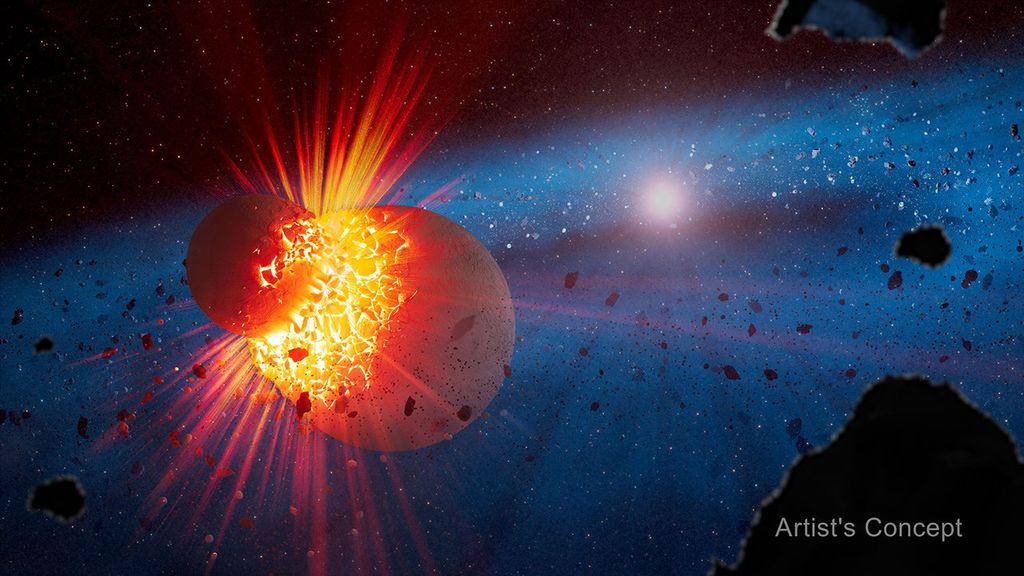
9-12 New NASA Research Shows Giant Asteroids Battered Early Earth . New research shows that more than four billion years ago the surface of Earth was heavily reprocessed – or melted, mixed, and buried – as a result of giant asteroid impacts. A new terrestrial bombardment model, calibrated using existing lunar and terrestrial data, sheds light on the role asteroid collisions played in the evolution of the uppermost layers of the early Earth during the geologic eon called the “Hadean” (approximately 4 to 4.5 billion years ago).