























2.2. How was the Sun different when it formed compared to now?
A core learning question from the Astrobiology Learning Progressions
Astrobiology Learning Progressions Navigation


Grades K-2 or Adult Naive Learner
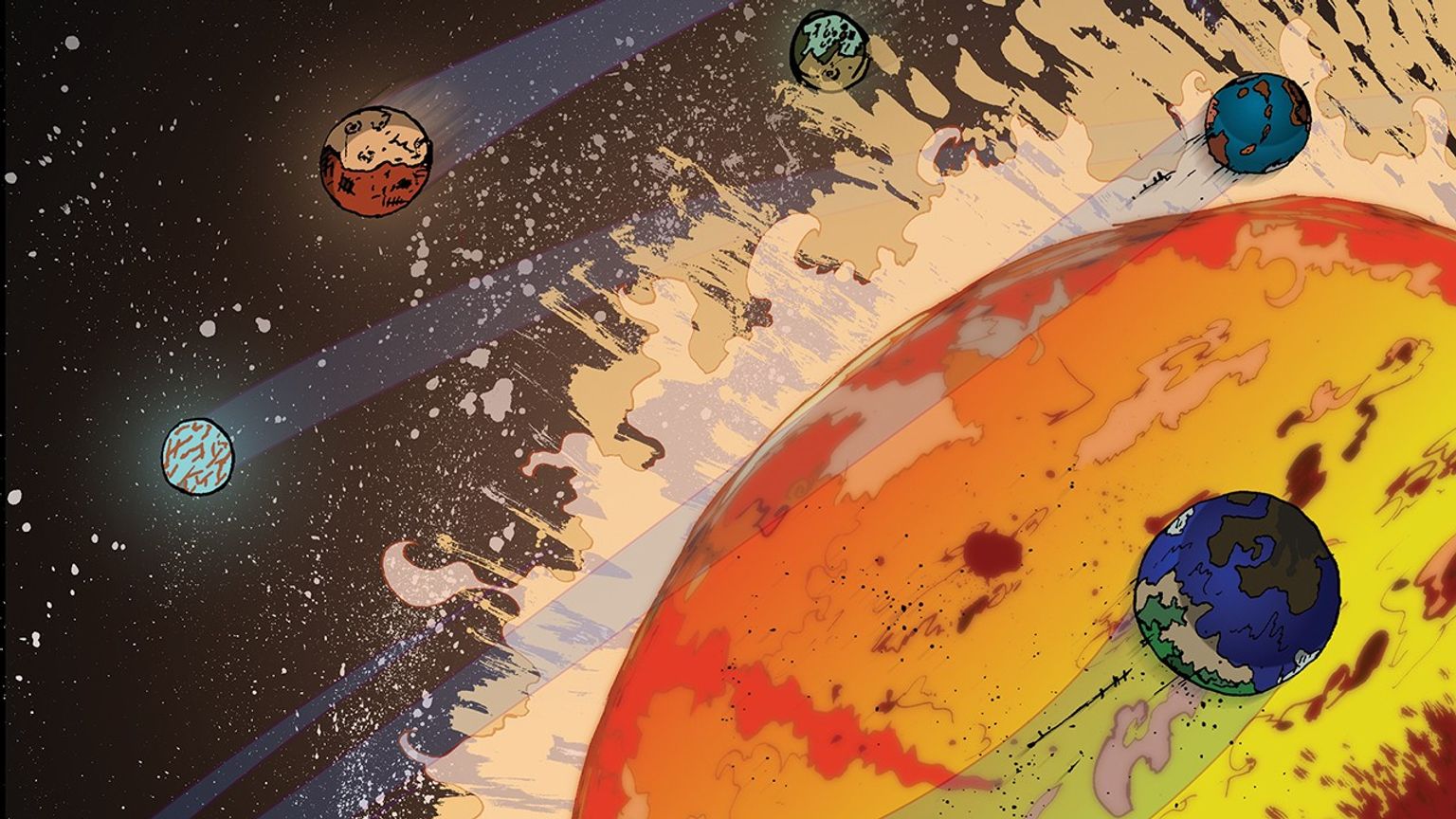
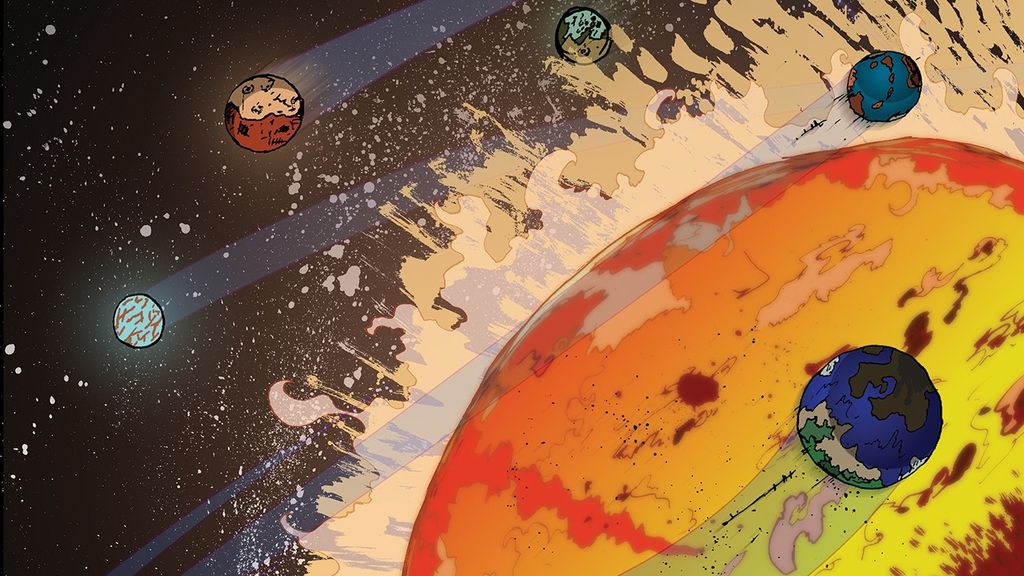
The young Sun was a little different than the Sun we see today. The young Sun was not as bright and didn’t give off as much heat as it does today. But the young Earth was also a very different place than it is now. Sometimes we talk about the air around Earth like it’s a blanket. But some blankets are better at making you warm, and the air around the young Earth was probably pretty good at keeping the planet warm.
Disciplinary Core Ideas
ESS1.C: The History of the Planet Earth: Some events happen very quickly; others occur very slowly, over a time period much longer than one can observe. (2-ESS1-1)
PS3.B: Conservation of Energy and Energy Transfer: sunlight warms Earth’s surface (K-PS3-1, K-PS3-2)
Crosscutting Concepts
Stability and Change: Things may change slowly or rapidly. (2-ESS1-1, 2-ESS2-1)
Big Ideas: The Sun and Earth have both changed since they were formed. The Sun is brighter and hotter than it was before. The air around Earth helps to keep it warm.
Boundaries: Events and timescales on Earth focus more on relative time than quantitative measurements of timescales. [site NGSS ]
K-5 The Science of the Sun: The Source of energy lab (page 49) and Harnessing the Sun’s Energy lab (page 55). In these two 30-minute lessons, students focus on the Sun as the source for all energy on Earth. Students gain a perspective of how powerful the Sun is and the small fraction of its energy we receive. Students also gain an understanding of how Earth relates to the other planets in the solar system. Goddard Space Flight Center/NASA. https://sdo.gsfc.nasa.gov/assets/docs/UnitPlanElementary.pdf

Grades 3-5 or Adult Emerging Learner
Just as the young Earth was a very different place than it is now, the young Sun was different than the Sun we see today. Back then, the Sun gave off less light and heat than it does today. It wouldn’t have looked as bright then! The way that the Sun makes heat causes it to get brighter and hotter over time.
But, if the young Sun wasn’t as bright or as hot, that makes us wonder how the young Earth was able to stay warm enough for life to survive. For instance, all of the water on Earth could have frozen, and we know that life needs liquid water to grow and thrive.
Scientists think that the atmosphere on the young Earth was also pretty different. The atmosphere is made up of all of the air around us and above, the whole way up until we get to space. The atmosphere acts kind of like a blanket, covering our world and keeping us warm. On the young Earth, that blanket might have been pretty good at keeping Earth warm enough for water to be liquid and living things to survive, even though the Sun wasn’t as bright or as hot.
Disciplinary Core Ideas
ESS1.B: Earth and the Solar System: The orbits of Earth around the Sun and of the Moon around Earth, together with the rotation of Earth about an axis between its North and South poles, cause observable patterns. These include day and night; daily and seasonal changes in the length and direction of shadows; phases of the Moon; and different positions of the Sun, moon, and stars at different times of the day, month, and year.
ESS1.C: The History of Planet Earth: Local, regional, and global patterns of rock formations reveal changes over time due to earth forces, such as earthquakes. The presence and location of certain fossil types indicate the order in which rock layers were formed. (4-ESS1-1)
Crosscutting Concepts
Patterns: Similarities and differences in patterns can be used to sort, classify, communicate and analyze simple rates of change for natural phenomena. (5-ESS1-2)
Big Ideas: Both Earth and the Sun have changed over time since their formation. The early Sun was not as hot and bright as it is now. There have also been changes in the energy the Sun gives off. The Earth’s early atmosphere helped keep Earth warm even though the Sun gave off less heat and energy then. This made the birth of life possible even with a young Sun.
Boundaries: This grade band explores the Sun’s apparent brightness compared to other stars as a result of its relative distance from Earth. Student’s may not have been introduced to other factors that affect apparent brightness of the Sun (such as stellar mass, age, stage). (5-ESS1-1)
K-5 The Science of the Sun: The Source of energy lab (page 49) and Harnessing the Sun’s Energy lab (page 55). In these two 30-minute lessons, students focus on the Sun as the source for all energy on Earth. Students gain a perspective of how powerful the Sun is and the small fraction of its energy we receive. Students also gain an understanding of how Earth relates to the other planets in the solar system. Goddard Space Flight Center/NASA. https://sdo.gsfc.nasa.gov/assets/docs/UnitPlanElementary.pdf
3-6 SpaceMath Problem 172: The Stellar Magnitude Scale. Students learn about positive and negative numbers using a popular brightness scale used by astronomers. [Topics: number relationships; decimals; negative and positive numbers] https://spacemath.gsfc.nasa.gov/stars/5Page10.pdf
4-6 SpaceMath Problem 160: The Relative Sizes of the Sun and Stars. Students work through a series of comparisons of the relative sizes of the sun compablack to other stars, to create a scale model of stellar sizes using simple fractional relationships. (e.g. if Star A is 6 times larger than Star B, and Star C is 1/2 the size of Star B, how big is Star C in terms of Star A?) [Topics: working with fractions; scale models] https://spacemath.gsfc.nasa.gov/stars/5Page25.pdf
5-8 SpaceMath Problem 156: Spectral Classification of Stars. Students use actual star spectra to classify them into specific spectral types according to a standard rubric. [Topics: working with patterns in data; simple sorting logic] https://spacemath.gsfc.nasa.gov/stars/5Page43.pdf
Grades 6-8 or Adult Building Learner
The young Sun, just like the young Earth, was very different than it is now. The Sun creates all of that light and heat through a process called “nuclear fusion”; that’s where atoms of one element are turned into atoms of another element (they’re fused together!). The Sun mostly does this by turning hydrogen into helium. Over time, as the Sun has made more helium, it has slowly gotten hotter and brighter. But that leads us to an interesting question – if the Sun was producing less light and heat back then than what it does today, wouldn’t there be freezing cold temperatures all over Earth, preventing life from getting started and surviving?
Scientists know that there was liquid water on the surface of the early Earth, so global freezing did not occur. So how did the water stay liquid? One explanation is that the atmosphere around the young Earth may have been very different than it is today. For instance, there might have been more gases like methane, carbon dioxide, and even water vapor in the atmosphere. These gases are what we call greenhouse gases. They can make the atmosphere act like a blanket which keeps the heat from Earth at the surface (rather than escaping into space). Such a blanket insulates Earth, keeping everything warm, and that’s pretty lucky for life as we know it!
Disciplinary Core Ideas
ESS1.B: Earth and the Solar System: The solar system consists of the Sun and a collection of objects, including planets, their moons, and asteroids that are held in orbit around the Sun by its gravitational pull on them. (MS-ESS1-2, MS-ESS1-3)
ESS2.A: Earth’s Materials and Systems: The planet’s systems interact over scales that range from microscopic to global in size, and they operate over fractions of a second to billions of years. These interactions have shaped Earth’s history and will determine its future. (MS-ESS2-2)
PS1.C (only in the Framework): Nuclear Processes: Nuclear fusion can result in the merging of two nuclei to form a larger one, along with the release of significantly more energy per atom than any chemical process. It occurs only under conditions of extremely high temperature and pressure. Nuclear fusion taking place in the cores of stars provides the energy released (as light) from those stars and produced all of the more massive atoms from primordial hydrogen. Thus, the elements found on Earth and throughout the universe (other than hydrogen and most of helium, which are primordial) were formed in the stars or supernovas by fusion processes.
PS1.A: Structure and Properties of Matter: Substances are made from different types of atoms, which combine with one another in various ways. Atoms form molecules that range in size from two to thousands of atoms. (MS-PS1-1) *In a liquid, the molecules are constantly in contact with others; in a gas, they are widely spaced except when they happen to collide. In a solid, atoms are closely spaced and may vibrate in position but do not change relative locations. (MS-PS1-4) *The changes of state that occur with variations in temperature or pressure can be described and predicted using these models of matter. (MS-PS1-4)
PS1.B: Chemical Reactions: Substances react chemically in characteristic ways. In a chemical process, the atoms that make up the original substances are regrouped into different molecules, and these new substances have different properties from those of the reactants. (MS-PS1-3)
PS3.A: Definitions of Energy: The term “heat” as used in everyday language refers both to thermal energy (the motion of atoms or molecules within a substance) and the transfer of that thermal energy from one object to another. In science, heat is used only for this second meaning; it refers to the energy transferred due to the temperature difference between two objects. (MS-PS1-4) *The temperature of a system is proportional to the average internal kinetic energy and potential energy per atom or molecule (whichever is the appropriate building block for the system’s material). The details of that relationship depend on the type of atom or molecule and the interactions among the atoms in the material. Temperature is not a direct measure of a system’s total thermal energy. The total thermal energy (sometimes called the total internal energy) of a system depends jointly on the temperature, the total number of atoms in the system, and the state of the material.
PS3.B: Conservation of Energy and Energy Transfer: Energy is spontaneously transferred out of hotter regions or objects and into colder ones. (MS-PS3-3)
Crosscutting Concepts
Scale, Proportion, and Quantity: Time, space, and energy phenomena can be observed at various scales using models to study systems that are too large or too small. (MS-ESS1-3) *Patterns: Macroscopic patterns are related to the nature of microscopic and atomic-level structure. (MS-PS1-2) Stability and Change: Small changes in one part of a system might cause large changes in another part. (MS-LS2-4)
Big Ideas: The Earth and the Sun have changed over time since their formation. The energy given off by the Sun provides nearly all of the energy on Earth. The early Sun was not as hot and bright as it is now. The Sun’s light and heat are made through nuclear fusion within the Sun’s core under extreme pressure and temperature. The Earth’s atmosphere likely had more Greenhouse gases which helped keep Earth warm even though the Sun gave off less heat and energy then. This made the birth of life possible even with a young Sun.
Boundaries: Students in this grade band begin developing models of molecules of varying complexities, like water, helium, carbon dioxide and methanol. Assessment does not include valence electrons and bonding energy. Students also begin physical, graphical or conceptual modeling of Earth-Sun-moon system. (MS-ESS1-1) *Assessment does not include Kepler’s laws of orbital motion or the apparent retrograde motion of the planets as viewed from Earth. (MS-ESS1-2)
3-6 SpaceMath Problem 172: The Stellar Magnitude Scale. Students learn about positive and negative numbers using a popular brightness scale used by astronomers. [Topics: number relationships; decimals; negative and positive numbers] https://spacemath.gsfc.nasa.gov/stars/5Page10.pdf
4-6 SpaceMath Problem 160: The Relative Sizes of the Sun and Stars. Students work through a series of comparisons of the relative sizes of the sun compablack to other stars, to create a scale model of stellar sizes using simple fractional relationships. (e.g. if Star A is 6 times larger than Star B, and Star C is 1/2 the size of Star B, how big is Star C in terms of Star A?) [Topics: working with fractions; scale models] https://spacemath.gsfc.nasa.gov/stars/5Page25.pdf
5-8 SpaceMath Problem 156: Spectral Classification of Stars. Students use actual star spectra to classify them into specific spectral types according to a standard rubric. [Topics: working with patterns in data; simple sorting logic] https://spacemath.gsfc.nasa.gov/stars/5Page43.pdf
6-9 SpaceMath Problem 395: Death Stars. Some stars create super-flares that are capable of eliminating life on planets that orbit close to the star. Students learn about these flares on common red-dwarf stars and compare them to flares on our own sun [Topics: scientific notation; percentages; rates of change] https://spacemath.gsfc.nasa.gov/astrob/7Page59.pdf
6-12 Astrobiology Math. This collection of math problems provides an authentic glimpse of modern astrobiology science and engineering issues, often involving actual research data. Students explore concepts in astrobiology through calculations. Relevant topics include Another Look at Solar Energy (page 45) and The Greenhouse Effect and Planetary Temperatures (page 41). NASA . https://www.nasa.gov/pdf/637832main_Astrobiology_Math.pdf
8-10 SpaceMath Problem 189: Stellar Temperature, Size and Power. Students work with a basic equation to explore the relationship between temperature, surface area and power for a selection of stars. [Topics: algebra] https://spacemath.gsfc.nasa.gov/astrob/5Page44.pdf
Grades 9-12 or Adult Sophisticated Learner
The young Sun, just like the young Earth, was very different than it is now. To understand why, we need to know a little bit about how the Sun and other stars give off so much energy.
Stars creates all of their light and heat through the process of nuclear fusion. This is where atoms of one kind of element merge together to make atoms of another element! You may recall that the Law of the Conservation of Energy tells us that energy cannot be created nor destroyed, but it can change forms. We also know from the Special Theory of Relativity that energy and mass have a very special relationship. We call it the “mass-energy equivalence”, but you’ve probably heard it more often stated as the famous equation E=mc2\. This tells us that any amount of mass also has an equivalent amount of energy, and vice versa. Well, it turns out that the process of nuclear fusion is also one where mass is converted into energy. When stars are fusing together elements, they producing lots and lots of energy. But they’re also making bigger and bigger chemical elements in the process.
The most common nuclear fusion reactions in stars are ones that convert hydrogen into helium. This is actually how most of the energy coming from the Sun is produced. However, stars will also then fuse together helium atoms to make elements like carbon, oxygen, and nitrogen. Many of the chemical elements are made this way. It’s such an important process that is has a special name, “stellar nucleosynthesis”, and it’s responsible for our Sun giving off so much light and heat.
Over time, as stellar nucleosynthesis has gone on in the Sun, making more and more helium and carbon and such, the Sun has slowly gotten hotter and brighter. The main reason for this is that as these heavier elements form and then start undergoing stellar nucleosynthesis reactions, the core of the Sun starts to contract (it shrinks down and becomes more dense) and that increases the temperatures and pressures inside, which then in turn causes even more reactions to release even more energy.
The Sun was about 30% less luminous in its youth than it is now, but scientists also know that there was liquid water on Earth’s surface at that time (from studying the rock record). How could water on Earth’s surface remain liquid with that much less light and heat coming from the Sun? How could life – which requires liquid water – have gotten started on the young Earth in freezing conditions? Scientists call this the “faint young Sun paradox.” Resolving this question is an active area of research, and there are likely many contributing factors. One way to resolve the conflict is with the greenhouse hypothesis, which states that Earth’s early atmosphere likely contained higher levels of greenhouse gases – especially methane, carbon dioxide, and water vapor. Those and other gases were coming from degassing and volcanic processes following the accretion of rocky particles during Earth’s formation. On Earth today, the carbon dioxide in the air is converted into oxygen by photosynthetic organisms like plants and algae. On the early Earth, there were no such organisms to do that conversion, so carbon dioxide remained in the atmosphere and contributed to global warming, which kept the water liquid on the surface despite the fainter, less luminous Sun.
Disciplinary Core Ideas
ESS1.A: The Universe and Its Stars: The star called the Sun is changing and will burn out over a lifespan of approximately 10 billion years. (HS-ESS1-1) *The study of stars’ light spectra and brightness is used to identify compositional elements of stars, their movements, and their distances from Earth. (HS-ESS1-2, HS-ESS1-3) *Nearly all observable matter in the universe is hydrogen or helium, which formed in the first minutes after the big bang. Elements other than these remnants of the big bang continue to form within the cores of stars. Nuclear fusion within stars produces all atomic nuclei lighter than and including iron, and the process releases the energy seen as starlight. Heavier elements are produced when certain massive stars achieve a supernova stage and explode. (HS-ESS1-2, HS-ESS1-3) *Stars go through a sequence of developmental stages — they are formed; evolve in size, mass, and brightness; and eventually burn out. Material from earlier stars that exploded as supernovas is recycled to form younger stars and their planetary systems.
ESS1.B: Earth and the Solar System: Cyclical changes in the shape of Earth’s orbit around the Sun, together with changes in the tilt of the planet’s axis of rotation, both occurring over hundreds of thousands of years, have altered the intensity and distribution of sunlight falling on the earth. These phenomena cause a cycle of ice ages and other gradual climate changes.
ESS2.A: Earth Materials and Systems: The geological record shows that changes to global and regional climate can be caused by interactions among changes in the Sun’s energy output or Earth’s orbit, tectonic events, ocean circulation, volcanic activity, glaciers, vegetation, and human activities. These changes can occur on a variety of time scales from sudden (e.g., volcanic ash clouds) to intermediate (ice ages) to very long-term tectonic cycles. (HS-ESS2-4)
PS3.D: Energy in Chemical Processes and Everyday Life: Nuclear Fusion processes in the center of the Sun release the energy that ultimately reaches Earth as radiation. (HS-ESS1-1) The main way that solar energy is captured and stored on Earth is through the complex chemical process known as photosynthesis. (HS-LS2-5)
PS1.C: Nuclear processes: Nuclear processes, including fusion, fission, and radioactive decays of unstable nuclei, involve release or absorption of energy. (HS-PS1-8)
PS3.A: Definitions of Energy: Energy is a quantitative property of a system that depends on the motion and interactions of matter and radiation within that system. That there is a single quantity called energy is due to the fact that a system’s total energy is conserved, even as, within the system, energy is continually transferred from one object to another and between its various possible forms. (HS-PS3-1, HS-PS3-2) At the macroscopic scale, energy manifests itself in multiple ways, such as in motion, sound, light, and thermal energy. (HS-PS3-2, HS-PS3-3)
PS3.B: Conservation of Energy and Energy Transfer: Conservation of energy means that the total change of energy in any system is always equal to the total energy transferred into or out of the system. (HS-PS3-1) Energy cannot be created or destroyed, but it can be transported from one place to another and transferred between systems. (HS-PS3-1, HS-PS3-4)
PS4.B: Electromagnetic Radiation: Electromagnetic radiation (e.g., radio, microwaves, light) can be modeled as a wave of changing electric and magnetic fields or as particles called photons. The wave model is useful for explaining many features of electromagnetic radiation, and the particle model explains other features. (HS-PS4-3) When light or longer wavelength electromagnetic radiation is absorbed in matter, it is generally converted into thermal energy (heat). (HS-PS4-4)
Crosscutting Concepts
Cause and Effect: Cause and effect relationships can be suggested and predicted for complex natural and human designed systems by examining what is known about smaller scale mechanisms within the system. (HS-PS3-5) Systems and System Models: When investigating or describing a system, the boundaries and initial conditions of the system need to be defined and their inputs and outputs analyzed and described using models. (HS-PS3-4) *Stability and Change: Change and rates of change can be quantified and modeled over very short or very long periods of time. Some system changes are irreversible. (HS-ESS3-5)
Big Ideas: The Earth and the Sun have changed over time since their formation. Our knowledge of stars and stellar processes tells us that the Sun gave off less energy when it was young than it does now. The “Faint young Sun paradox” was presented as a scientific problem to question how water on Earth remained liquid with less heat coming from the early Sun. Elevated levels of greenhouse gases in the atmosphere helped keep the early Earth warm even though the Sun gave off less heat and energy. With a liquid water supply and ideal atmospheric conditions, the birth of life on Earth was possible with a young Sun.
Boundaries: Emphasis is on the energy transfer mechanisms that allow energy from nuclear fusion in the Sun’s core to reach Earth and the way nucleosynthesis varies as a function of the mass of a star and the stage of its lifetime. Grade level appropriate observations include the masses and lifetimes of other stars, as well as the ways that the Sun’s radiation varies due to sudden solar flares (“space weather”), the 11-year Sunspot cycle, and non-cyclic variations over centuries. (HS-ESS1-1). Does not include details of the atomic and subatomic processes involved with the Sun’s nuclear fusion (HS-ESS1-1) or details of the many different nucleosynthesis pathways for stars of different masses (HS-ESS1-3).
6-9 SpaceMath Problem 395: Death Stars. Some stars create super-flares that are capable of eliminating life on planets that orbit close to the star. Students learn about these flares on common red-dwarf stars and compare them to flares on our own sun [Topics: scientific notation; percentages; rates of change] https://spacemath.gsfc.nasa.gov/astrob/7Page59.pdf
6-12 Astrobiology Math. This collection of math problems provides an authentic glimpse of modern astrobiology science and engineering issues, often involving actual research data. Students explore concepts in astrobiology through calculations. Relevant topics include Another Look at Solar Energy (page 45) and The Greenhouse Effect and Planetary Temperatures (page 41). NASA . https://www.nasa.gov/pdf/637832main_Astrobiology_Math.pdf
8-10 SpaceMath Problem 189: Stellar Temperature, Size and Power. Students work with a basic equation to explore the relationship between temperature, surface area and power for a selection of stars. [Topics: algebra] https://spacemath.gsfc.nasa.gov/astrob/5Page44.pdf
9-12 SpaceMath Problem 483: The Radioactive Dating of a Star in the Milky Way! Students explore Cayrel’s Star, whose age has been dated to 12 billion years using a radioisotope dating technique involving the decay of uranium-238. [Topics: half-life; exponential functions; scientific notation] https://spacemath.gsfc.nasa.gov/stars/9Page5.pdf
9-12 SpaceMath Problem 482: Exploring Density, Mass and Volume Across the Universe. Students calculate the density of various astronomical objects and convert them into hydrogen atoms per cubic meter in order to compare how astronomical objects differ enormously in their densities. [Topics: density=mass/volume; scientific notation; unit conversion; metric math] https://spacemath.gsfc.nasa.gov/stars/9Page4.pdf