
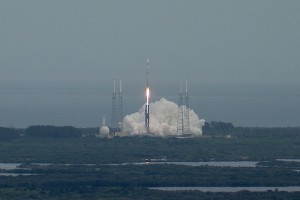
The Centaur upper stage performed its first burn and is now coasting with the MAVEN spacecraft aboard. It will coast until 2:09 p.m. EST and then reignite to put MAVEN on its final course for Mars.
Launch Images
 Read Full Post
























 Read Full Post
The Centaur upper stage performed its first burn and is now coasting with the MAVEN spacecraft aboard. It will coast until 2:09 p.m. EST and then reignite to put MAVEN on its final course for Mars.
The fuel and oxygen tanks on the Atlas V booster and Centaur upper stage are loaded with propellants now, a major step on the way to launching today at 1:28 p.m. EST. Launch controllers are getting ready for the last planned hold of the countdown, a 10-minute pause that begins at T-4 minutes.
The field mills around the launch site are back to green this afternoon following a switch to red conditions.
Launch controllers gave the "go" to begin loading liquid hydrogen, or LH2, into the Centaur upper stage. The Centaur will hold about 12,000 gallons of the propellant. The RL-10 engine burns hydrogen and oxygen to produce 22,300 pounds of thrust.
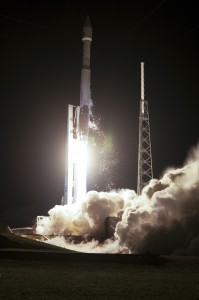
Today's liftoff fire and thunder will be produced by an Atlas V rocket powered by an RD-180 engine at the bottom of the Atlas V first stage. The engine, which uses two thrust chambers and nozzles, burns rocket-grade kerosene and liquid oxygen to generate 860,200 pounds of thrust. A Centaur upper stage will take over four minutes, …
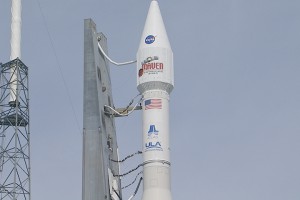
The engine on the Centaur upper stage is being conditioned for the flow of liquid hydrogen through it later in the countdown. The stage will hold about 12,000 gallons of the minus-423 degree propellant. Meanwhile, controllers also are overseeing the loading of liquid oxygen into the Atlas V first stage.
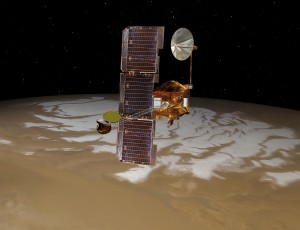
The MAVEN spacecraft will become the fourth operational spacecraft in orbit around Mars when it reaches the Red Planet in 10 months, assuming the three already there remain active. NASA's Mars Odyssey (pictured) is the elder of the group, having launched in 2001. Launched in 2003, the European Space Agency's Mars Express is the middle child …

Omar Baez, left, of NASA's Launch Services Program, or LSP, is launch manager for MAVEN. He is the highest authority during the countdown and provides NASA's "go/no-go" decision to the mission director. He sits at a console in the Atlas Space Operations Center at Cape Canaveral Air Force Station, a building known as the ASOC. …
