























More Motion In The Ocean
By Alek Petty
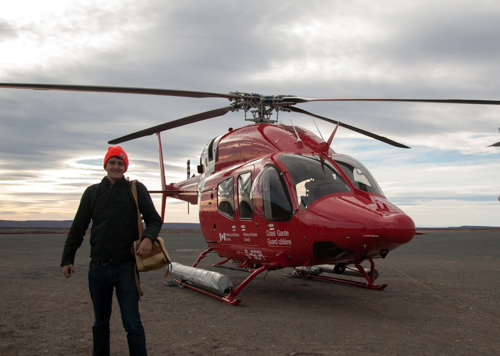
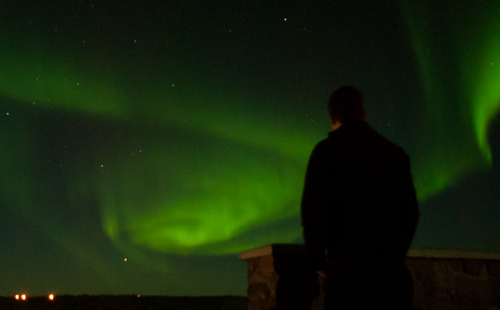
My journey up to the ship went smoothly and I even had time to observe the Northern Lights (Aurora Borealis) in full bloom during our overnight layover in Yellowknife (in the Northwest Territories of Canada). The following day, a Canadian Coast Guard helicopter transferred us from Kugluktuk airport onto the ship, and after another day spent refueling and replenishing the boat, we were finally on our way to the Arctic Ocean.
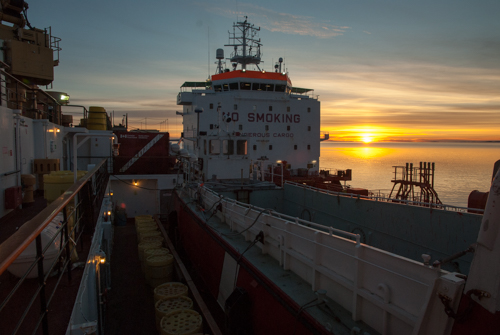
I actually spent the first two days of our polar expedition sat out on deck, enjoying the sunshine and views over the Amundsen Gulf. In the distance I could just about make out the mouth of the Mackenzie River delta – a key outflow of fresh and mineral rich river runoff into the Arctic. This shelf sea region is rich in wildlife, including beluga whales and even narwhals. We looked out eagerly, but only spotted a couple of lowly seals in the distance. Maybe on our way back we’ll have more joy.
On Saturday morning, we emerged into the Arctic Ocean proper —the Beaufort Sea! — where conditions were a bit less serene. In fact, one of the consequences of the diminished Arctic sea ice cover over the past decades has been an increase in Arctic Ocean waviness, as the lack of sea ice enables winds to more effectively whip up the ocean. Arguably one of the most distressing impacts of climate change for us unhardened scientists.
Despite the continued lack of sea ice, the water sampling exercises have begun in earnest. At each research station (a virtual station if you will, we just stop at a predetermined location in the ocean) a large metal carousel with various water samplers attached —a rosette, as we call it— is released, profiling the water column as it sinks to the bottom of the ocean, before being hauled back up to the ship for analysis.
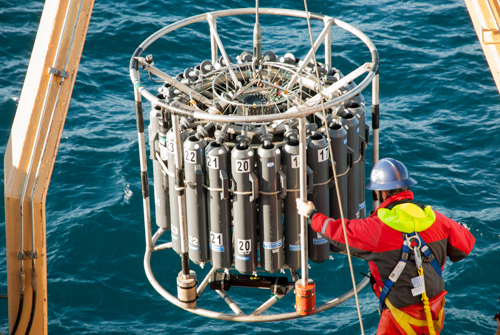
There are around 50 stations in total that we plan on hitting during this expedition. The various scientists on board all have their own things their looking for in the water —plankton, bacteria, alkalinity, dissolved inorganic/organic carbon, micro-plastics (yep, they make it to the Arctic Ocean too), etc. You name it, we’re sampling it.
One of my tasks, along with Japanese scientist Seita Hoshino, is to profile the water column in-between theses stations using XCTD (eXpendable Conductivity Temperature and Density) probes. XCTDs provide a quick and cheap (well, about $800 per probe, so not that cheap) real-time analysis of the temperature and salinity of the water column while the ship is moving. I’ll try and show you an example profile in a later blog post.
We’re hoping to hit some ice soon, as for us ice observers there’s not a whole lot for us to get really excited about yet. It’s quite the contrast to the cold, icy conditions of my 2014 expedition thus far…
