















NASA’s Perseverance Sets Off-World Record for Total Distance Driven
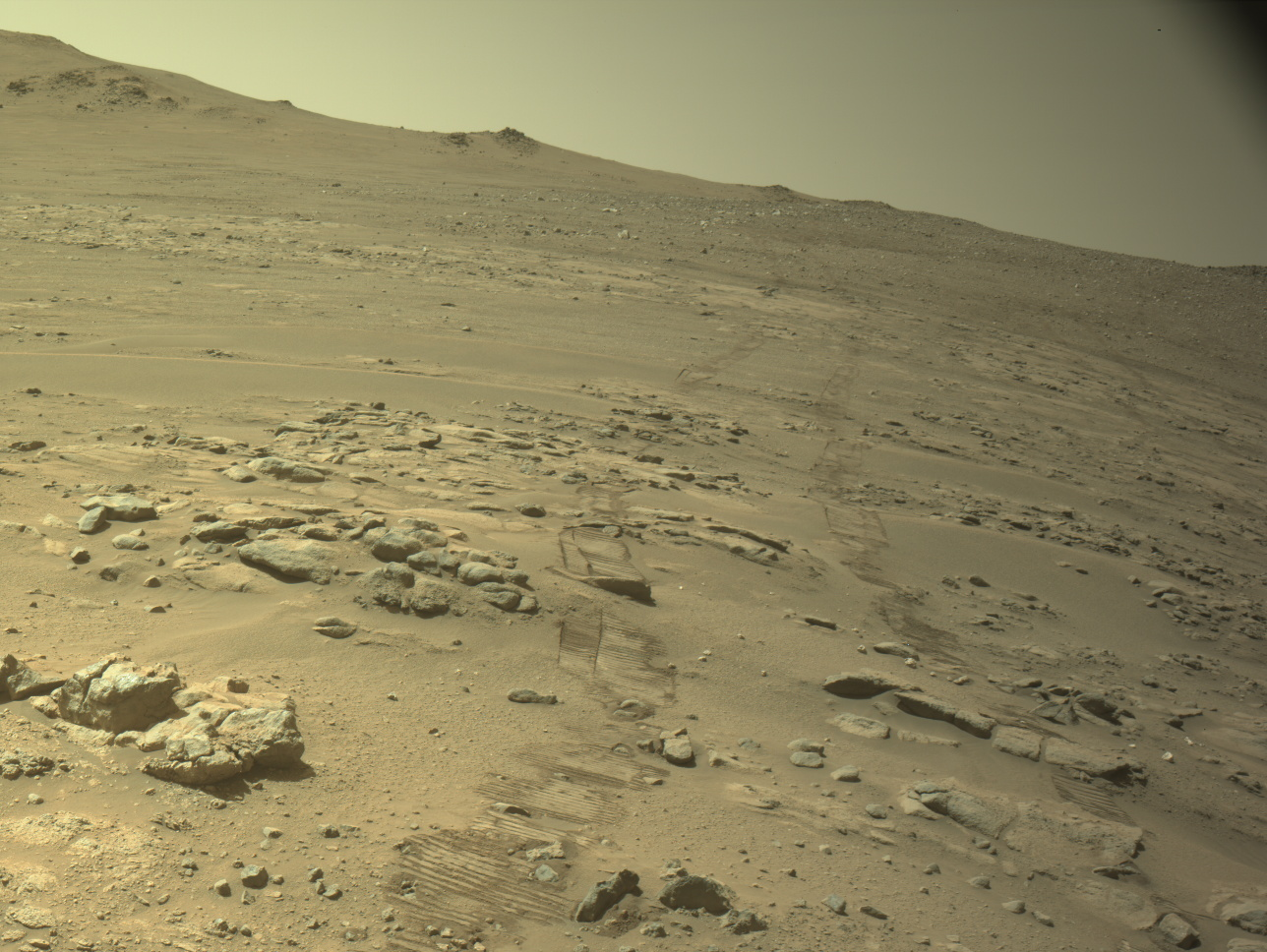
NASA’s Perseverance Mars rover has driven farther than any vehicle ever has on the surface of another world. On Oct. 11, the rover’s odometer reached 28.10 miles (45.22 kilometers), eclipsing the record of 28.06 miles (45.16 kilometers) set by NASA’s Opportunity rover, which explored Mars from 2004 to 2018. Perseverance reached the mark on the 2,006th Martian day, or sol, of its mission, covering in five and a half years a distance that took Opportunity almost 15.
The milestone came as Perseverance traveled toward an area called “Idubi” through the region off the western rim of Jezero Crater nicknamed “Lac de Charmes,” where the rover is investigating what may be some of the oldest terrain ever explored in the solar system. The rocks and terrain of Lac de Charmes are so ancient that their Earthly equivalents have long since been erased by erosion and plate tectonics (Mars doesn’t have tectonic plates), and Idubi is where the science team hopes to find traces of ancient hydrothermal systems.
Much of the credit belongs to Perseverance’s self-driving capability. Using an autonomous navigation system known as AutoNav, the rover images the terrain while rolling, builds a 3D map of hazards, and plots its course between waypoints selected by rover planners on Earth — a capability the team calls “thinking while driving.” Perseverance can do all that at or near its top speed, covering as much as 1,351 feet (412 meters) in a single sol. The six-wheeled scientist has driven more than 90% of its total distance using AutoNav to evaluate the terrain, compared with about 5% for the first Martian AutoNav system on Opportunity and its twin, Spirit. Where NASA’s first Mars rover, Sojourner, assessed the path ahead using 20 measurement points, Perseverance processes 600,000 with every look.
“It is an honor to be working on Perseverance at a moment when the technology has evolved to the point that drives like these are routine,” said Steven Lee, the project manager of the Curiosity and Perseverance rovers at NASA’s Jet Propulsion Laboratory in Southern California. “The original mission called for no more than 12.4 miles of driving. We’ve blown well past that, and with all mobility systems fully operational and favorable extended-ground-life test results, we expect Perseverance to keep adding to this record for many years to come.”
NASA recently approved the mission’s first extension, which began in October and will carry Perseverance’s exploration of the crater rim through roughly the end of 2028.
On six wheels, many shoulders
Perseverance’s record caps nearly three decades of NASA rover operations on Mars, each mission driving farther and more capably than the last.
The microwave-oven-size Sojourner rover covered about 330 feet (100 meters) during its 83-sol mission in 1997. The golf-cart-size twins Spirit and Opportunity arrived in 2004 with 90-sol prime missions. Spirit logged 4.8 miles (7.7 kilometers) before succumbing to the Martian winter in 2010. Opportunity kept rolling for 5,111 sols, completing the first extraterrestrial marathon in 2015 and setting the record Perseverance has now surpassed. The agency’s Curiosity rover, which landed in Gale Crater in 2012 and remains hard at work, has logged more than 23.65 miles (38.07 kilometers).
“The rover that broke this record did so by making its own decisions about the path. Given the autonomy to just go, Perseverance is a better driver than the one that landed, and we’re not done,” Mark Maimone, deputy team chief for robotic operations on Perseverance. “Our newest software teaches Perseverance to steer less and roll more, and to check its own position against orbital maps mid-drive. The next frontier is sunlight itself. Glare in the navigation cameras is why we park by mid-afternoon if we’re driving toward the Sun, and if we can teach the rover to see past those artifacts, every rover that follows gets a longer working day.”
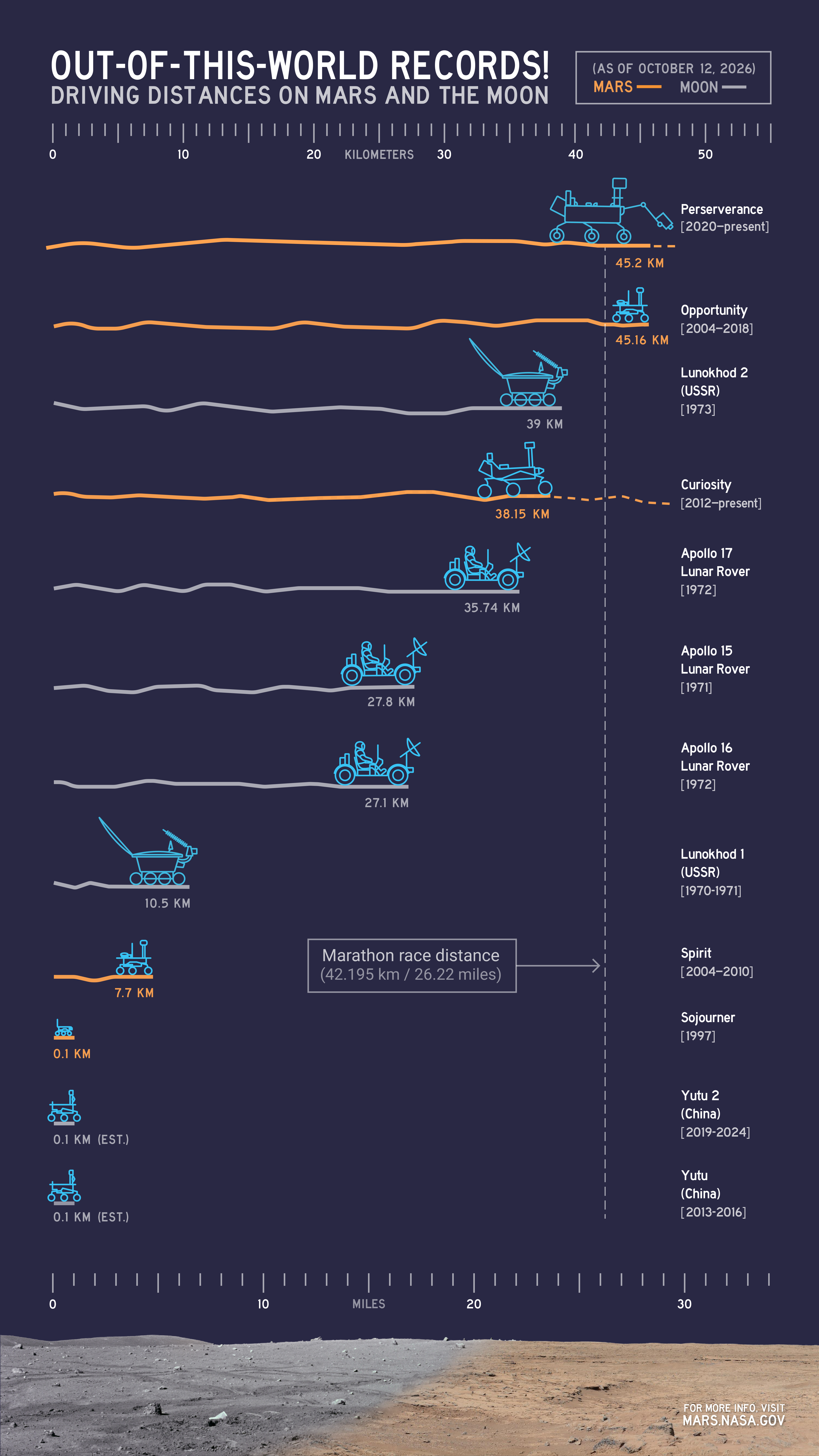
The extraterrestrial off-road driving record isn’t limited to Mars: Lunar driving records were broken earlier in the journey. Perseverance rolled past both the 22.2 miles (35.7 kilometers) covered by Apollo 17 astronauts Gene Cernan and Harrison Schmitt in 1972 and the 24.2 miles (39 kilometers) driven by the Soviet Union’s Lunokhod 2 rover in 1973.
Setting distance records is just a bonus. Stamina and longer drives are putting more geologic diversity within reach faster — more outcrops examined and more of the Red Planet’s history read from its rocks. That reach carried Perseverance from an ancient lakebed up a fossilized river system, where the rover found a potential biosignature at a rock called “Cheyava Falls,” and on to the crater rim, where an entirely different kind of ancient habitat — hydrothermal — may await.
Perseverance has collected 29 rock and regolith samples spanning the crater floor, a delta fan formed by a long-gone river, and now the crater rim. In the latter region, it has been exploring impact-generated rocks some 4 billion years old, from a chapter of planetary history almost entirely erased on Earth.
After Lac de Charmes, the rover will continue along the crater rim and head south during the extended mission towards Rainbow Falls, a 328-foot-wide (100-meter-wide) block of ancient crust uplifted by the impact that created Jezero.