NASA’s Psyche Mission Tracks Interstellar Comet 3I/ATLAS
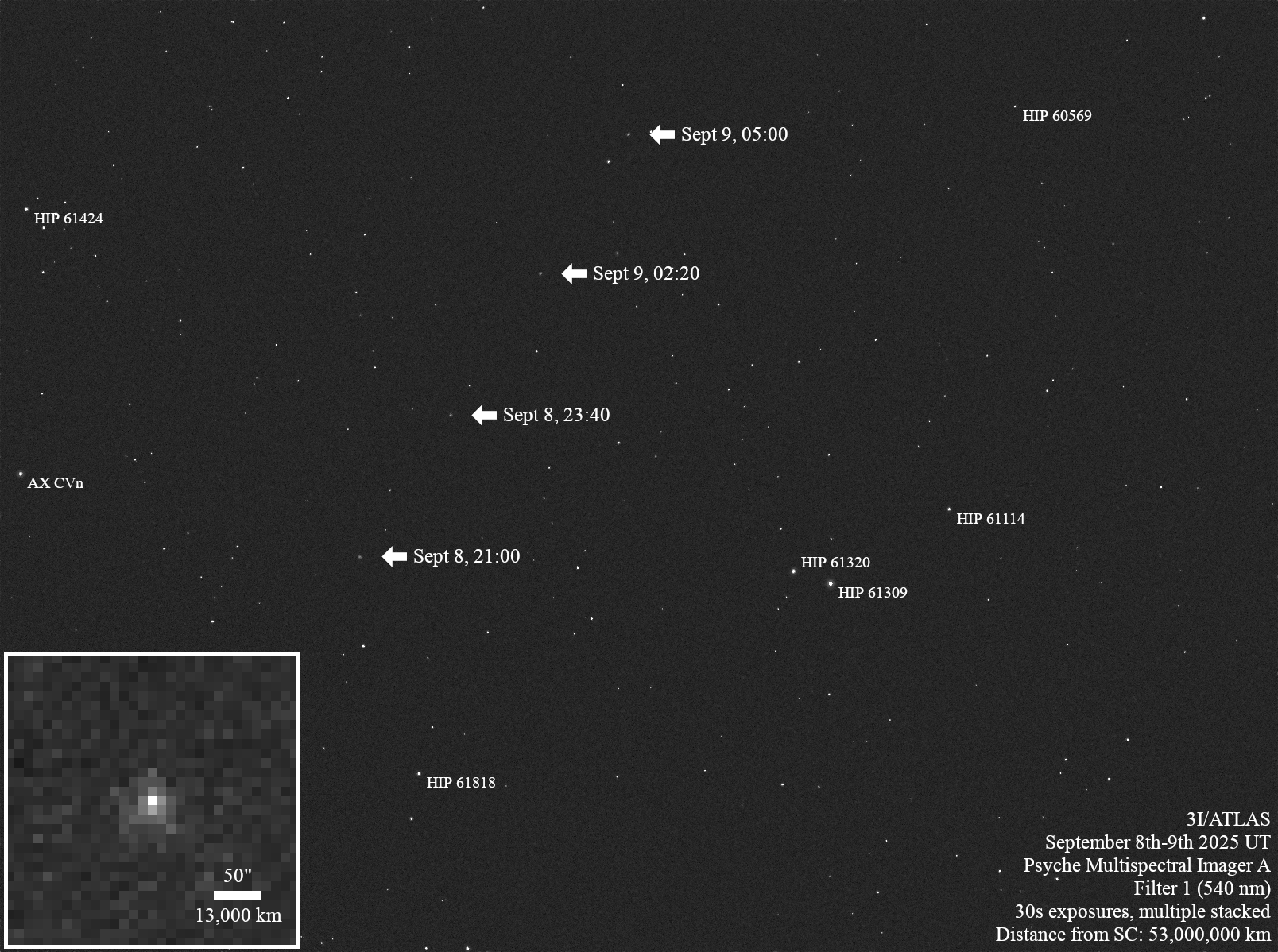
NASA’s Psyche observed interstellar comet 3I/ATLAS over the course of eight hours on Sept. 8 and 9, when the comet was about 33 million miles (53 million kilometers) from the spacecraft. Captured by the mission’s multispectral imager, these observations help astronomers refine the trajectory of 3I/ATLAS.
Psyche’s multispectral imager instrument comprises a pair of identical cameras equipped with filters and telescopic lenses to photograph the metal-rich asteroid Psyche’s surface in different wavelengths of light. While comet 3I/ATLAS was distant from the spacecraft during these observations, the imager’s sensitivity to the comet’s reflected sunlight meant that the mission could precisely track the object. Observations by the mission have also provided more information about 3I/ATLAS’s faint coma, or cloud of gas and dust, surrounding its nucleus — the central frozen core of ice and rock.
Psyche joins many other NASA missions in determining the comet’s location over time, which helps astronomers better understand its motion as it passes through the solar system. While the comet poses no threat to Earth, NASA’s space missions help support the agency’s ongoing commitment to find, track, and better understand solar system objects.
Managed by NASA’s Jet Propulsion Laboratory in Southern California, the Psyche spacecraft is healthy and currently about 260 million miles (420 million kilometers) from Earth. It will fly relatively close to Mars in May 2026 for a gravity assist that will speed up the spacecraft and modify its direction of travel toward the asteroid Psyche. The spacecraft will begin orbiting the asteroid in July 2029 to start its prime mission, which is expected to last at least 26 months.