
















Scientists estimate that Earth is home to more than 100 million lakes. Among the most unusual is Lake Unter-See, one of Antarctica’s largest and deepest surface lakes, known for its distinctive water chemistry. Its ice-covered waters have exceptionally high levels of dissolved oxygen and methane, low dissolved carbon dioxide, and a high pH.
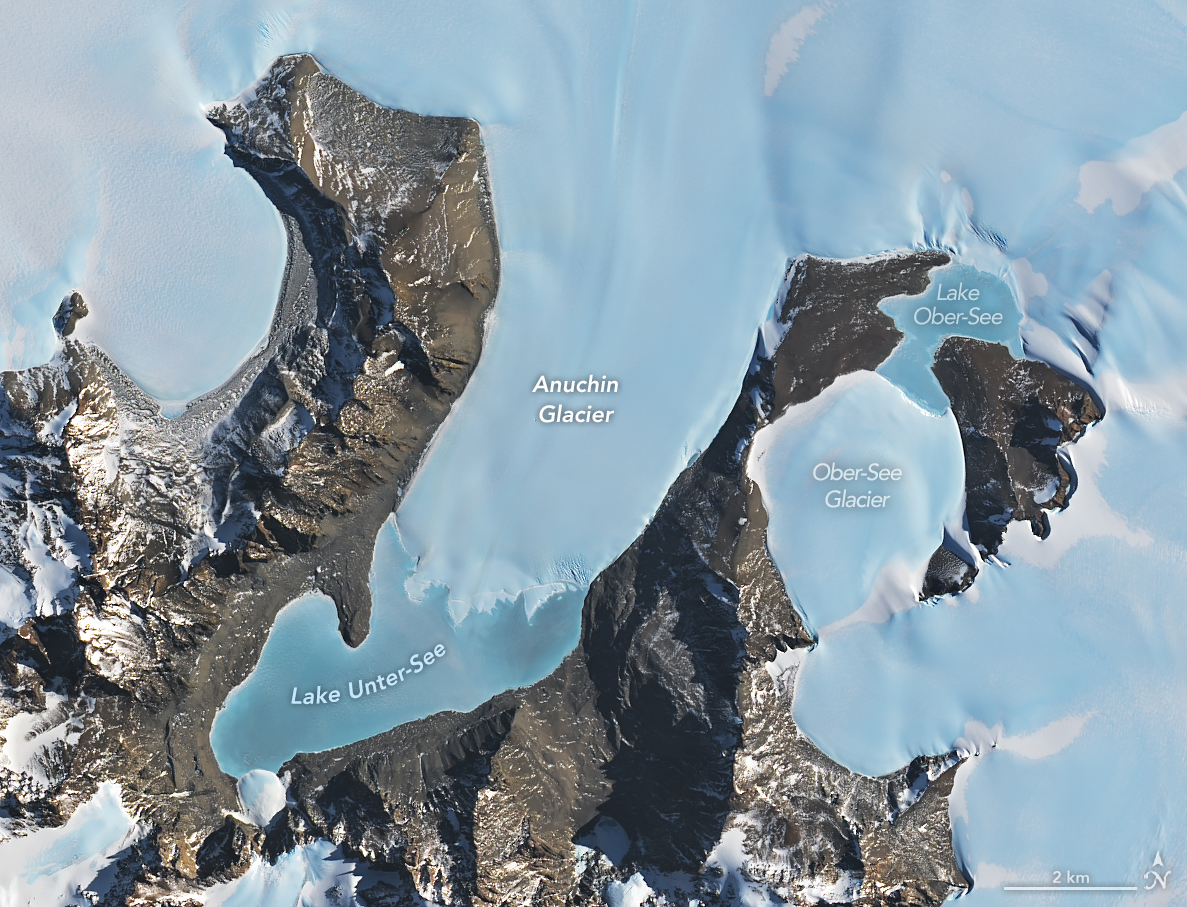
The OLI (Operational Land Imager) on Landsat 9 captured this image on February 16, 2026, during the Antarctic summer. With mean annual temperatures of about minus 10 degrees Celsius (14 degrees Fahrenheit), Lake Unter-See remains frozen year-round, its waters tightly sealed beneath 2 to 4 meters (7 to 13 feet) of ice. Sunlight penetrates the ice and warms the water below, melting the submerged face of Anuchin Glacier where it enters the lake, but the cold surface and strong winds drive evaporation and sublimation, preventing significant surface melting. The lake's maximum depth is nearly 170 meters (558 feet).
Hidden below the ice is one of the lake's most remarkable features: large, conical microbialite structures spread across the lake's floor. The structures, formed by photosynthetic microbes that trap and bind sediment, were first discovered by geobiologist Dale Andersen and colleagues in 2008. The formations are thought to be modern, living examples similar to some of Earth's oldest fossils—stromatolites found in places such as southwestern Greenland and Western Australia. They offer a glimpse back to a time more than 3 billion years ago, when microbes were the only form of life on Earth.
The scientists noted that similar periodic flooding may provide "biological stimuli to other carbon dioxide-depleted Antarctic ecosystems and perhaps even icy lakes on early Mars.”
The formations in Lake Unter-See are large in comparison to similar structures found elsewhere on Earth. "Unter-See's microbialites are unlithified, finely laminated structures that rise up to 70 centimeters (28 inches) above the lake floor and, to date, have not been reported in any other modern environment," Andersen said. The microbes that build them, primarily cyanobacteria, likely benefit from what Andersen described as Unter-See's "restricted" and "low-disturbance" conditions, where the largest animals are microscopic rotifers, nematodes, and tardigrades.
Astrobiologists also look to the lake as a possible analog for the type of environment where life might persist, or perhaps leave traces, on other worlds. The lake's dark, stratified, anoxic south basin, which supports a diverse microbial ecosystem, has been treated as a small-scale analog for the subsurface ocean on Saturn's moon Enceladus—a lightless environment containing dissolved hydrogen, methane, carbon dioxide, and ammonia. Enceladus is a place, Andersen said, where microbial life, if present, would likely rely on chemistry rather than sunlight. Lake Unter-See's ice-sealed waters also make it a valuable analog for the ice-covered lakes thought to have existed on early Mars, he added.
Despite its seemingly stable conditions, the lake occasionally experiences abrupt changes. During fieldwork in 2019, Andersen and colleagues observed a rapid increase in Unter-See's water levels. The team later analyzed elevation data from NASA’s ICESat-2 (Ice, Cloud, and Land Elevation Satellite-2) and confirmed that the 2-meter rise was caused by a glacial lake outburst flood from nearby Lake Ober-See. Time-lapse images from cameras on the ground also recorded the event, and in situ measurements made afterward documented its effects within the lake.
The team concluded that the outburst flood had released about 17.5 million cubic meters of meltwater, altering Unter-See’s pH and replenishing the normally carbon-depleted system with carbon dioxide-rich waters, likely enhancing microbial productivity. The scientists noted that similar periodic flooding may provide "biological stimuli to other carbon dioxide-depleted Antarctic ecosystems and perhaps even icy lakes on early Mars."
Editor's Note: This story was corrected on April 9, 2026, to more accurately describe Lake Unter-See's water chemistry. Details were also added that more fully explain why astrobiology researchers study the lake.
NASA Earth Observatory image by Michala Garrison, using Landsat data from the U.S. Geological Survey. Story by Adam Voiland.
References & Resources
- Andersen, D.T. via YouTube (2024, October 6) Whispers Beneath the Ice: Discovering the Hidden Life of Lake Untersee. Accessed March 10, 2026.
- Andersen, D.T., et al. (2011) Discovery of large conical stromatolites in Lake Untersee, Antarctica. Geobiology, 9(3), 280-293.
- Astrobiology (2026) Dale Andersen's Field Reports. Accessed March 10, 2026.
- Austrian Polar Research Institute (2023, May 22) Glacier shapes unique Antarctic lake ecosystem. Accessed March 10, 2026.
- Extinct (2025, June 1) From Stromatolites to Martian Leopard Spots: Circumstantial Traces and the Reconstruction of Early Life. Accessed March 10, 2026.
- Faucher, B., et al. (2021) Glacial lake outburst floods enhance benthic microbial productivity in perennially ice-covered Lake Untersee (East Antarctica). Communications Earth & Environment, 2, 211.
- Greco, C. et al. (2020) Microbial Diversity of Pinnacle and Conical Microbial Mats in the Perennially Ice-Covered Lake Untersee, East Antarctica. Frontiers in Microbiology, 11(607251).
- NASA Earth Observatory (2006, June 18) Strelley Pool Chert and Early Life. Accessed March 10, 2026.
- SETI (2026, February 26) Dale Andersen’s Antarctic Field Season 18-19 February. Accessed March 10, 2026.
- Verpoorter, C., et al. (2014) A global inventory of lakes based on high-resolution satellite imagery. Geophysical Research Letters, 41(18), 6396-6402.
- Vimercati, L. Lake Untersee, Queen Maud Land, Antarctica. Accessed March 10, 2026.