





















NASA Fuels Roman Space Telescope for Late August Launch
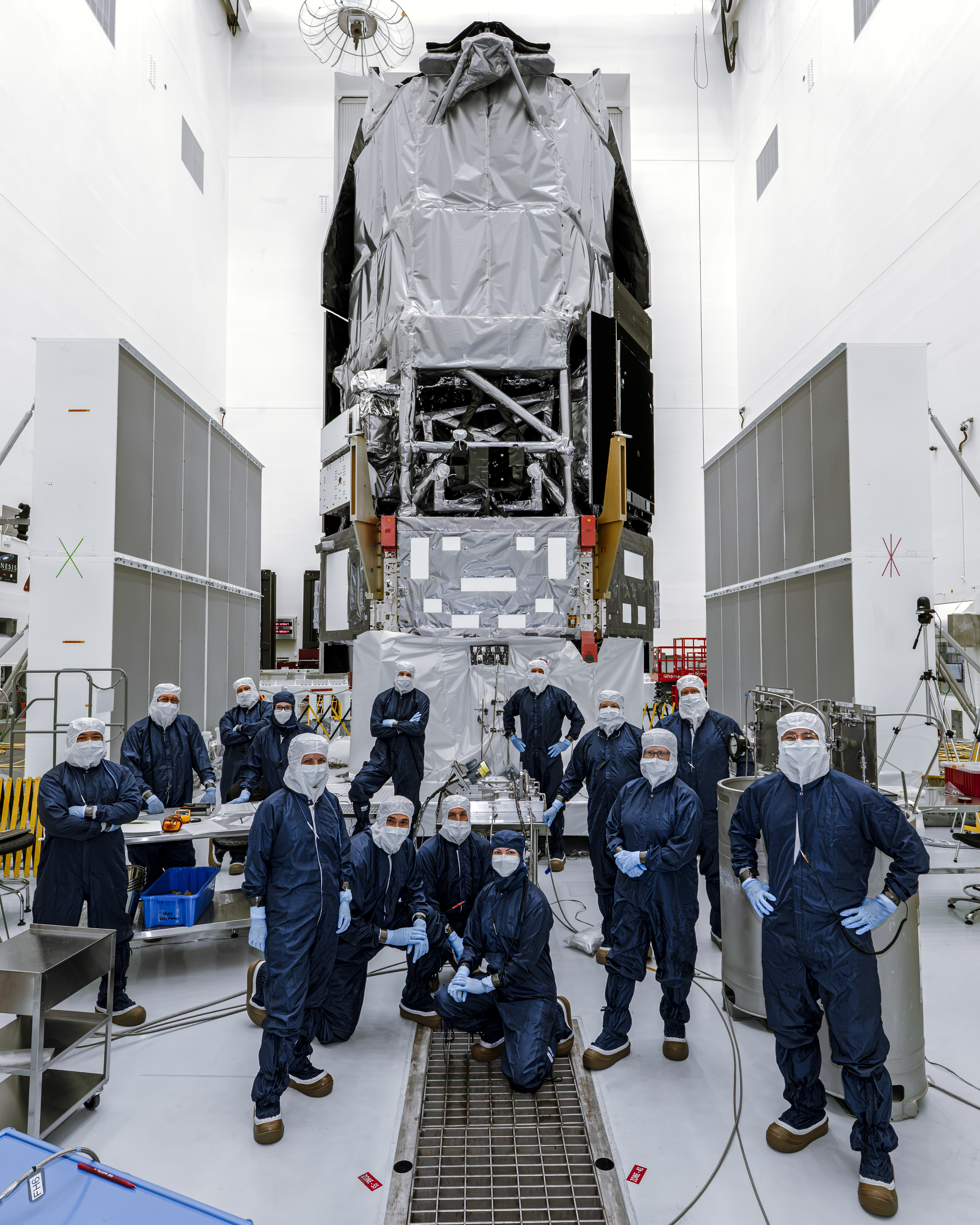
Technicians completed fueling NASA’s Nancy Grace Roman Space Telescope, bringing it an important step closer to launch. On July 25, the team completed operations that carefully loaded 290 gallons of hydrazine fuel into the observatory at the Payload Hazardous Servicing Facility at NASA’s Kennedy Space Center in Florida.
After launch and separation from the rocket, Roman will use this onboard propellant to perform maneuvers as it travels to Sun-Earth Lagrange point 2, or L2, located about one million miles from Earth. There, about four times the distance to the Moon, it will have an ideal home for astronomy.
Roman will use its propellant to power two types of thrusters that help it stay in its planned orbit around L2 and ensure the solar array panels face the Sun, which is the observatory’s main source of power throughout the mission. Roman has a five-year primary mission, and potentially enough fuel to support an additional five years for an extended mission. The Roman team recently cleaned and checked out the six solar array panels to prepare them for launch.
Researchers are eager to study thousands of exoplanets Roman will discover, to learn how closely they resemble Earth. They also will use Roman to study the mystery of dark energy and why it’s causing the universe to expand faster over time.
Now that fueling is complete, technicians soon will attach Roman to a device that secures to the rocket’s top stage. After that, Roman will be encapsulated within the rocket’s protective shell, known as a payload fairing. The payload fairing protects the spacecraft from aerodynamic forces and heat during ascent.
Launching nine months ahead of schedule, NASA and SpaceX are targeting liftoff for no earlier than 7:26 a.m. EDT Sunday, Aug. 30, aboard a SpaceX Falcon Heavy from Launch Complex 39A at Kennedy.
To learn more about Roman, visit: