




























NASA’s Roman Space Telescope Begins Integrated Operations for Launch
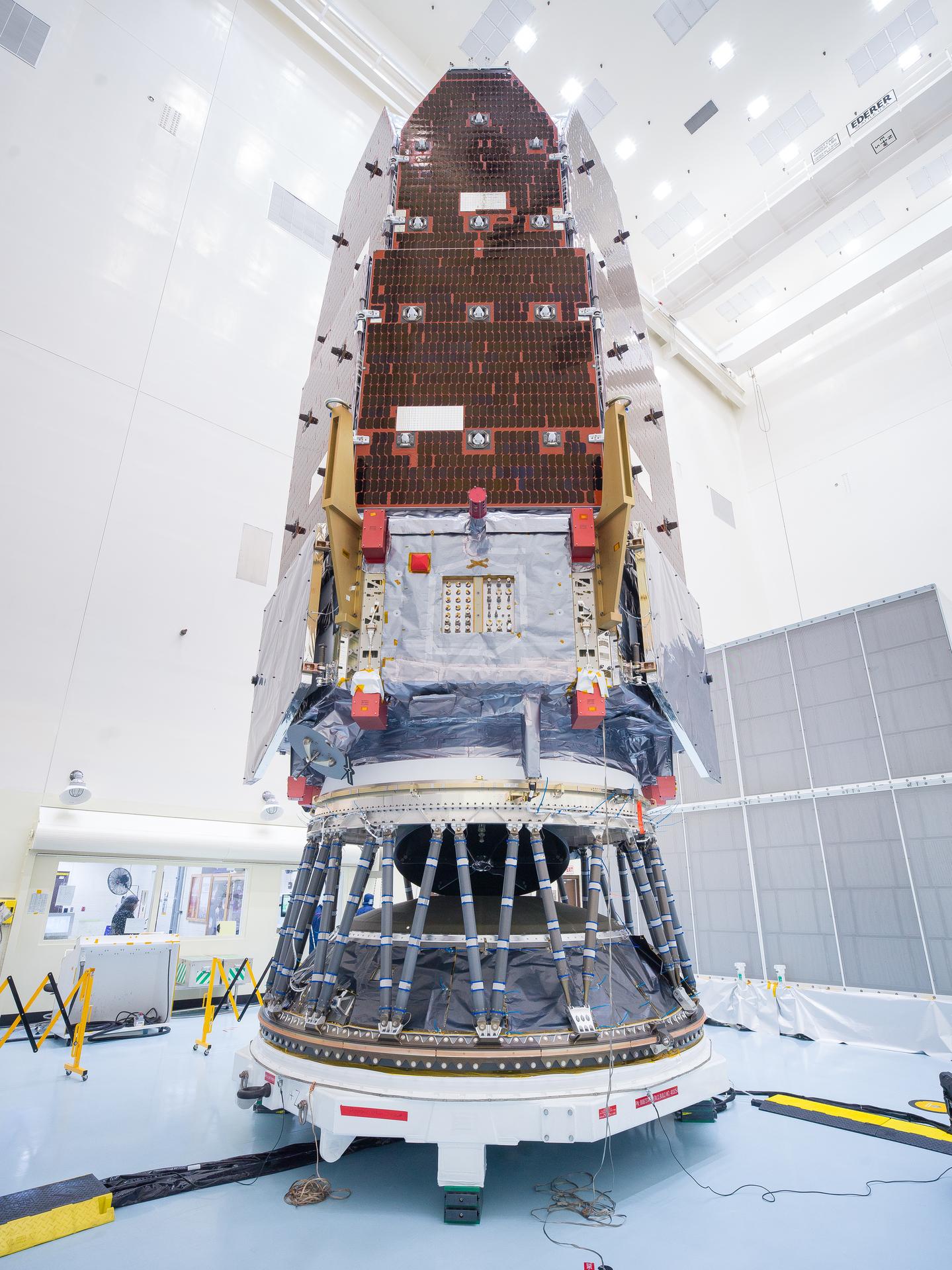
NASA’s Nancy Grace Roman Space Telescope is one step closer to its journey into deep space later this month, nine months ahead of schedule. Recently, teams at the Payload Hazardous Servicing Facility at NASA’s Kennedy Space Center in Florida began integration operations with SpaceX hardware ahead of encapsulation later this month.
After attaching the Roman spacecraft to its payload adapter, the team lifted Roman onto a strut payload attach fitting, a specialized piece of hardware designed for large, heavy loads. This allows the team to secure the payload to the second stage on SpaceX’s Falcon Heavy rocket.
In the coming weeks, the team will complete several key steps to prepare the observatory ahead of launch. At the Payload Hazardous Servicing Facility, technicians will encapsulate the observatory inside a SpaceX Falcon Heavy payload fairing to protect Roman through liftoff and ascent. Once encapsulated, teams will transport Roman to SpaceX’s hangar at pad 39A at Kennedy for integration with Falcon Heavy.
Roman’s science instruments are designed to help researchers understand dark energy, the mysterious force accelerating the universe’s expansion. The observatory also will map how galaxies form, cluster, and evolve by tracing the influence of dark matter. Roman is designed to discover thousands of new planets outside our solar system and pave the way for future missions that could search for life on Earth-like planets.
NASA and SpaceX are targeting launch for no earlier than 7:26 a.m. EDT on Sunday, Aug. 30, from Launch Complex 39A at Kennedy, and Roman remains ahead of schedule.
To learn more about Roman, visit:
