







Suggested Searches

James Webb Space Telescope

    Near Infrared Imager and Slitless Spectrograph Operations Update

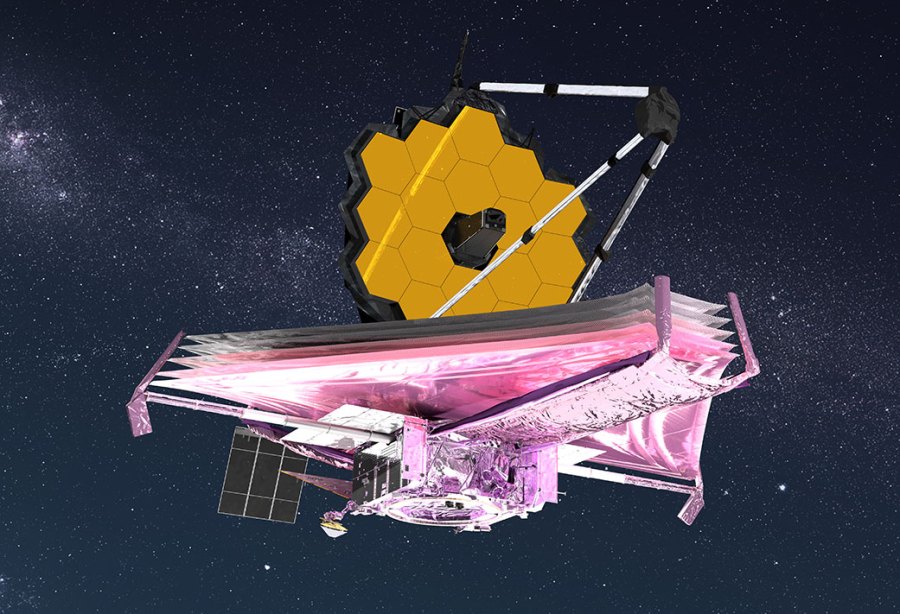
    In this illustration, the multilayered sunshield on NASA’s James Webb Space Telescope stretches out beneath the observatory’s honeycomb mirror

    On Sunday, Jan. 15, the James Webb Space Telescope's Near Infrared Imager and Slitless Spectrograph (NIRISS) experienced a communications delay within the instrument, causing its flight software to time out. The instrument is currently unavailable for science observations while NASA and the Canadian Space Agency (CSA) work together to determine and correct the root cause of the delay. There …

    Read Full Post

    James Webb Space Telescope Operations Update

    In this illustration, the multilayered sunshield on NASA’s James Webb Space Telescope stretches out beneath the observatory’s honeycomb mirror

    The James Webb Space Telescope resumed science operations Dec. 20, after Webb's instruments intermittently went into safe mode beginning Dec. 7 due to a software fault triggered in the attitude control system, which controls the pointing of the observatory. During a safe mode, the observatory's nonessential systems are automatically turned off, placing it in a …

    Read Full Post

    Webb Glimpses Field of Extragalactic PEARLS, Studded With Galactic Diamonds

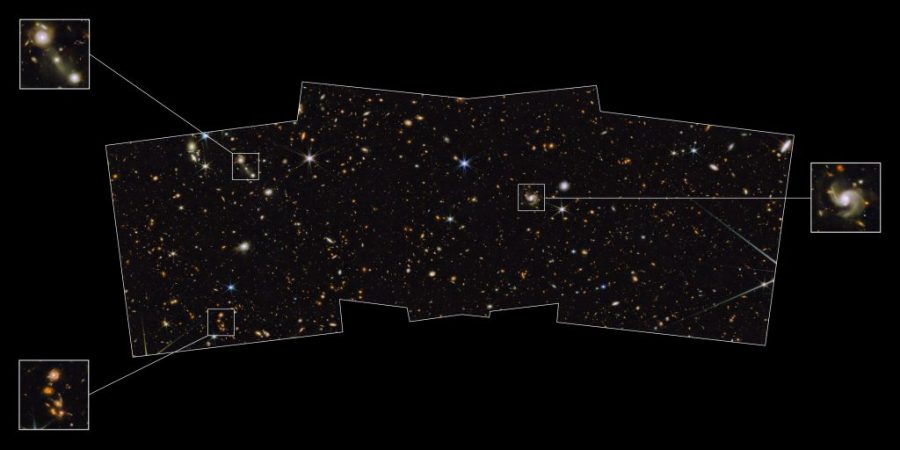
    On a black background, a white border outlines an irregularly shaped, mostly rectangular area. Within the outline lie hundreds of galaxies of various shapes, colors, and sizes. Two white boxes on the left side of the field enclose groups of galaxies. From each box, a line extends out beyond the border of the galaxy field to an enlarged image of the galaxy group, revealing streams of stars and tidal tails. On the right side, a third box encloses a spiral galaxy. A line extends beyond the border of the galaxy field to an enlarged image of the spiral galaxy. A few stars are also scattered across the image. Some have Webb's characteristic 8 diffraction spikes, while others have additional spikes due to a combination of image exposures.

    NASA's James Webb Space Telescope has captured one of the first medium-deep wide-field images of the cosmos, featuring a region of the sky known as the North Ecliptic Pole. The image, which accompanies a paper published in the Astronomical Journal, is from the Prime Extragalactic Areas for Reionization and Lensing Science (PEARLS) GTO program. "Medium-deep" …

    Read Full Post

    NASA’s Webb Reaches New Milestone in Quest for Distant Galaxies

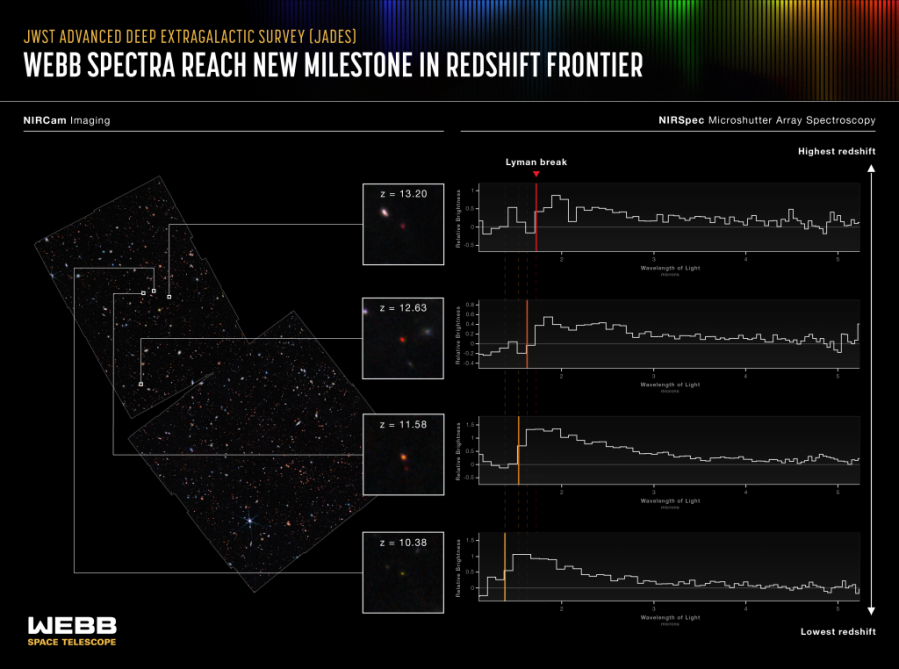
    Infographic of the spectra of four distant galaxies, showing the shift of the location of a spectral feature called the Lyman break, and the relationship between shift and time since the light was emitted, with images for reference.

    Editor's Note: This post highlights data from Webb science in progress, which has not yet been through the peer-review process. An international team of astronomers has used data from NASA's James Webb Space Telescope to report the discovery of the earliest galaxies confirmed to date. The light from these galaxies has taken more than 13.4 …

    Read Full Post

    Webb, Keck Telescopes Team Up to Track Clouds on Saturn’s Moon Titan

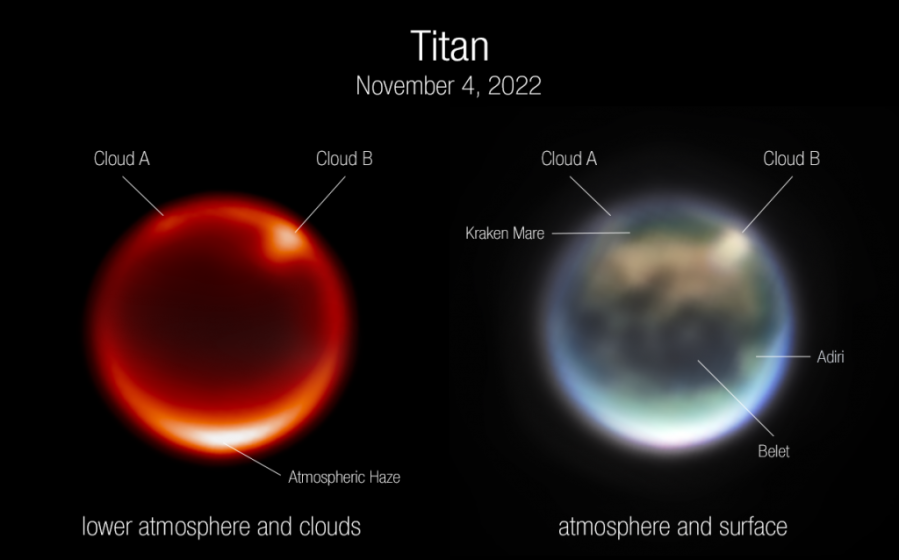
    Editor's Note: This post highlights data from Webb science in progress, which has not yet been through the peer-review process. On the morning of Saturday, Nov. 5, an international team of planetary scientists woke up with great delight to the first Webb images of Saturn's largest moon, Titan. Here, Principal Investigator Conor Nixon and others …

    Read Full Post

    NASA Webb Image Coming This Week

    In this illustration, the multilayered sunshield on NASA’s James Webb Space Telescope stretches out beneath the observatory’s honeycomb mirror

    NASA will share a new image or spectrum from the James Webb Space Telescope at least every other week on the mission's blog. This week, check the blog on Thursday, Dec. 1 at 11 a.m. EST for new images highlighting one of Saturn's moons. In the meantime, learn more about what to expect as Webb observations make …

    Read Full Post

    NASA Webb Micrometeoroid Mitigation Update

    In this illustration, the multilayered sunshield on NASA’s James Webb Space Telescope stretches out beneath the observatory’s honeycomb mirror

    Micrometeoroid strikes are an unavoidable aspect of operating any spacecraft. NASA's James Webb Space Telescope was engineered to withstand continual bombardment from these dust-sized particles moving at extreme velocities, to continue to generate groundbreaking science far into the future. ​​"We have experienced 14 measurable micrometeoroid hits on our primary mirror, and are averaging one to …

    Read Full Post

    Beneath the Night Sky in a Galaxy (Not Too) Far Away

    Editor's Note: This post highlights data from Webb science in progress, which has not yet been through the peer-review process. We spoke with Kristen McQuinn of Rutgers University, one of the lead scientists on Webb Early Release Science (ERS) program 1334, focused on resolved stellar populations. These are large groups of stars – including stars …

    Read Full Post

    Webb Mid-Infrared Instrument Mode Returns to Functionality

    In this illustration, the multilayered sunshield on NASA’s James Webb Space Telescope stretches out beneath the observatory’s honeycomb mirror

    The James Webb Space Telescope's Mid-Infrared Instrument (MIRI) has four observing modes. On Aug. 24, after measuring increased friction in one of the grating wheels used in MIRI's medium resolution spectrometry (MRS) mode, the Webb team paused science observations using this specific mode. Since then, a team of experts has carried out an in-depth investigation that has reviewed instrument …

    Read Full Post