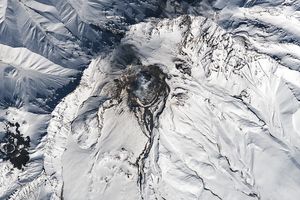






















Dark volcanic debris mars the otherwise pristine lower flanks of Shiveluch Volcano in this false-color satellite image. The debris traveled about 10 kilometers (6 miles) from Shiveluch’s growing lava dome. Rock falls and pyroclastic flows (avalanches of hot volcanic material) are common at Shiveluch, due to the steep sides and unstable rock of the growing dome. A similar flow occurred on January 25, 2011.
This image was collected by the Advanced Spaceborne Thermal Emission and Reflection Radiometer (ASTER) on the Terra satellite on February 19, 2012. Forests are a dull red, and fresh debris is dark brown. The stark white southern face of Shiveluch is the snow-covered remains of an enormous avalanche. On November 12, 1964, much of the southern flank of the volcano collapsed, causing an eruption like the 1980 explosion of Mount St. Helens. The debris from the 1964 eruption remains largely free of vegetation, likely due to frequent scouring by fresh pyroclastic flows.
References & Resources
- Belousov, A.B. (1994, July 7). The Shiveluch volcanic eruption of 12 November 1964—explosive eruption provoked by failure of the edifice. Journal of Volcanology and Geothermal Research. 66 (1995), 357–365.
- USGS/Cascades Volcano Observatory (2009, June 25). Lava Domes, Volcanic Domes, Composite Domes. Accessed February 24, 2012.
NASA image by Jesse Allen and Robert Simmon, with data from the NASA/GSFC/METI/ERSDAC/JAROS, and U.S./Japan ASTER Science Team. Caption by Robert Simmon.