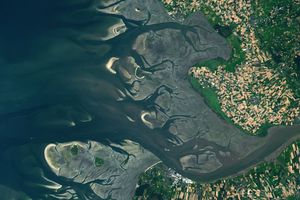





















What is likely a large coccolithophore bloom appeared across the southern half of the Barents Sea on August 21, 2002. The above image of the bloom was taken on August 21 by the Sea-viewing Wide Field-of-view Sensor (SeaWiFS), flying aboard the OrbView-2 satellite. Blooms similar to the one shown above have been seen in this region over the past few years.
Coccolithophores are a type of microscopic plant known as phytoplankton. Unlike most other types of phytoplankton, coccolithophores surround themselves with microscopic plating made of calcite. These scales, known as coccoliths, are shaped like hubcaps and are only three one-thousandths of a millimeter in diameter. What coccoliths lack in size, they make up in volume. At any one time a single coccolithophore is attached to or surrounded by at least 30 scales. Additional coccoliths are dumped into the water when the coccolithophores multiply asexually, die or simply make too many scales. In areas with trillions of coccolithophores, the waters will turn an opaque turquoise from the dense cloud of coccoliths.
References & Resources
Image courtesy the SeaWiFS Project, NASA/Goddard Space Flight Center, and ORBIMAGE