






















As is common in summer, the air over northeastern Sudan and the Red Sea was full of dust in July and August 2014. Though dust storms are not as concentrated or intense as in other parts of the Middle East, they occur with greater frequency in Sudan than just about anywhere else in the region.
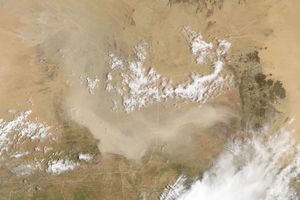
For instance, the Moderate Resolution Imaging Spectroradiometer (MODIS) on NASA’s Terra satellite captured this natural-color image of dust blowing over the Red Sea on August 4, 2014. Some of the thickest plumes were located in the vicinity of Tokar, a town of about 40,000 people in northeastern Sudan.
The dust blends in with light-toned land surface in many areas, making it somewhat difficult to distinguish. However, notice that overlying dust makes features on land appear blurred. (Download the large image and compare surface features on the western and eastern shores of the Red Sea to see this in more detail.) The dust is more clearly visible over the darker water of the Red Sea.
In this part of Sudan, dry lake beds and ephemeral rivers provide ample dry sand and clay particles that are picked up by winds blowing from interior Africa. In July and early August 2014, MODIS instruments detected dust blowing over this area nearly every day. A similar pattern occurred in the summer of 2013 as well.
Dust storms can have a significant effect on human society. Large amounts of dust in the air can contribute to air pollution, reduce visibility, cause airport closures, and increase the risk of traffic accidents. Dust can also reduce soil fertility, damage crops, decrease the efficiency of solar devices, and damage telecommunications equipment.
It also plays important roles in the broader ecosystem. Dust storms provide oceans with key minerals and nutrients that affect water chemistry and marine food webs. Airborne also dust has a significant—but poorly understood—affect on Earth’s climate.
“Mineral dust is the dominant atmospheric aerosol. It plays an important role in the Earth’s climate system, although the magnitude and even the sign of its radiative effect at the top-of-the-atmosphere remain uncertain,” noted Jish Prakash and colleagues from King Abdullah University in a recent study published in Atmospheric Chemistry and Physics.
References & Resources
- Prakash, J. et al (2014, July 22) The impact of dust storms on the Arabian Peninsula and the Red Sea. Atmospheric Chemistry and Physics, 14, 1981-19245.
NASA image by Jeff Schmaltz, LANCE/EOSDIS Rapid Response. Caption by Adam Voiland.