


























October is a month of transition for weather patterns over the Arabian Sea. In the summer, winds blow from the sea toward land. In the winter, the winds reverse and push out over the Arabian Sea from the northeast. During October, between the summer and winter monsoons, the prevailing wind direction varies.
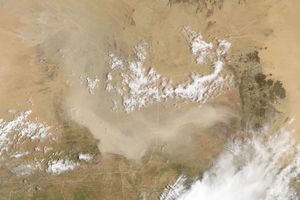
When the Moderate Resolution Imaging Spectroradiometer (MODIS) on NASA’s Terra satellite acquired this image on October 14, 2014, northeasterly winds were dominant and blew several dust plumes off the coast of Iran, Pakistan, and India. Additional satellite images of dust spreading southeast were acquired on October 15 and October 16.
The dust most likely has several sources. The Thar Desert, the Arabian Sea coastline, and the alluvial plain of the Indus River are all known as significant regional dust sources, according to one analysis of Arabian Sea dust authored by an East Carolina University geographer.
References & Resources
- Pease, P. et al, (1998, July) Aerosols over the Arabian Sea: geochemistry and source areas for aeolian desert dust. Journal of Arid Environments, 39 (3), 477-396.
- Kumar, P. et al, (2008, May) Hydrographic characterization of southeast Arabian Sea during the wane of southwest monsoon and spring intermonsoon. Environmental Monitoring and Assessment, 140 (1-3), 231-247.
- NASA Earth Observatory (2006, February 22) Asian Monsoon Strengthens Over Arabian Sea.
NASA image courtesy Jeff Schmaltz, LANCE MODIS Rapid Response. Caption by Adam Voiland.