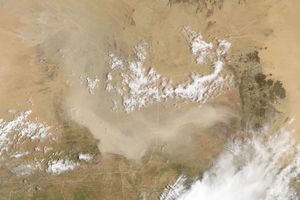




















Described as the world’s largest gypsum dune field, New Mexico’s White Sands National Monument stretches over 275 square miles (710 square kilometers). Winds occasionally loft the gypsum sands into the air, and a dust storm emerged from the dunes in late February 2012.
The Moderate Resolution Imaging Spectroradiometer (MODIS) on NASA’s Aqua satellite captured this natural-color image on February 28, 2012. A dust plume blows northeastward toward the New Mexico-Texas border. Around the national monument, the landscape appears in a mixture of earth tones, with isolated patches of green.
The dust blowing out of White Sands National Monument was part of a larger pattern of dust storms in the region, including dust in Mexico, Kansas, and Oklahoma. Those plumes are visible in the high-resolution image (downloadable below the main image above).
References & Resources
NASA image courtesy Jeff Schmaltz, LANCE/EOSDIS MODIS Rapid Response Team at NASA GSFC. Caption by Michon Scott.