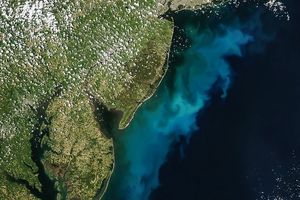





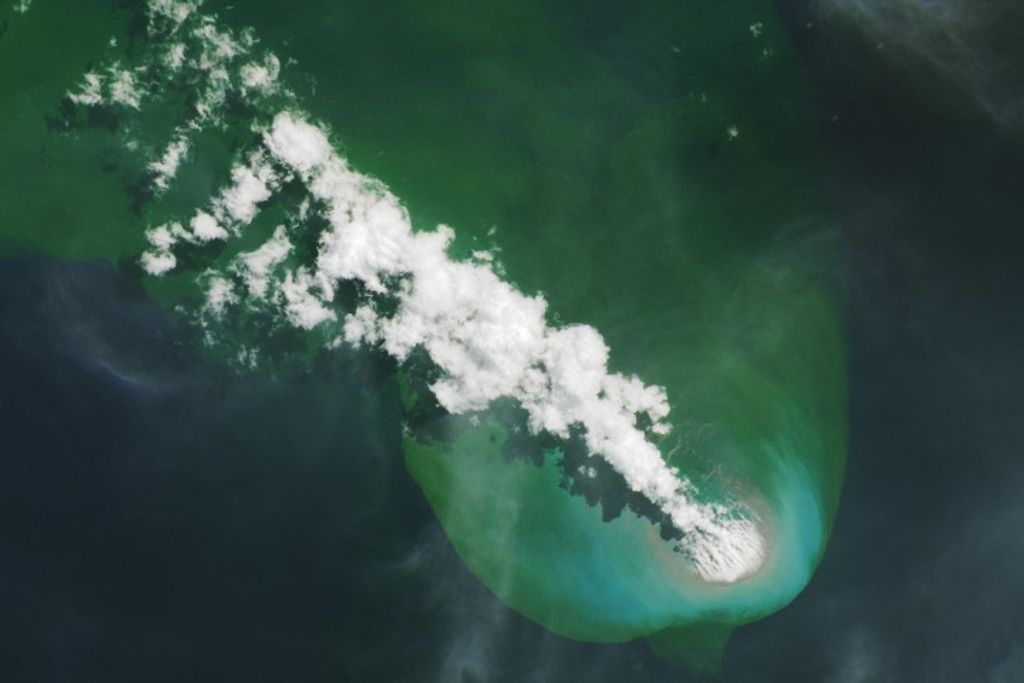
















Iridescent shades of peacock blue and emerald green decorated the South Atlantic Ocean off the coast of Argentina on December 24, 2007. The Moderate Resolution Imaging Spectroradiometer (MODIS) on NASA’s Terra satellite captured this image the same day. In this image, the colors spread out toward the south, like an inverted feather fan. Though hundreds of kilometers in length, these bright bands of color were formed by miniscule objects—tiny surface-dwelling ocean plants known as phytoplankton.
Phytoplankton thrive in the ocean waters off the Argentine coast, thanks to the waters’ cool temperature and richness of nutrients. In this area, the Malvinas (Falkland) Current sweeps northward along the continental shelf, bringing with it cold water from the Southern Ocean. The action of the current sweeping along the edge of the shelf pulls nutrients up from the ocean floor. These nutrients serve as a natural fertilizer that promotes phytoplankton growth.
The high-resolution image provided above is at MODIS’ full spatial resolution (level of detail) of 250 meters per pixel. The MODIS Rapid Response System provides this image at additional resolutions.
References & Resources
NASA image by Jeff Schmaltz, MODIS Rapid Response Team, Goddard Space Flight Center.