


























APOD
Astronomy Picture of the Day
Discover the cosmos! Each day a different image or photograph of our fascinating universe is featured, along with a brief explanation written by a professional astronomer.
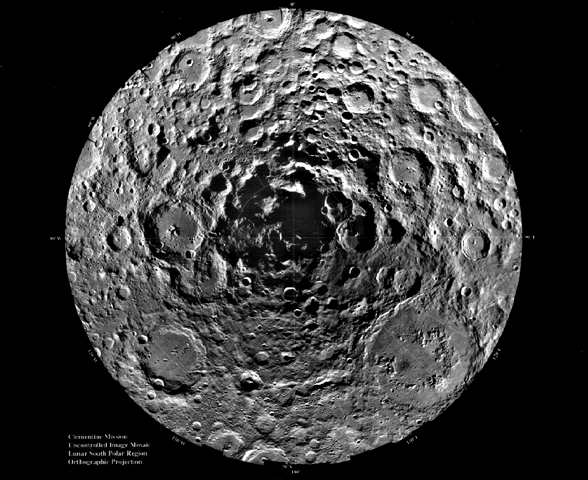
Ice at the Lunar South Pole
Explanation: Explanation : Ice on the Moon? The prospecting Clementine spacecraft may well have discovered it. In 1994, Clementine spent 70 days in lunar orbit mapping the Moon's surface . Shown above is a dramatically detailed composite view centered on the Lunar South Pole - constructed from 1500 Clementine images. This area contains part of the South Pole-Aitken impact basin , the largest known crater in the solar system, probably caused by the impact of a comet or asteroid . The depth of the basin and crater walls at the Lunar South Pole create the permanent shadow region visible above - hypothesised to be large and cold enough to trap water brought to the moon by cometary impacts as surface ice . Indeed, a recent analysis of Clementine data from this area has found a signature of water ice. Water on the Moon presents exciting possibilities as resource for future lunar exploration .
| Date | December 4, 1996 |
|---|---|
| Credit |
Ice at the Lunar South Pole Credit: Clementine, BMDO, NRL, LLNL |
| Authors & editors: | Robert Nemiroff (MTU) & Jerry Bonnell (UMCP) |
| A service of: |
ASD at NASA / GSFC, NASA Science Activation & Michigan Tech. U. |