

























APOD
Astronomy Picture of the Day
Discover the cosmos! Each day a different image or photograph of our fascinating universe is featured, along with a brief explanation written by a professional astronomer.
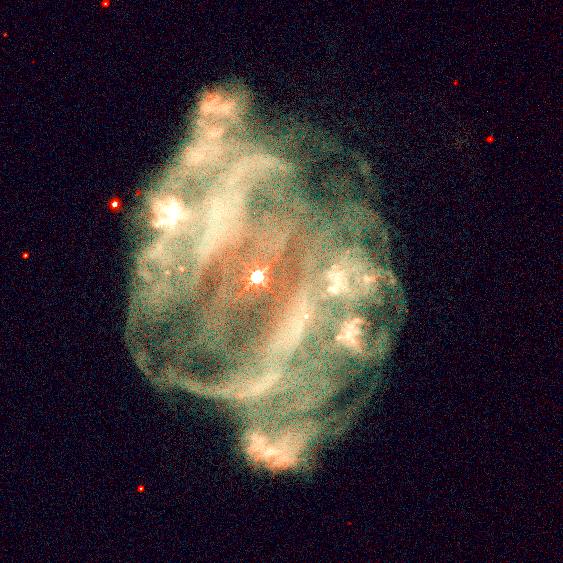
NGC 5307: A Symmetric Planetary Nebula
Explanation: Some stellar nebulae are strangely symmetric. For example, every major blob of gas visible on the upper left of NGC 5307 appears to have a counterpart on the lower right. This picture taken by the Hubble Space Telescope was released last week . NGC 5307 is an example of a planetary nebula with a spiral shape. Spiral planetary nebulae are thought to be caused by a bright central white dwarf star expelling a symmetric wobbling jet of rapidly moving gas. It takes light about 10,000 years to reach us from NGC 5307 , and about 6 months just to go from one side to the other. In contrast, light takes only about 8 minutes to reach Earth from the Sun .
| Date | December 31, 1997 |
|---|---|
| Credit | Credit: H. Bond (STScI) & R. Ciardullo (Penn State), WFPC2, HST, NASA |
| Authors & editors: | Robert Nemiroff (MTU) & Jerry Bonnell (UMCP) |
| A service of: |
ASD at NASA / GSFC, NASA Science Activation & Michigan Tech. U. |