
























APOD
Astronomy Picture of the Day
Discover the cosmos! Each day a different image or photograph of our fascinating universe is featured, along with a brief explanation written by a professional astronomer.
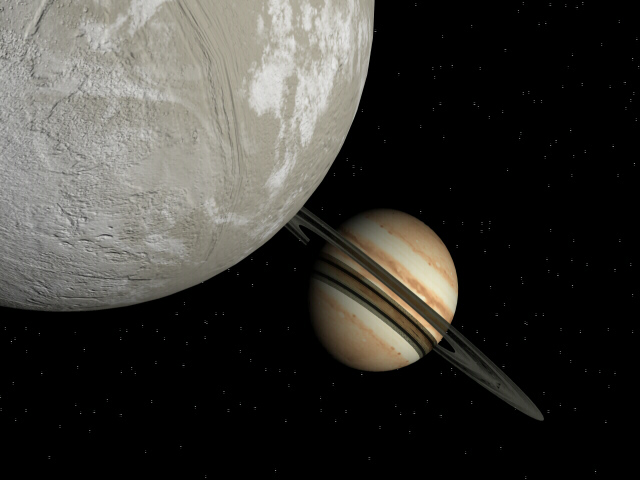
Worlds of a Distant Sun: 47 Ursae Majoris b
Explanation: In the last few years, observational astronomy has given humanity evidence of the existence of worlds beyond the solar system. Solar-type stars are now inferred to harbor planets of approximately Jupiter mass - some residing in temperature zones which could conceivably support liquid water and therefore life ! Above is a hypothetical scene near one such planet whose sun, 47 Ursae Majoris (47 UMa), is very similar to our own. In our sky, 47 UMa appears as a faint, inconspicuous star below the cup of the “the Big Dipper” . (Our own sun would be equally inconspicuous when viewed from 47 UMa ...) Astronomers G. Marcy and P. Butler announced the discovery of a planet associated with this star in 1996 and reported it to have a mass of about 2.4 Jupiters or more with an orbital period of 3 years. This artist's extrasolar vision pictures the detected planet, 47 UMa b, as a gas giant surrounded by a ring of material - analogous to our own gas giant Saturn . In the foreground lies a hypothetical moon of 47 UMa b. Could such a moon support life? 47 UMa is only 44 light years distant, fairly close by astronomical standards - yet there is evidence for planetary systems which are closer still. NASA plans to explore nearby planetary systems using spaceborne observatories.
| Date | October 5, 1997 |
|---|---|
| Credit | Credit and Copyright: John Whatmough, Extrasolar Visions |
| Authors & editors: | Robert Nemiroff (MTU) & Jerry Bonnell (UMCP) |
| A service of: |
ASD at NASA / GSFC, NASA Science Activation & Michigan Tech. U. |