
























APOD
Astronomy Picture of the Day
Discover the cosmos! Each day a different image or photograph of our fascinating universe is featured, along with a brief explanation written by a professional astronomer.
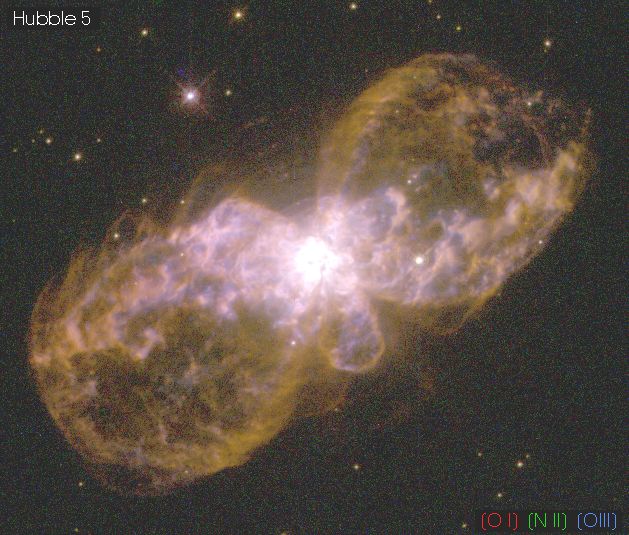
The Hubble 5 Planetary Nebula
Explanation: The Hubble Double Bubble Planetary Nebula is bubbling over with excitement. More mundanely known as Hubble 5 , this bipolar planetary nebula is being created by a hot wind of particles streaming away from the central star system. The hot gas expands into the surrounding interstellar medium in a fashion similar to the inflation of hot air balloons . A supersonic shock-wave can form at the boundary, causing newly excited gas there to shine as electrons recombine with resident elements . In the above picture , colors are assigned according to the energy of the recombinant radiation. This star system lies about 2200 light-years from Earth , and likely includes a Sun-like star slowly transforming itself into a white dwarf .
| Date | January 19, 1998 |
|---|---|
| Credit | Credit: B. Balick (U. Washington) et al., WFPC2, HST, NASA |
| Authors & editors: | Robert Nemiroff (MTU) & Jerry Bonnell (UMCP) |
| A service of: |
ASD at NASA / GSFC, NASA Science Activation & Michigan Tech. U. |