

























APOD
Astronomy Picture of the Day
Discover the cosmos! Each day a different image or photograph of our fascinating universe is featured, along with a brief explanation written by a professional astronomer.
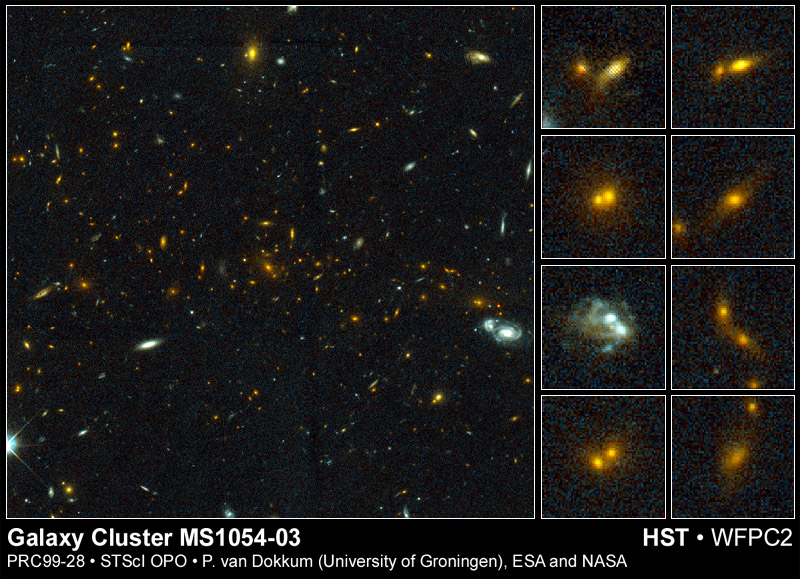
Cosmic Collisions in a Galaxy Cluster
Explanation: Hundreds of galaxies appear as faint smudges of light in this Hubble Space Telescope picture of galaxy cluster MS1054-03. Eight billion light-years away , the cluster is among the most distant known clusters of galaxies and is now reported to contain the largest number of colliding galaxies ever found in a cluster. Examples of these truly cosmic collisions are shown in the insets at the right. Disrupted by gravitational effects, the colliding galaxies are thought to merge over a billion years or so to form larger galaxies - a theory of galaxy formation which seems to be borne out by these results . Though galaxy collisions appear to have occurred much more frequently in the distant, early Universe , they are still seen to happen in the nearby, “close-to-present” Universe.
| Date | July 22, 1999 |
|---|---|
| Credit | Credit: P. van Dokkum, M. Franx (U. Groningen/ U. Leiden), ESA, NASA |
| Authors & editors: | Robert Nemiroff (MTU) & Jerry Bonnell (UMCP) |
| A service of: |
ASD at NASA / GSFC, NASA Science Activation & Michigan Tech. U. |