


























APOD
Astronomy Picture of the Day
Discover the cosmos! Each day a different image or photograph of our fascinating universe is featured, along with a brief explanation written by a professional astronomer.
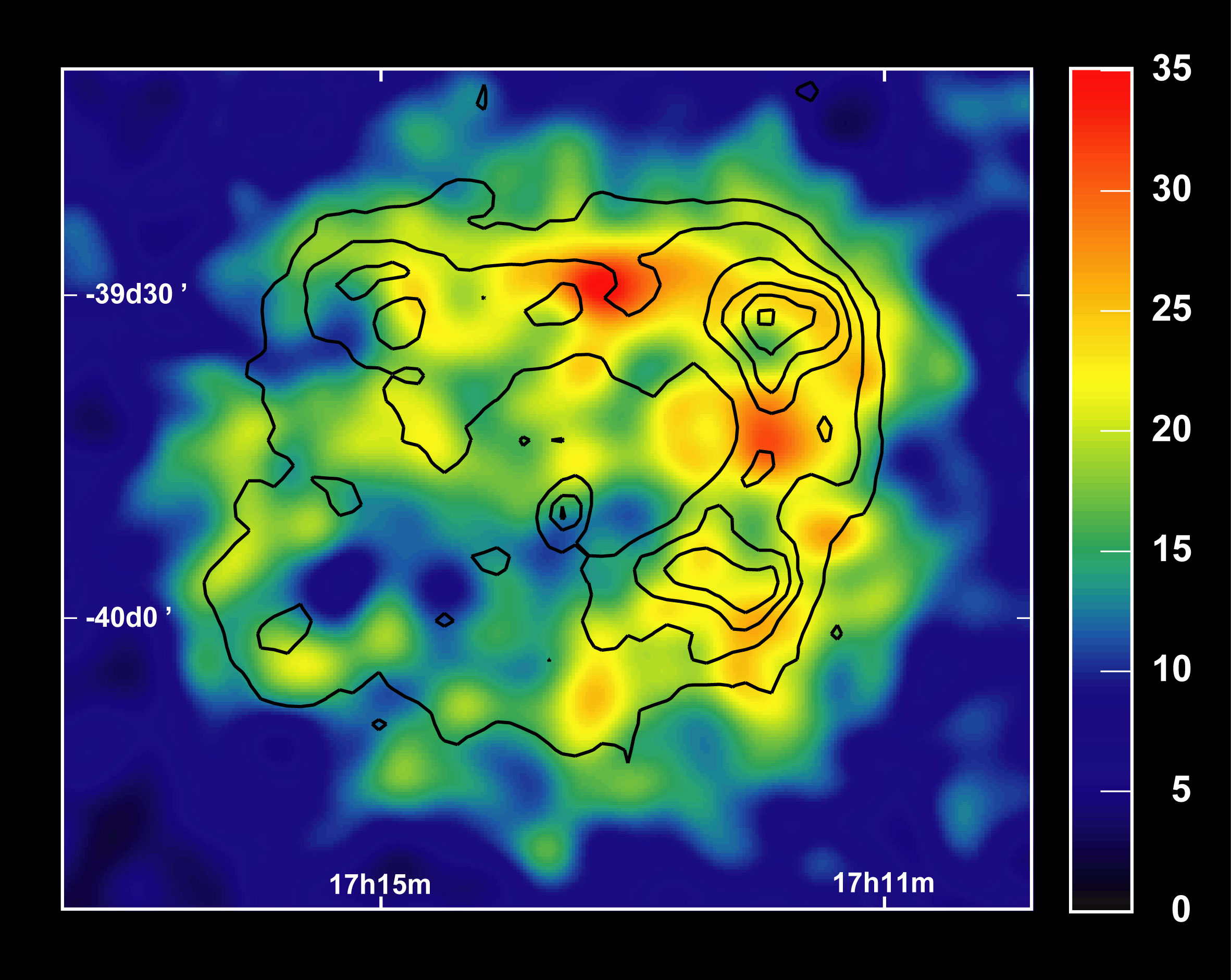
Supernova Remnant Imaged in Gamma Rays
Explanation: Gamma rays are the most energetic form of light . With up to a billion times the energy of ordinary “medical” x-rays , they easily penetrate telescope lenses and mirrors, making it very difficult to create gamma-ray images of cosmic sources. Still, an array of large telescopes designed to detect gamma-ray induced atmospheric flashes - the HESS ( High Energy Stereoscopic System ) experiment - has produced this historic, resolved image of a supernova remnant at extreme gamma-ray energies . Astronomers note that the premier gamma-ray view of the expanding stellar debris cloud is clearly similar to x-ray images of the remnant and convincingly supports the idea that these sites of powerful shock waves are also sources of cosmic rays within our galaxy. The gamma-ray intensity is color-coded in the picture, shown with dark contour lines that trace levels of x-ray emission from the object. At an estimated distance of 3,000 light-years, the supernova remnant measures about 50 light-years across and lies near the galactic plane.
| Date | November 5, 2004 |
|---|---|
| Credit | Credit: HESS Collaboration - image courtesy Werner Hofmann ( MPI ) |
| Authors & editors: | Robert Nemiroff (MTU) & Jerry Bonnell (UMCP) |
| A service of: |
ASD at NASA / GSFC, NASA Science Activation & Michigan Tech. U. |