



























APOD
Astronomy Picture of the Day
Discover the cosmos! Each day a different image or photograph of our fascinating universe is featured, along with a brief explanation written by a professional astronomer.
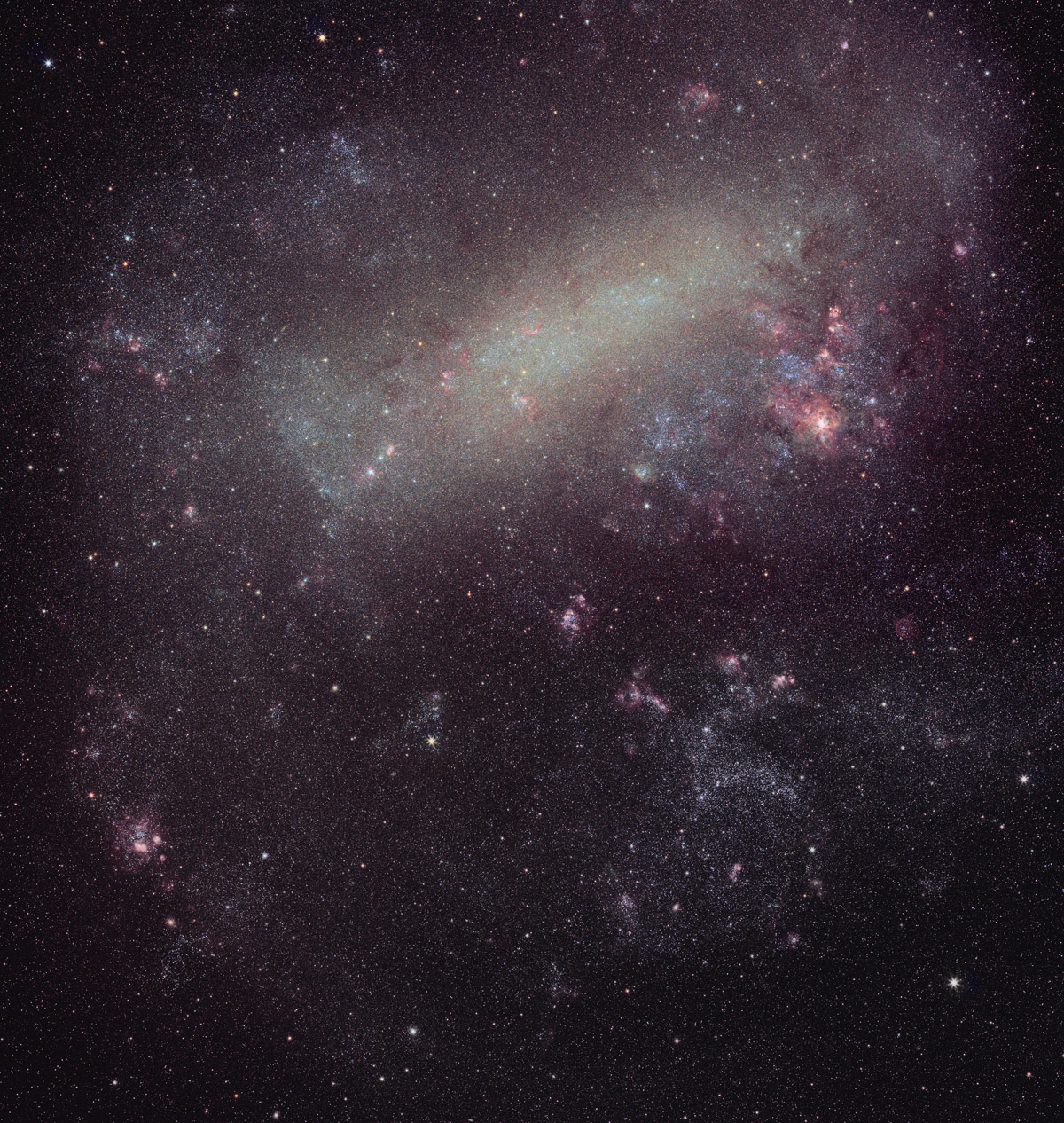
The Large Cloud of Magellan
Explanation: Portuguese navigator Fernando de Magellan and his crew had plenty of time to study the southern sky during the first circumnavigation of planet Earth. As a result, two fuzzy cloud-like objects easily visible for southern hemisphere skygazers are known as the Clouds of Magellan . Of course, these star clouds are now understood to be dwarf irregular galaxies, satellites of our larger spiral Milky Way galaxy. The Large Magellanic Cloud (LMC) pictured above is only about 180,000 light-years distant in the constellation Dorado . Spanning about 15,000 light-years or so, it is the most massive of the Milky Way's satellite galaxies and is the site of the closest supernova in modern times. The prominent red knot on the right is 30 Doradus, or the Tarantula Nebula , a giant star-forming region in the Large Magellanic Cloud .
| Date | September 2, 2004 |
|---|---|
| Credit | Credit & Copyright: Loke Kun Tan ( StarryScapes ) |
| Authors & editors: | Robert Nemiroff (MTU) & Jerry Bonnell (UMCP) |
| A service of: |
ASD at NASA / GSFC, NASA Science Activation & Michigan Tech. U. |