
























APOD
Astronomy Picture of the Day
Discover the cosmos! Each day a different image or photograph of our fascinating universe is featured, along with a brief explanation written by a professional astronomer.
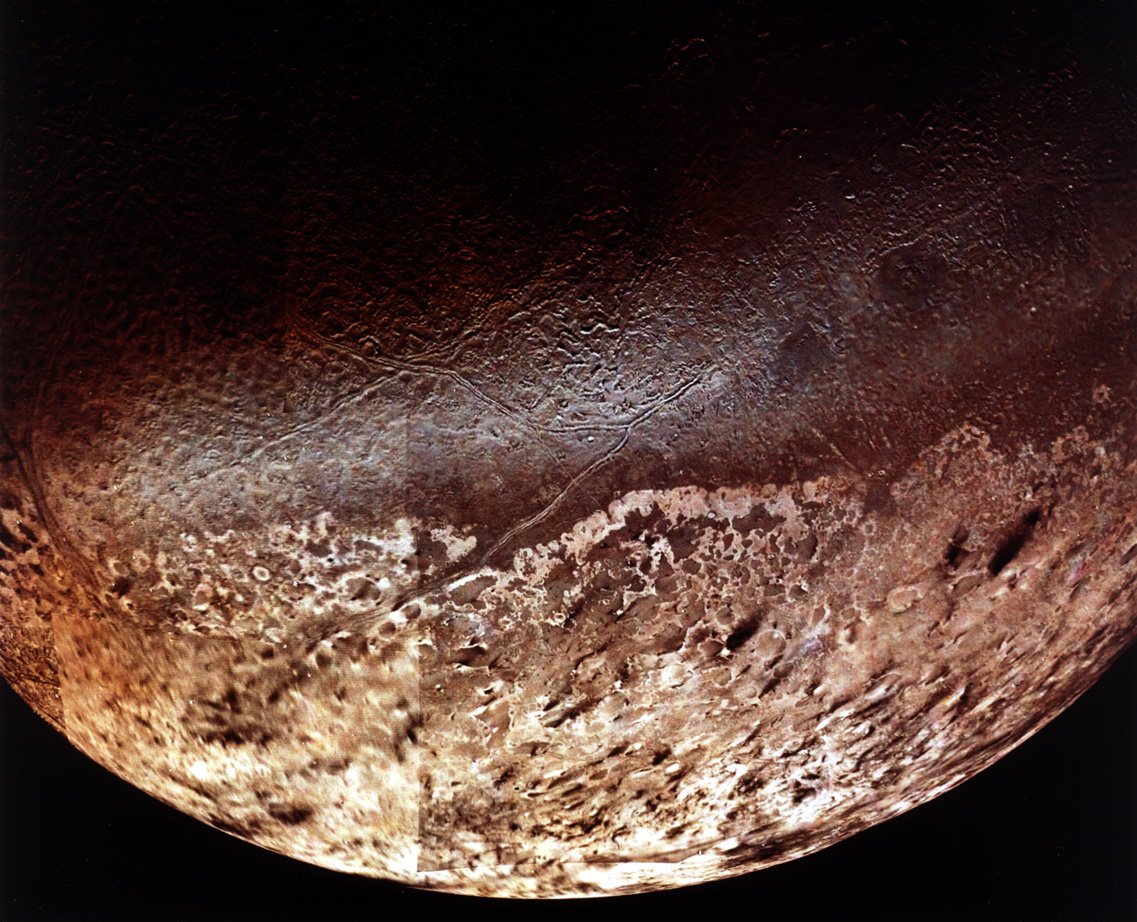
Triton: Neptune's Largest Moon
Explanation: In October of 1846, William Lassell was observing the newly discovered planet Neptune . He was attempting to confirm his observation, made just the previous week, that Neptune had a ring. But this time he discovered that Neptune had a satellite as well. Lassell soon proved that the ring was a product of his new telescope's distortion, but the satellite Triton remained. The above picture of Triton was taken in 1989 by the only spacecraft ever to pass Triton : Voyager 2. Voyager 2 found fascinating terrain , a thin atmosphere, and even evidence for ice volcanoes on this world of peculiar orbit and spin. Ironically, Voyager 2 also confirmed the existence of complete thin rings around Neptune - but these would have been quite invisible to Lassell!
| Date | March 4, 2007 |
|---|---|
| Credit | Credit: Voyager 2, NASA |
| Authors & editors: | Robert Nemiroff (MTU) & Jerry Bonnell (UMCP) |
| A service of: |
ASD at NASA / GSFC, NASA Science Activation & Michigan Tech. U. |