























APOD
Astronomy Picture of the Day
Discover the cosmos! Each day a different image or photograph of our fascinating universe is featured, along with a brief explanation written by a professional astronomer.
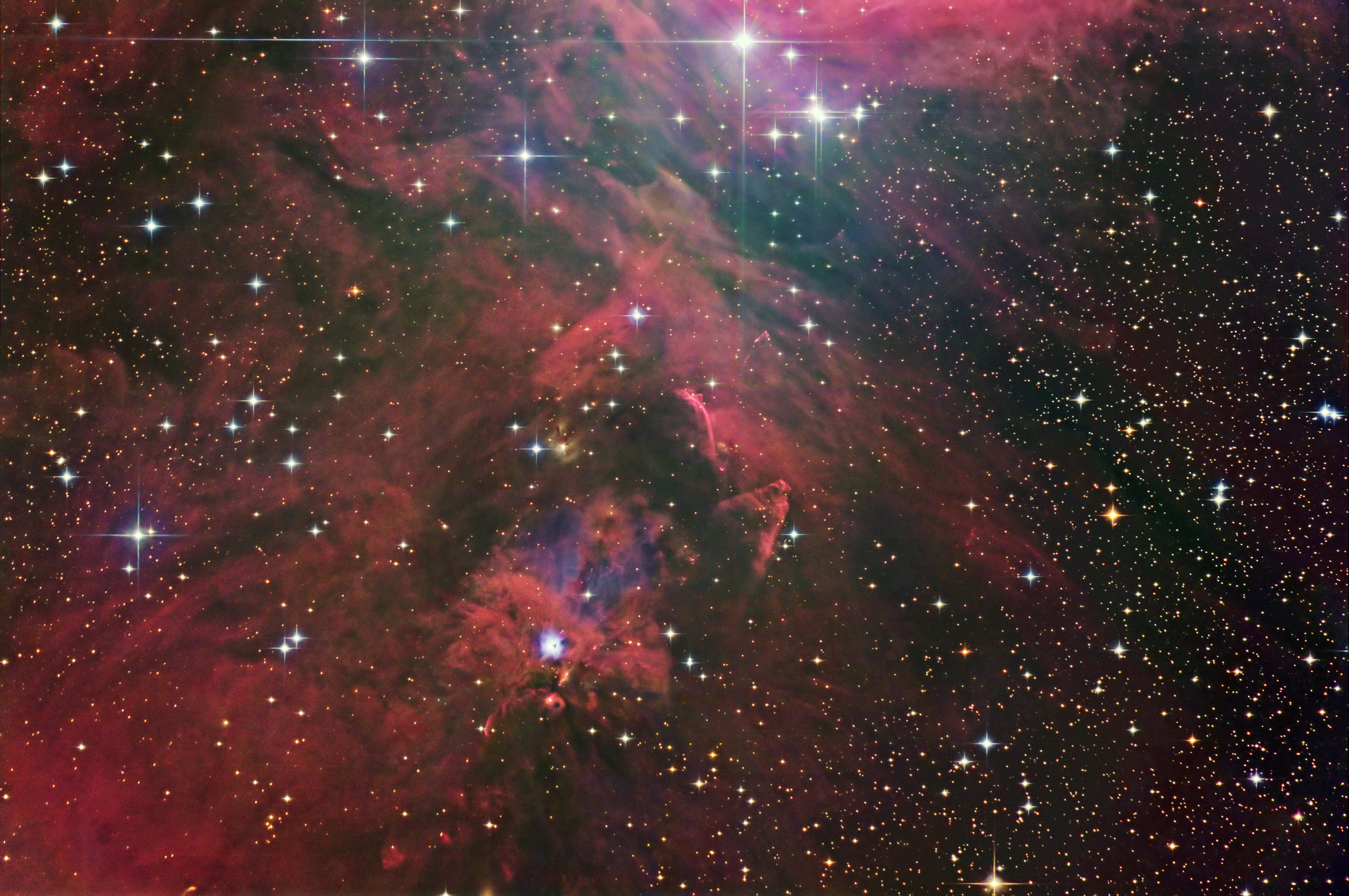
South of Orion
Explanation: This tantalizing array of nebulae and stars can be found about 2 degrees south of the famous star-forming Orion Nebula. The region abounds with energetic young stars producing jets and outflows that push through the surrounding material at speeds of hundreds of kilometers per second . The interaction creates luminous shock waves known as Herbig-Haro (HH) objects. For example, the graceful, flowing arc just right of center is cataloged as HH 222, also called the Waterfall Nebula. Seen below the Waterfall, HH 401 has a distinctive cone shape. The bright bluish nebula below and left of center is NGC 1999 , a dusty cloud reflecting light from an embedded variable star. The entire cosmic vista spans over 30 light-years, near the edge of the Orion molecular cloud complex some 1,500 light-years distant.
| Date | April 3, 2008 |
|---|---|
| Credit | Credit & Copyright: Johannes Schedler ( Panther Observatory ) |
| Authors & editors: | Robert Nemiroff (MTU) & Jerry Bonnell (UMCP) |
| A service of: |
ASD at NASA / GSFC, NASA Science Activation & Michigan Tech. U. |