


























APOD
Astronomy Picture of the Day
Discover the cosmos! Each day a different image or photograph of our fascinating universe is featured, along with a brief explanation written by a professional astronomer.
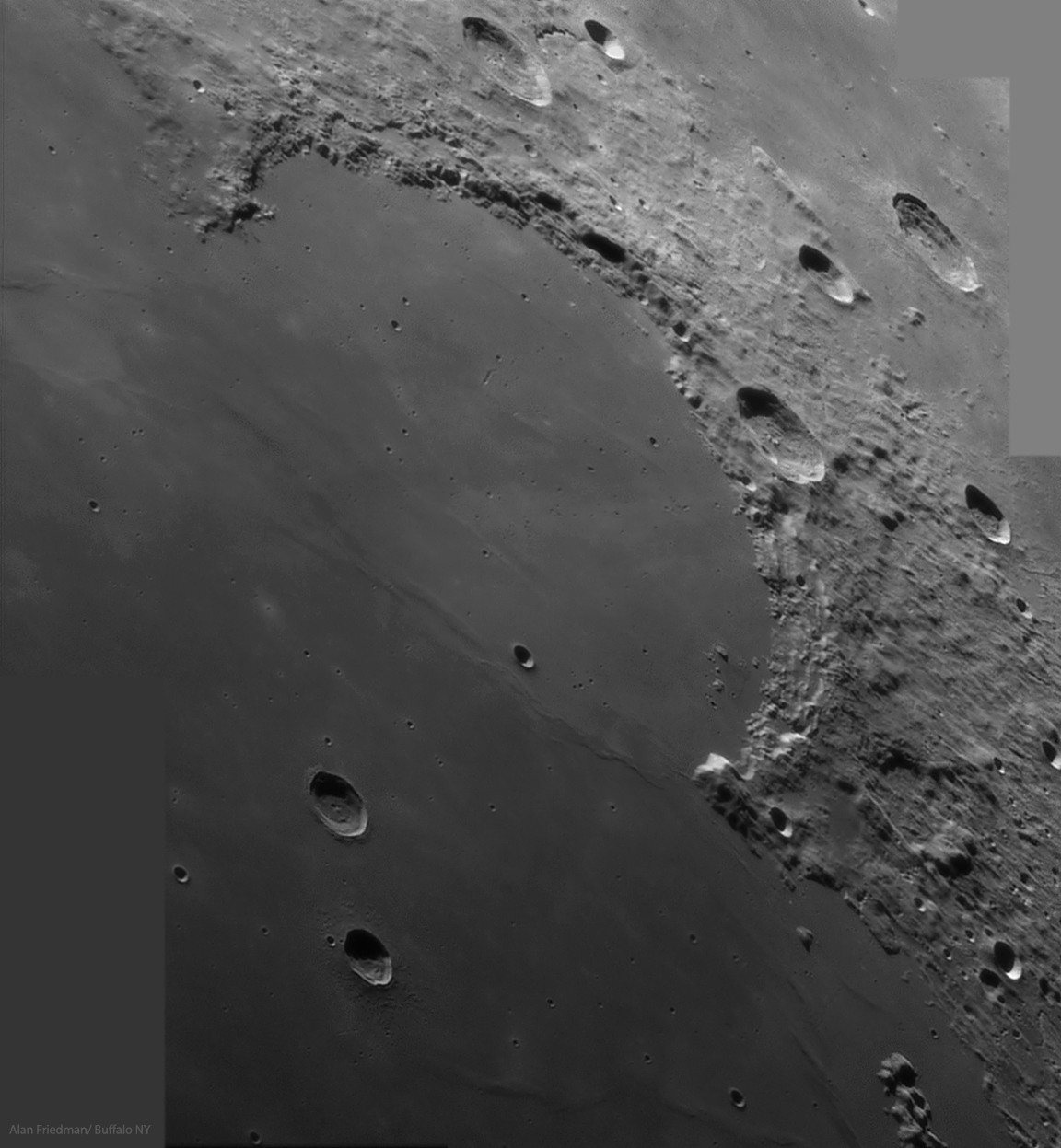
The Bay of Rainbows
Explanation: Dark, smooth regions that cover the Moon's familiar face are called by Latin names for oceans and seas. The naming convention is historical , though it may seem a little ironic to denizens of the space age who recognize the Moon as a mostly dry and airless world, and the smooth, dark areas as lava-flooded impact basins . For example, this elegant lunar vista, a careful mosaic of telescopic images, looks across the expanse of the northwestern Mare Imbrium , or Sea of Rains, into the Sinus Iridum - the Bay of Rainbows. Ringed by the Jura Mountains (montes), the bay is about 250 kilometers across, bounded at the bottom of the rugged arc by Cape ( promontorium ) Laplace. The cape's sunlit face towers nearly 3,000 meters above the bay's surface. At the top of the arc is Cape Heraclides, at times seen as a moon maiden .
| Date | February 8, 2008 |
|---|---|
| Credit | Credit & Copyright: Alan Friedman |
| Authors & editors: | Robert Nemiroff (MTU) & Jerry Bonnell (UMCP) |
| A service of: |
ASD at NASA / GSFC, NASA Science Activation & Michigan Tech. U. |