

























APOD
Astronomy Picture of the Day
Discover the cosmos! Each day a different image or photograph of our fascinating universe is featured, along with a brief explanation written by a professional astronomer.
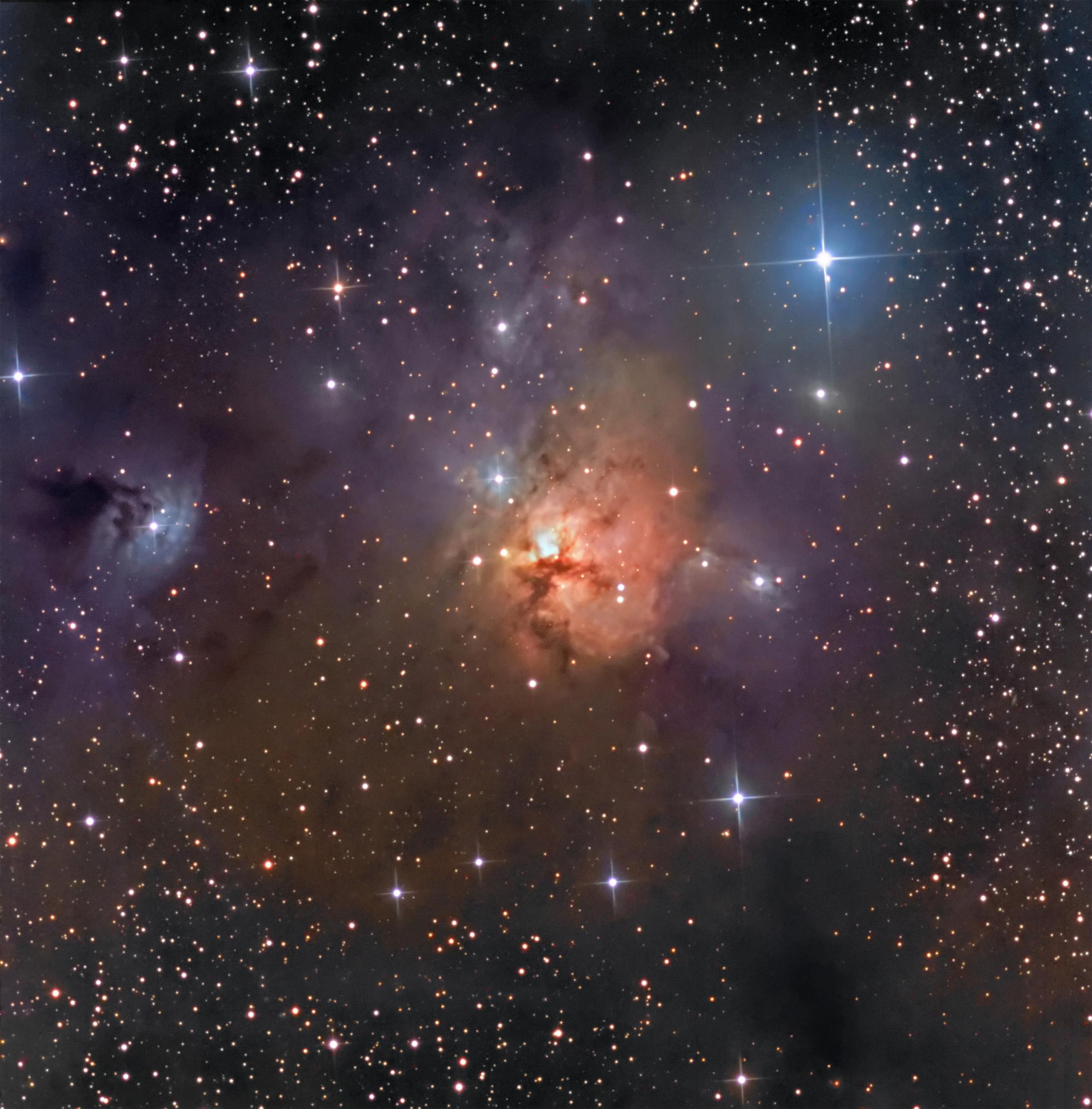
NGC 1579: Trifid of the North
Explanation: Colorful NGC 1579 resembles the better known Trifid Nebula, but lies much farther north in planet Earth's sky, in the heroic constellation Perseus . About 2,100 light-years away and 3 light-years across, NGC 1579 is, like the Trifid , a study in contrasting blue and red colors, with dark dust lanes prominent in the nebula's central regions. In both, dust reflects starlight to produce beautiful blue reflection nebulae . But unlike the Trifid, in NGC 1579 the reddish glow is not emission from clouds of glowing hydrogen gas excited by ultraviolet light from a nearby hot star. Instead, the dust in NGC 1579 drastically diminishes, reddens, and scatters the light from an embedded , extremely young, massive star , itself a strong emitter of the characteristic red hydrogen alpha light.
| Date | January 30, 2009 |
|---|---|
| Credit | Credit & Copyright: Don Goldman |
| Authors & editors: | Robert Nemiroff (MTU) & Jerry Bonnell (UMCP) |
| A service of: |
ASD at NASA / GSFC, NASA Science Activation & Michigan Tech. U. |