




























APOD
Astronomy Picture of the Day
Discover the cosmos! Each day a different image or photograph of our fascinating universe is featured, along with a brief explanation written by a professional astronomer.
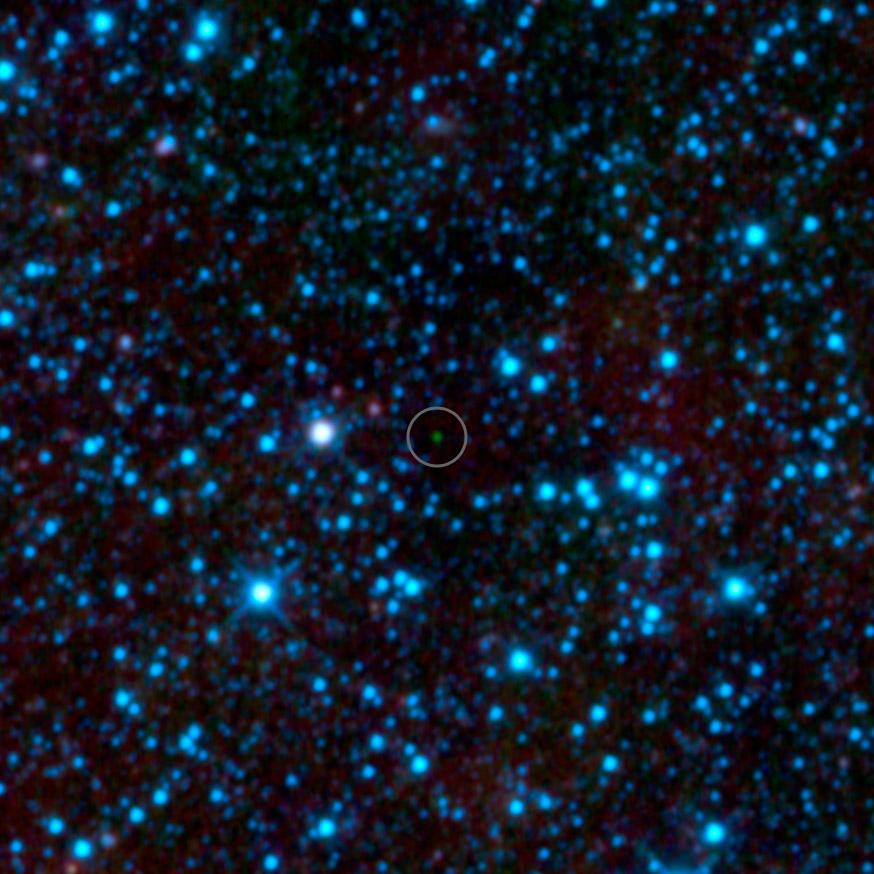
The Coldest Brown Dwarf
Explanation: This cosmic snapshot composed with image data from NASA's Wide-field Infrared Survey Explorer ( WISE ) satellite captures a multitude of faint stars and distant galaxies toward the constellation Lyra at wavelengths longer than visible light. But the object circled at the center is not quite a star. Cataloged as WISE 1828+2650, it lies within 40 light-years of the Sun and is currently the coldest brown dwarf known . A brown dwarf begins like a star, with the gravitational collapse of a dense cloud of gas and dust, but is not massive enough to achieve the core temperatures and densities that trigger hydrogen fusion , the stable source of a star's energy. Instead the failed star ultimately cools and emits most of its light at infrared wavelengths . Remarkably, brown dwarfs are roughly the size of the planet Jupiter. How cold is WISE 1828+2650? While brown dwarfs have measured surface temperatures of up to 1,400 degrees C (2,600 degress F), this brown dwarf , assigned to spectral class Y, has the estimated temperature of a warm room, less than about 27 degrees C (80 degrees F).
| Date | August 30, 2011 |
|---|---|
| Credit | Credit: NASA , JPL-Caltech , WISE |
| Authors & editors: | Robert Nemiroff (MTU) & Jerry Bonnell (UMCP) |
| A service of: |
ASD at NASA / GSFC, NASA Science Activation & Michigan Tech. U. |