
























APOD
Astronomy Picture of the Day
Discover the cosmos! Each day a different image or photograph of our fascinating universe is featured, along with a brief explanation written by a professional astronomer.
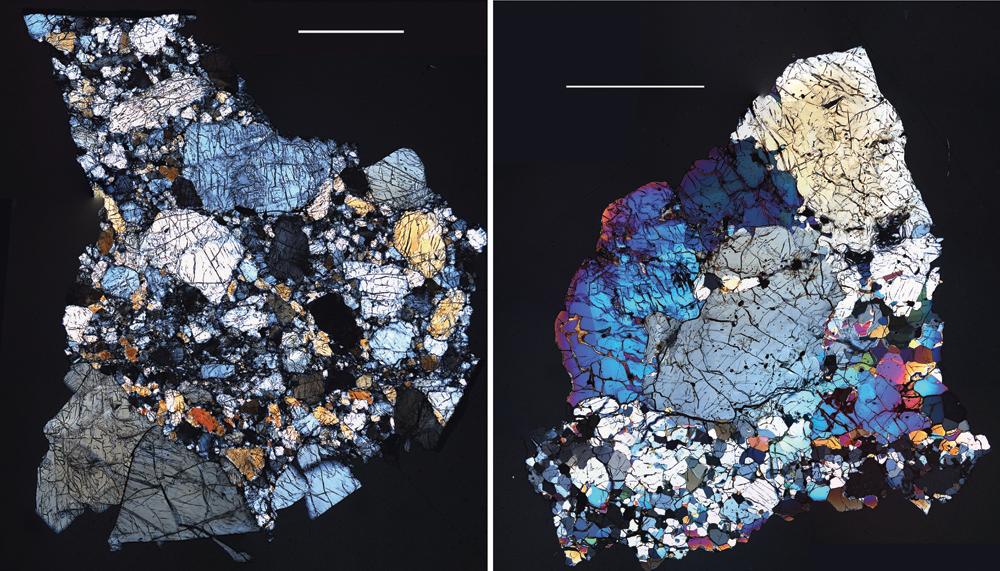
Vesta Rocks
Explanation: These colorful images are of thin slices of meteorites viewed through a polarizing microscope. Part of the group classified as HED (Howardite, Eucrite, Diogenite) meteorites for their mineral content, they likely fell to Earth from 4 Vesta , the mainbelt asteroid currently being explored by NASA's Dawn spacecraft . Why are they thought to be from Vesta? Because the HED meteorites have visible and infrared spectra that match the spectrum of that small world . The hypothesis of their origin on Vesta is also consistent with data from Dawn's ongoing observations. Excavated by impacts , the diogenites shown here would have originated deep within the crust of Vesta. Similar rocks are also found in the lower crust of planet Earth. A sample scale is indicated by the white bars, each 2 millimeters long.
Browse or share: Lastest lunar eclipse pictures
| Date | December 10, 2011 |
|---|---|
| Credit | Image Credit: NASA / JPL-Caltech / Hap McSween (Univ. Tennessee), A. Beck and T. McCoy (Smithsonian Inst.) |
| Authors & editors: | Robert Nemiroff (MTU) & Jerry Bonnell (UMCP) |
| A service of: |
ASD at NASA / GSFC, NASA Science Activation & Michigan Tech. U. |