



























APOD
Astronomy Picture of the Day
Discover the cosmos! Each day a different image or photograph of our fascinating universe is featured, along with a brief explanation written by a professional astronomer.
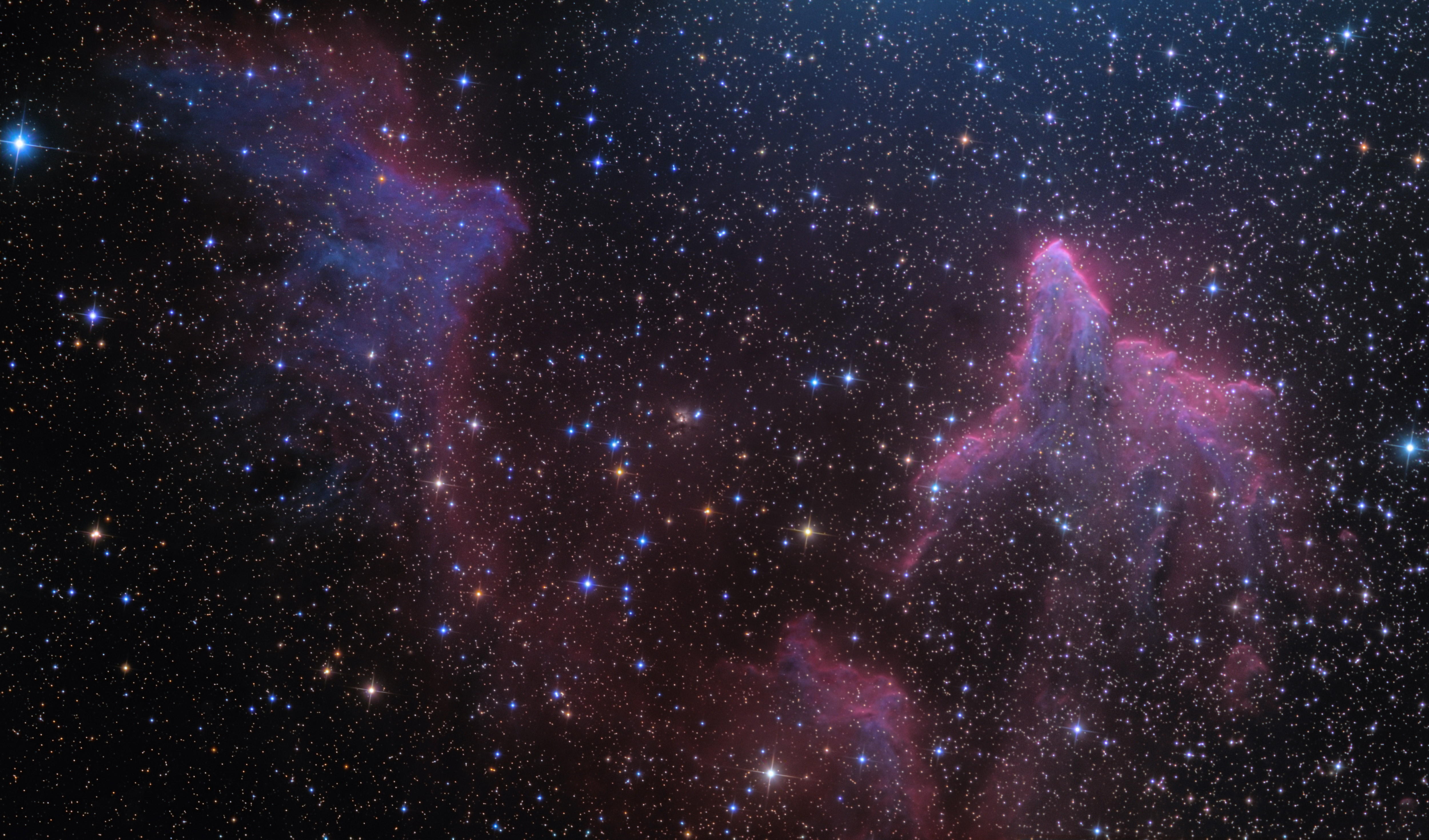
IC 59 and IC 63 in Cassiopeia
Explanation: These bright rims and flowing shapes suggest to some melting ice cream on a cosmic scale. Looking toward the constellation Cassiopeia , the colorful (zoomable) skyscape features the swept back, comet-shaped clouds IC 59 (left) and IC 63. About 600 light-years distant, the clouds aren't actually melting, but they are slowly dissipating under the influence of ionizing ultraviolet radiation from hot,luminous star gamma Cas. Gamma Cas is physically located only 3 to 4 light-years from the nebulae, just off the upper right edge of the frame. In fact, slightly closer to gamma Cas, IC 63 is dominated by red H-alpha light emitted as the ionized hydrogen atoms recombine with electrons. Farther from the star, IC 59 shows proportionally less H-alpha emission but more of the characteristic blue tint of dust reflected star light . The field of view spans about 1 degree or 10 light-years at the estimated distance of gamma Cas and friends .
| Date | November 3, 2011 |
|---|---|
| Credit | Image Credit & Copyright: Ken Crawford ( Rancho Del Sol Obs. ) |
| Authors & editors: | Robert Nemiroff (MTU) & Jerry Bonnell (UMCP) |
| A service of: |
ASD at NASA / GSFC, NASA Science Activation & Michigan Tech. U. |